The word corny is common in everyday English, especially in texting, social media comments, memes, movies, and casual conversations.
When someone calls a joke, message, pickup line, movie scene, or romantic statement “corny,” they usually mean it feels overly sentimental, predictable, old-fashioned, or awkward in a way that may be funny rather than seriously offensive.
The tone matters because corny can be an insult, playful teasing, or even a compliment depending on the situation. For example, a friend might call a silly joke corny because it is predictable, while someone might describe a romantic message as “cute and corny” because they genuinely like it.
Understanding the corny slang meaning is useful when you see the word in a text, TikTok comment, Instagram caption, dating conversation, or casual chat. It can describe everything from humor and flirting to emotional speeches and cheesy behavior.
Quick Answer
Corny slang meaning refers to something that is overly cheesy, predictable, sentimental, or trying too hard to be funny or romantic. In texting and casual conversation, calling something “corny” usually means it feels awkward or cliché, although it can sometimes be said affectionately when something is intentionally cheesy or cute.
Meaning & Definition
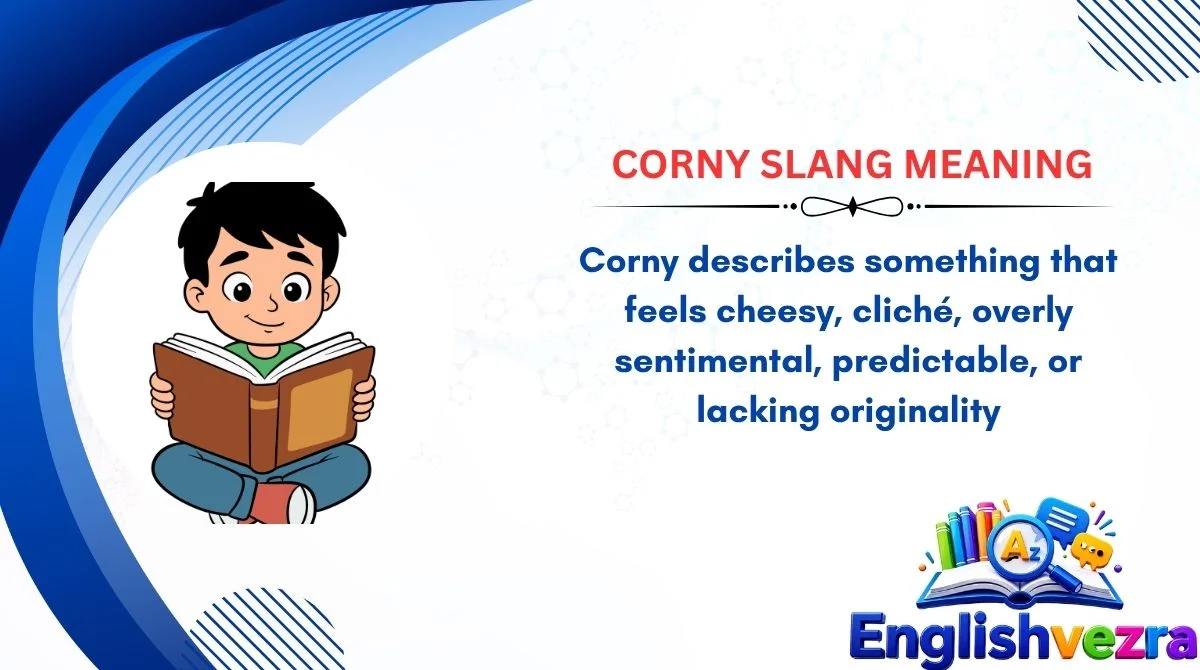
Corny describes something that feels cheesy, cliché, overly sentimental, predictable, or lacking originality. It is most often used to describe humor, romantic expressions, jokes, movies, advertisements, speeches, or behavior.
For example:
- “That joke was so corny.”
- “That pickup line is corny.”
- “His speech was a little corny, but sweet.”
- “This movie has some really corny dialogue.”
- “Stop being so corny!”
The exact meaning depends heavily on tone.
Corny as criticism
When someone says something is corny negatively, they may think it is predictable or embarrassing.
Example:
“Bro, that pickup line was corny.”
Here, the speaker probably means the pickup line sounded cliché or awkward.
Corny as playful teasing
Friends often use corny without seriously criticizing someone.
Example:
“You’re so corny 😂”
This could simply mean the person keeps making cheesy jokes or saying overly sweet things.
Corny as something lovable
Sometimes being corny is actually part of the appeal.
Example:
“I know this is corny, but I really miss you.”
In this case, the speaker recognizes that the statement sounds sentimental but says it anyway.
So, corny does not always mean bad. It can describe something that is intentionally cheesy, harmlessly silly, or emotionally sincere.
Background
The modern use of corny developed from the older adjective corny, which was associated with something considered unsophisticated, sentimental, or overly simplistic. Over time, the word became strongly connected with jokes, entertainment, romantic expressions, and predictable ideas.
The exact historical development of every modern slang use is not always clear, so it would be misleading to claim that one specific person, website, or social-media platform invented the current meaning.
Today, corny is standard informal English rather than a specialized abbreviation. It appears in ordinary speech as well as online communication.
The word became particularly useful in casual digital communication because it can express a reaction quickly. Instead of explaining that a joke is predictable, overly sentimental, or awkward, someone can simply say:
“That’s corny.”
Social media has also made the word more flexible. A person may call a caption corny, a motivational quote corny, a romantic video corny, or even their own message corny.
Importantly, the word has not completely lost its negative sense. Calling something corny can still indicate that the speaker thinks it is cliché or trying too hard. However, internet culture often uses the word playfully, making the tone less harsh than it might appear at first.
Usage in Different Contexts
The meaning of corny changes slightly depending on where it appears.
In Chat
In private messages, corny often describes a joke, compliment, pickup line, or emotional statement.
Example:
“You’re the sunshine of my life.”
Response:
“Lol, that’s so corny.”
The person may be teasing rather than genuinely rejecting the message.
On Social Media
On Instagram, TikTok, Facebook, or X, users may call a caption, video, joke, trend, or motivational post corny.
Example:
“That motivational caption is kinda corny.”
Here, the speaker probably thinks the wording is cliché or overly dramatic.
In Professional Settings
Corny is informal, so it is less appropriate in formal business writing. However, people may use it casually when discussing advertisements, presentations, slogans, or workplace humor.
Example:
“The commercial is a little corny, but the message works.”
In Casual Conversations
Among friends, corny is extremely flexible.
It can refer to:
- Bad jokes
- Dad jokes
- Cheesy compliments
- Predictable movies
- Overly emotional statements
- Cliché advice
- Awkward flirting
- Dramatic behavior
The speaker’s tone determines whether it is criticism or friendly teasing.
Meaning in Chat, WhatsApp, Instagram, and TikTok
On messaging and social platforms, corny is usually used as an informal reaction.
Someone might send a romantic quote and receive:
“Bro, that’s corny 😂”
This does not necessarily mean the person is angry. The laughing emoji can make the comment playful.
On WhatsApp, friends might use “corny” after a bad joke or overly dramatic message.
On Instagram, someone could describe a caption as corny because it sounds like a common motivational or romantic quote.
On TikTok, users may call a video, joke, trend, dialogue, or relationship content corny. TikTok conversations can also use the term humorously when something is deliberately exaggerated or cheesy.
Examples
Friend: “I made a new joke.”
You: “Let me guess… it’s corny 😂”
Person A: “You make my world brighter every day.”
Person B: “That was corny, but kinda cute.”
Comment: “Why is this video so corny 😭”
In these examples, the word does not necessarily carry the same level of criticism. Context, emojis, relationship, and tone all matter.
Meaning in Physics, Medical, and Aircraft Terminology
Corny does not have a standard technical meaning in physics, medical terminology, or aviation.
Physics
There is no commonly recognized physics concept called “corny.” If you see the word in physics-related content, it is probably being used in its ordinary informal sense or as part of a separate phrase.
Medical Terminology
“Corny” is not a standard medical diagnosis, condition, or commonly recognized medical abbreviation. A medical professional using the word casually would normally be using its everyday meaning.
Aircraft or Aviation
There is no standard aviation meaning of “corny” comparable to established technical terms used for aircraft, flight operations, navigation, or safety.
Therefore, if someone encounters corny in one of these contexts, they should not automatically assume it represents a technical abbreviation.
Common Misconceptions
One common misunderstanding is assuming that corny always means irrationalor bad. It does not.
Someone may call a joke corny because it is predictable, but they might still find it funny.
Another misconception is that calling something corny always means the speaker dislikes it. In casual conversations, people frequently use the word affectionately.
For example:
“Your jokes are terrible. You’re so corny 😂”
This could actually be a friendly compliment about someone’s personality.
People can also confuse corny with words such as “cringe,” “cheesy,” or “boring.” These words overlap, but they are not identical.
- Corny often suggests cliché or overly sentimental.
- Cringe focuses more on embarrassment or discomfort.
- Cheesy can mean overly sentimental or cliché.
The surrounding conversation helps determine which interpretation makes the most sense.
Similar Terms & Alternatives
Several informal words can have meanings close to corny.
Cheesy
Cheesy often describes something excessively sentimental, romantic, or cliché.
“That romantic scene was cheesy.”
Cringe
Cringe describes something that causes embarrassment, discomfort, or secondhand embarrassment.
“That video was so cringe.”
Cliché
A cliché is an overused idea, phrase, or expression.
“That line is such a cliché.”
boring
Boring usually means unimpressive, weak, boring, or disappointing.
“That was a boring joke.”
Tacky
Tacky can describe something that seems cheap, tasteless, or lacking good judgment.
These words can overlap with corny, but the emotional tone and exact meaning are different.
How to Respond to It
Your response should depend on how the other person uses corny.
If someone is joking with you, you can respond playfully:
- “You know you loved it 😂”
- “Corny but effective.”
- “I’m just being myself.”
- “Okay, okay, I’ll stop 😂”
- “At least I made you laugh.”
If someone seriously criticizes your joke, you can keep the response simple:
- “Fair enough.”
- “Yeah, I was reaching with that one.”
- “I thought it was funny.”
- “I’ll do better next time.”
If someone says your romantic message is corny, you might say:
“Maybe, but I meant it.”
That response works particularly well when the sentiment is genuine.
Differences from Similar Words
| Term | Typical Meaning | Common Tone |
|---|---|---|
| Corny | Predictable, cheesy, overly sentimental, or silly | Playful or critical |
| Cheesy | Excessively sentimental or cliché | Often playful |
| Cringe | Embarrassing or uncomfortable | Usually negative |
| boring | Unimpressive or boring | Usually negative |
| Cliché | Overused idea or expression | Neutral to negative |
| Tacky | Tasteless or lacking style | Usually negative |
The most important distinction is that corny can be affectionate. Someone can think something is corny while still enjoying it.
For example, a romantic movie might be called corny because its dialogue is predictable, while a friend might call your joke corny because they know you regularly make silly jokes.
Relevance in Online Conversations & Dating Apps
The word corny appears naturally in online dating because flirting often involves compliments, pickup lines, romantic jokes, and playful messages.
For example:
“Are you always this cute, or am I just lucky?”
Someone might respond:
“That was so corny 😂”
That response does not automatically mean rejection. The person may be teasing or acknowledging that the line was intentionally cheesy.
Dating-app conversations especially depend on context. A person who says “corny” with a laughing emoji may be encouraging the conversation, while someone who responds with a short, serious “corny” may genuinely dislike the approach.
On social media, the same principle applies. A person may describe a couple’s video as corny because the content is overly romantic, while another viewer might use the word positively because they enjoy that style.
When interpreting the term online, consider the message before it, emojis, punctuation, relationship between the people, and overall tone rather than treating “corny” as an automatic insult.
FAQs
What does corny mean in text?
In text messages, corny usually means something is cheesy, predictable, overly sentimental, or trying too hard to be funny or romantic. A person might call a joke, compliment, pickup line, or emotional message corny. The term can be negative, but friends often use it playfully to tease each other.
Is corny a slang term?
Corny is commonly used as informal everyday language, especially when describing jokes, romantic comments, movies, or behavior. It is not merely a texting abbreviation; it is a regular English adjective that has a strong informal use. Online conversations have made its playful and humorous usage particularly common.
What does corny mean on social media?
On social media, corny usually describes content that feels cliché, cheesy, predictable, overly emotional, or awkward. People may call a TikTok video, Instagram caption, meme, joke, or romantic post corny. Depending on the comment and emojis, the person may be criticizing it or simply joking around.
What does it mean when someone calls you corny?
When someone calls you corny, they usually mean that something you said or did was cheesy, predictable, overly sentimental, or silly. It is not necessarily a serious insult. Friends and romantic partners may use it affectionately when teasing someone who makes lots of jokes or says sweet things.
How do you respond when someone says you’re corny?
You can respond playfully if the comment is clearly teasing. Try something like, “You know you liked it,” “Corny but cute,” or “I’m just being myself.” If the person sounds genuinely critical, a simple “Fair enough” or “I thought it was funny” can keep the conversation relaxed.
Is corny the same as cringe?
Corny and cringe can overlap, but they are not exactly the same. Corny usually suggests something cheesy, predictable, cliché, or overly sentimental. Cringe focuses more strongly on embarrassment or discomfort. Something can be corny without being genuinely embarrassing, especially when people use the word affectionately.
Can corny be a compliment?
Yes, corny can be used positively or affectionately. Someone might describe a romantic message as “corny but cute” because they appreciate its sweetness even though it sounds cliché. Friends can also call each other’s jokes corny while enjoying the humor. The speaker’s tone and the surrounding conversation are important.
What does corny mean in dating?
In dating conversations, corny usually describes a cheesy pickup line, romantic statement, compliment, joke, or flirting style. It does not automatically mean rejection. If someone says “That was corny 😂,” they may simply be teasing you. The rest of the conversation can reveal whether they found it charming or genuinely disliked it.
Conclusion
Understanding the corny slang meaning is mainly about recognizing the difference between something being cheesy and something being genuinely bad. Corny usually describes a joke, statement, romantic message, movie scene, caption, or behavior that feels predictable, overly sentimental, silly, or cliché.
The word is especially common in casual conversations, texting, WhatsApp, Instagram, TikTok, and online dating. Its tone can range from criticism to friendly teasing or even affection. Someone saying “That’s corny” may dislike what they saw, but they could also be laughing because the content is intentionally cheesy.
Corny is also different from terms such as cringe, boring, cheesy, and cliché, even though their meanings sometimes overlap.
Most importantly, there is no standard technical meaning for the word in physics, medicine, or aviation. When you encounter it online, always consider the surrounding conversation and the relationship between the people involved.

Samuel Hartwell is an English language educator and word enthusiast who enjoys explaining meanings in simple, clear ways. He creates helpful content to make English vocabulary easier to understand and learn.