If someone sends you “CU” in a text message, comment, or social media chat, you may wonder whether it is a slang word, an abbreviation, or something else.
In everyday digital communication, people often shorten common phrases to save time and make conversations quicker. CU is one of those informal shortcuts.
You may see it in text messages, WhatsApp conversations, Instagram DMs, TikTok comments, online chats, gaming conversations, and casual messages between friends. It is especially common when someone wants to say goodbye without typing the full phrase.
The exact meaning can still depend on the conversation. In ordinary texting, CU usually means “see you.”
However, the same letters can represent different things in technical, medical, scientific, or organizational contexts. That is why understanding the surrounding words is important.
Below, we’ll explain the common meaning, possible alternatives, context-specific uses, and how to respond when someone sends you “CU.”
Quick Answer
CU meaning in text is usually “see you.” It is an informal abbreviation used in texting and online conversations as a quick way to say goodbye or indicate that you expect to see or talk to someone again. For example, “CU tomorrow” simply means “See you tomorrow.”
Meaning & Definition
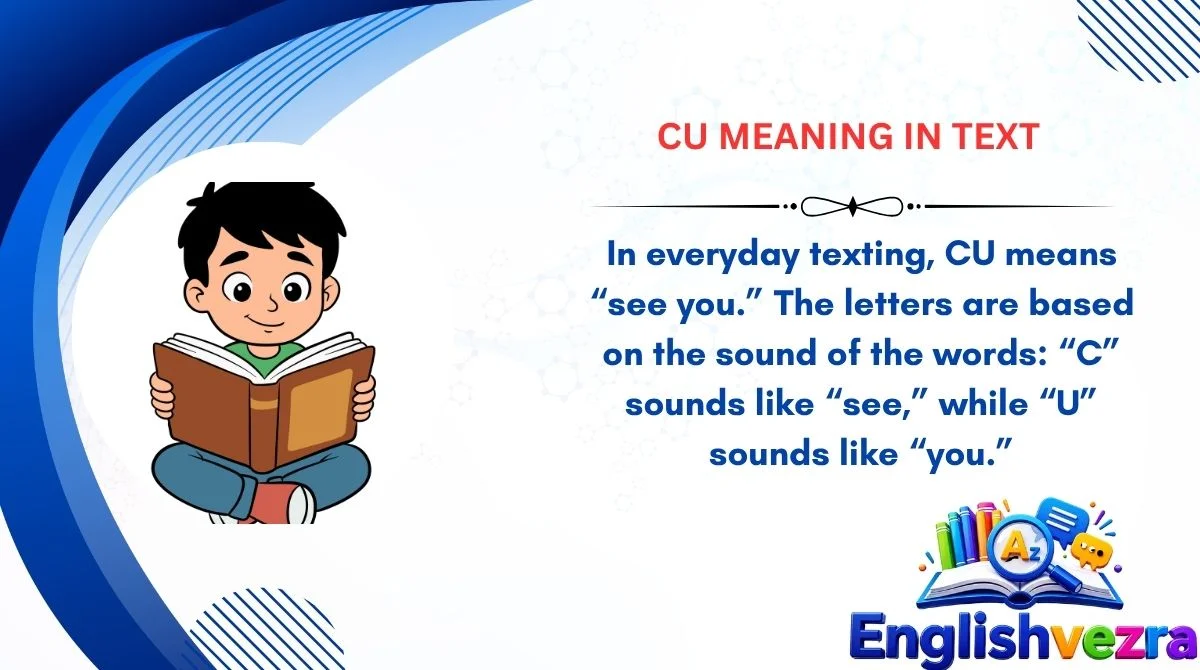
In everyday texting, CU means “see you.” The letters are based on the sound of the words: “C” sounds like “see,” while “U” sounds like “you.” This makes CU a form of text shorthand or phonetic abbreviation.
People generally use it when ending a conversation or saying goodbye. It can sound friendly, casual, and relaxed rather than formal.
For example:
- “I have to go now, CU later!” = “I have to go now, see you later!”
- “CU tomorrow.” = “See you tomorrow.”
- “Okay, CU soon.” = “Okay, see you soon.”
- “CU at school.” = “See you at school.”
The abbreviation doesn’t normally change the basic meaning of the sentence. It simply makes the message shorter.
The tone depends on the surrounding conversation. Between close friends, CU can feel perfectly natural. Someone might also use it jokingly or casually with another person they know well.
It is generally not considered formal English. In a professional email, academic assignment, official notice, or serious business communication, writing “see you” or another complete phrase is usually more appropriate.
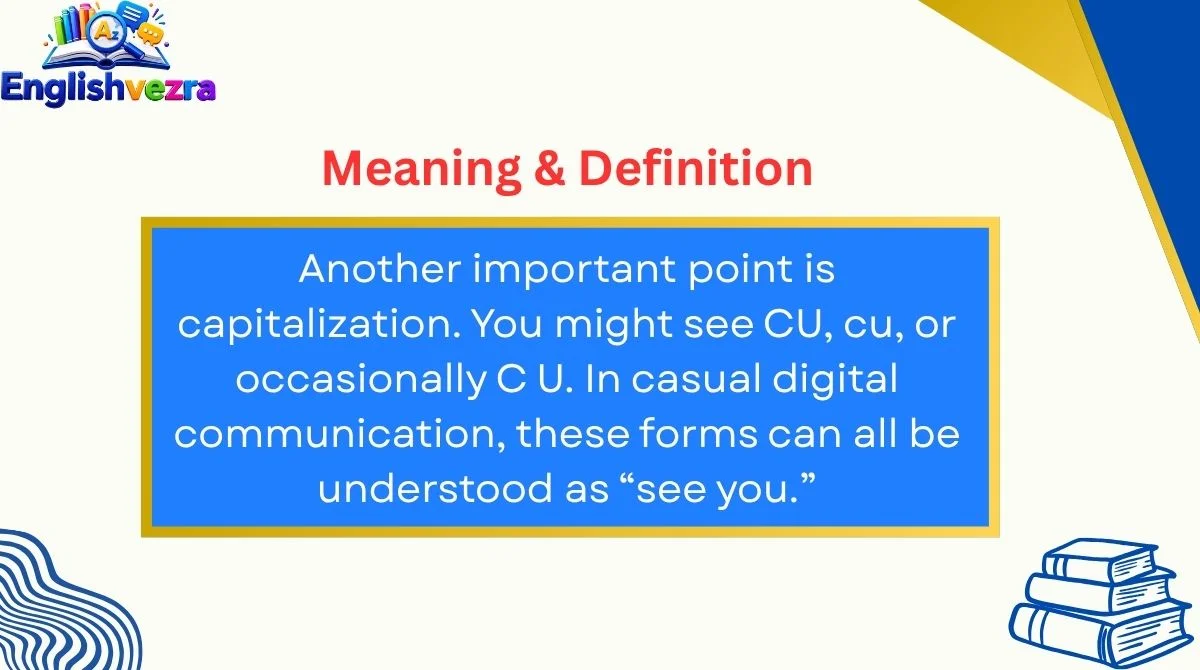
Another important point is capitalization. You might see CU, cu, or occasionally C U. In casual digital communication, these forms can all be understood as “see you.”
However, the letters can have other meanings in specialized situations. If you encounter CU outside an ordinary conversation, don’t automatically assume it means “see you.” Context should always guide the interpretation.
Background
The use of CU comes from a broader style of informal electronic communication in which people replace words with letters that sound similar when spoken.
The idea is straightforward:
- C → “see”
- U → “you”
This type of shorthand became particularly useful in environments where people wanted to communicate quickly with limited typing. Similar shortcuts include “U” for “you,” “R” for “are,” and expressions such as “CU later.”
It is difficult to point to one specific person, message, or event as the definitive origin of CU. Rather than being a term with one clearly documented invention, it developed as part of the broader evolution of informal text shorthand.
As digital communication became more common, abbreviated expressions became familiar in chats, SMS messages, forums, and later social media.
The popularity of CU does not mean it is appropriate in every type of writing. It remains primarily an informal expression. Language changes depending on the environment, and online conversations often allow much shorter and more playful forms than formal writing.
You may therefore find CU perfectly normal in a friend’s message but unusual in a professional letter.
The important takeaway is that its everyday texting meaning is easy to understand once you recognize the sound-based wordplay: CU = see you.
Usage in Different Contexts
The meaning and tone of CU can change slightly depending on where it appears.
In Chat
In private chats, CU is commonly used as a short goodbye.
Example:
“I’m heading out now. CU later!”
Here, the sender is simply saying they will see or speak to you later.
On Social Media
People may use CU in comments, direct messages, captions, or replies. It can be used when ending a conversation or referring to meeting someone.
Example:
“Great talking to you! CU soon.”
The meaning is still generally “see you soon.”
In Professional Fields
CU should not automatically be interpreted as “see you” in professional or technical material. Abbreviations can have specialized meanings depending on the field, organization, or document.
If you encounter CU in a technical report, medical record, scientific document, or workplace material, read the surrounding information before deciding what it means.
In Casual Conversations
Casual conversations are where the “see you” interpretation is most natural.
Friends might write:
- “CU tomorrow.”
- “CU at the game.”
- “Okay, CU later.”
- “CU soon!”
In these examples, CU functions as an informal replacement for see you.
Meaning in Chat, WhatsApp, Instagram, and TikTok
Across messaging and social platforms, CU usually carries the same basic meaning: “see you.”
On WhatsApp, someone might write:
“I’m going to sleep now, CU tomorrow.”
That means:
“I’m going to sleep now, see you tomorrow.”
On Instagram, a friend might end a DM with:
“CU at the party!”
This means they expect to see you at the party.
On TikTok, CU may appear in a comment or direct message, although the exact interpretation depends on the surrounding words.
For example:
“CU in the next live!”
This can naturally mean:
“See you in the next live!”
You may also encounter variations such as:
- CU later — see you later
- CU soon — see you soon
- CU tomorrow — see you tomorrow
- CU there — see you there
- CU around — see you around
The expression is generally informal and friendly.
It is also possible for someone to write “c u” instead of “CU.” The spacing and capitalization do not normally change the intended meaning in casual conversation.
Context remains important. If the phrase appears by itself after a conversation, such as:
“CU!”
it is very likely a simple goodbye.
If it appears inside a technical sentence, however, it may have an entirely different interpretation.
Meaning in Physics, Medical, and Aircraft Terminology
CU does not have one universal meaning across physics, medicine, and aviation. Specialized abbreviations are often dependent on the particular field, organization, document, or terminology system.
Physics and Science
In scientific contexts, Cu is widely recognized as the chemical symbol for copper. Notice that the conventional chemical symbol is written Cu, with a capital C and lowercase u.
This is different from the informal texting abbreviation CU.
For example:
Cu
in a chemistry-related context refers to copper, not “see you.”
So capitalization and context can matter.
Medical Terminology
There is no single universal medical definition of CU that should automatically replace its ordinary texting meaning in every medical situation. Medical abbreviations can vary between specialties, institutions, and documents.
If you encounter CU in a medical document, the surrounding terminology and the source’s abbreviation system should be checked rather than assuming it means “see you.”
Aircraft and Aviation Terminology
Likewise, CU does not have one universal aviation meaning that should be assumed whenever the abbreviation appears in an aircraft-related context.
Aviation uses many standardized abbreviations, codes, and identifiers, and their interpretation depends on the specific system or document in which they appear.
Therefore, if you see CU in an aviation manual, flight-related document, aircraft information, or professional communication, use the surrounding context to determine its intended meaning.
Common Misconceptions
One of the biggest misconceptions is assuming that CU always means “see you.” That is true in ordinary texting, but abbreviations can have different meanings in specialized contexts.
CU vs. Cu
The capitalization can provide an important clue.
CU in a casual message may mean:
“See you.”
Cu in a chemistry context means:
Copper.
These are not the same use.
CU Is Not Always a Slang Word
CU is better described as an informal abbreviation or text shorthand when it means “see you.” Calling every abbreviation “slang” can be misleading.
Slang often involves informal vocabulary or expressions, while CU is primarily a shortened spelling based on pronunciation.
CU Does Not Necessarily Mean “Goodbye Forever”
When someone says:
“CU later”
they generally mean they expect another interaction. It is normally a casual goodbye, not a permanent farewell.
Context Matters
If a message says:
“CU tomorrow”
the meaning is obvious.
But if you see CU in a scientific or professional document, you should not automatically apply the texting definition.
Similar Terms & Alternatives
Several abbreviations and expressions can be confused with CU or serve a similar purpose.
| Term | Common Meaning | Typical Use |
|---|---|---|
| CU | See you | Casual texting |
| C U | See you | Casual messages |
| c u | See you | Informal texting |
| CUL | See you later | Informal online communication |
| CU2 | See you too | Text shorthand |
| TTYL | Talk to you later | Chat and texting |
| TTYS | Talk to you soon | Informal messages |
| BYE | Goodbye | General conversation |
| See ya | See you | Casual speech/text |
| Later | See you later | Casual conversation |
These alternatives aren’t always interchangeable.
For example, TTYL focuses on talking again later, while CU focuses more directly on seeing someone again. In online communication, however, people sometimes use these expressions loosely.
How to Respond to It
If someone sends you “CU” as a goodbye, you don’t need a complicated response. A simple friendly reply is usually enough.
Casual Responses
- “CU later!”
- “See you!”
- “CU soon!”
- “Yep, see you!”
- “See you tomorrow!”
- “Take care!”
Friendly Responses
If you want to sound warmer, you could say:
“CU soon! Have a great day 😊”
or:
“Sure, see you later!”
If You’re Unsure
If the context isn’t clear, you can simply ask:
“Do you mean see you?”
This is especially useful if CU appears in a conversation where the usual texting meaning doesn’t make sense.
Differences from Similar Words
Understanding the difference between CU and similar abbreviations can help prevent confusion.
CU vs. TTYL
CU means “see you,” while TTYL means “talk to you later.”
Someone saying CU may be referring to seeing you in person, although online users can also use it loosely. TTYL specifically emphasizes another conversation later.
CU vs. Bye
Bye is a complete word used to end a conversation. CU is an abbreviation that commonly means “see you.”
For example:
“Bye, CU tomorrow!”
Here, both expressions are used together.
CU vs. See Ya
See ya is an informal spoken-style version of “see you.” CU expresses essentially the same idea in abbreviated text form.
CU vs. CUL
CUL is commonly understood as “see you later.” CU by itself is broader and may simply mean “see you.”
The extra L in CUL adds the idea of “later.”
Relevance in Online Conversations & Dating Apps
CU can appear naturally in modern online conversations, including direct messages and dating apps. If someone ends a conversation with “CU soon,” they are generally indicating that they expect to interact with you again.
On a dating app, context becomes especially important because people use informal language differently depending on how comfortable they feel.
For example:
“Had fun chatting with you. CU soon 😊”
This sounds friendly and suggests the person expects another interaction.
However, CU alone should not be treated as proof of romantic interest. It is simply a casual expression meaning “see you” in most ordinary messaging contexts.
The surrounding conversation provides the real clue. Look at what was discussed before the abbreviation, whether plans were mentioned, and whether the person used other expressions that clarify their intention.
For example:
“CU Friday at 7!”
is much more specific than:
“CU!”
The first clearly refers to a planned meeting, while the second may simply be a casual goodbye.
FAQs
What does CU mean in text?
CU usually means “see you” in text messages. It is an informal abbreviation based on the pronunciation of “C” and “U.” People commonly use it when ending a conversation or saying they expect to see or communicate with someone again.
What does CU mean in chat?
In chat, CU generally means “see you.” It can be used as a short goodbye, such as “CU later,” “CU tomorrow,” or simply “CU!” The intended meaning is usually clear from the surrounding conversation.
Is CU a slang term?
CU is better described as informal text shorthand than traditional slang. It abbreviates “see you” by using letters that sound like the words. It is common in casual digital communication but is generally unsuitable for formal writing.
What does CU mean on social media?
CU usually means “see you” on social media as well. Someone may use it in a DM, comment, or casual conversation to say goodbye or indicate that they expect to interact with you again.
How do you respond to CU in a text?
You can respond to CU with a simple “See you!” or “CU later!” Other natural responses include “See you soon,” “Take care,” or “See you tomorrow,” depending on the conversation and whether you have plans to meet.
Can CU have different meanings?
Yes, CU can have different meanings depending on context. In ordinary texting, it usually means “see you.” In scientific contexts, Cu is the chemical symbol for copper. Specialized fields may also use abbreviations differently, so context is important.
What does CU mean in WhatsApp messages?
CU usually means “see you” in WhatsApp messages. For example, “CU tomorrow” means “see you tomorrow.” It is casual shorthand and is most likely to appear between friends, family members, or other people having an informal conversation.
Does CU mean goodbye?
Yes, CU can function as a casual way to say goodbye. It usually carries the idea of “see you again” rather than simply ending contact. Expressions such as “CU later” and “CU soon” make that meaning even clearer.
Conclusion
CU usually means “see you” in text and online conversations. It is a simple form of informal text shorthand created by using letters that sound like the words “see” and “you.” You may encounter it in WhatsApp chats, Instagram DMs, TikTok conversations, gaming chats, and other casual digital communication.
Expressions such as “CU later,” “CU soon,” and “CU tomorrow” are straightforward variations that communicate a casual goodbye or an expectation of another interaction.
However, context matters. CU in a casual message is different from Cu in a scientific context, where it represents copper. Specialized medical, aviation, or professional uses should also be interpreted according to the terminology of that particular field rather than automatically assuming the texting meaning.
When someone sends you CU as a casual goodbye, a simple “See you!” is usually a perfectly natural response.

Samuel Hartwell is an English language educator and word enthusiast who enjoys explaining meanings in simple, clear ways. He creates helpful content to make English vocabulary easier to understand and learn.