The phrase “Eiffel Tower” usually refers to the famous landmark in Paris, France. However, when people encounter the phrase in internet comments, private messages, memes, dating conversations, or adult-oriented discussions, it can have a completely different meaning.
This is why someone searching for eiffel tower meaning slang may be confused if they only know the phrase as the name of a tourist attraction.
In slang, “Eiffel Tower” can be used as a sexual expression describing a specific intimate position involving three people.
The phrase gets its nickname from the visual shape associated with the arrangement, rather than from any official connection to the actual Eiffel Tower.
Because this slang meaning is adult in nature, context is especially important. A person discussing travel to Paris is almost certainly referring to the landmark, while a suggestive meme or dating conversation may use the phrase differently.
Quick Answer
Eiffel Tower meaning slang refers to an adult sexual expression describing a three-person intimate arrangement involving two people positioned together while a third person is involved. The phrase is named metaphorically after the shape of the famous Eiffel Tower. Its meaning depends heavily on context.
Meaning & Definition
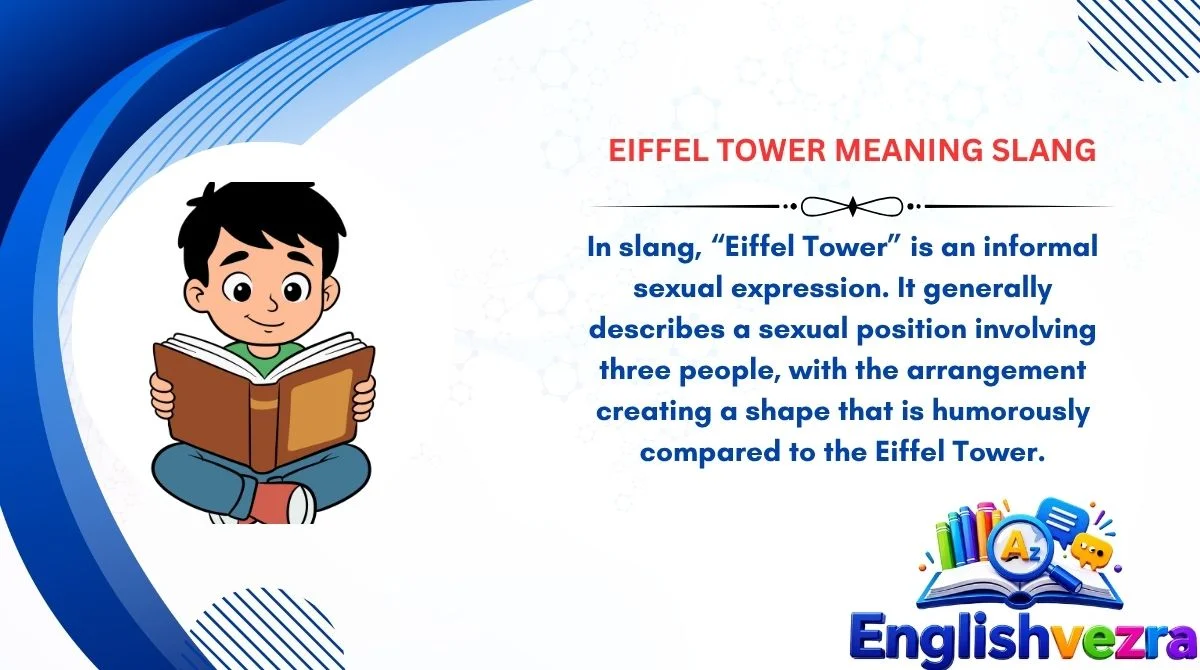
In slang, “Eiffel Tower” is an informal sexual expression. It generally describes a sexual position involving three people, with the arrangement creating a shape that is humorously compared to the Eiffel Tower.
The phrase is not a medical term, scientific expression, or formal relationship label. It belongs primarily to internet slang and adult vocabulary.
The ordinary meaning of “Eiffel Tower” remains the famous iron landmark in Paris. Therefore, seeing the phrase by itself does not automatically mean someone is using sexual slang. The surrounding conversation determines the intended interpretation.
For example, a travel discussion such as “I want to visit the Eiffel Tower someday” clearly refers to the Paris landmark. On the other hand, a suggestive meme containing the phrase may be using the slang interpretation.
Because this expression describes sexual activity, it is generally unsuitable for professional, academic, or family-friendly conversations. It may appear in adult jokes, memes, private chats, dating conversations, or discussions about sexual slang.
It is also worth remembering that slang can vary between communities. Not everyone uses “Eiffel Tower” in the same way, and some people may recognize only the landmark meaning.
When explaining the term, it is best to distinguish between the literal meaning and the slang meaning. The literal meaning concerns the Paris monument, while the slang meaning is an informal adult expression.
Background
The slang use of “Eiffel Tower” appears to come from a visual comparison between the shape created by the sexual arrangement and the recognizable triangular profile of the Eiffel Tower.
There is no need to assume that the expression originated from France, Paris, or the actual history of the monument. The slang expression is simply a metaphorical nickname based on the visual resemblance.
The exact point at which the expression became popular is difficult to establish with certainty. Internet slang often develops gradually through jokes, adult communities, memes, forums, social media, and private conversations. A phrase can become widely recognizable without having one clearly documented creator.
It is therefore more accurate to describe the expression as informal internet and adult slang rather than claiming a specific inventor or exact origin.
The name works because the Eiffel Tower has a distinctive shape that is easily recognizable. Slang frequently borrows names of objects, places, animals, or cultural references to describe sexual positions or behaviors in humorous ways.
This also explains why the same phrase can be confusing. Someone familiar only with the landmark may see “Eiffel Tower” and assume the conversation is about tourism or architecture.
When the expression appears in adult content, however, the intended meaning can be different. Context, accompanying words, emojis, jokes, and the nature of the conversation can make that distinction clearer.
Usage in Different Contexts
The meaning of “Eiffel Tower” changes significantly depending on where and how it is used.
In Chat
In private messaging, the phrase may be used as an adult joke, sexual reference, or question about slang. A person might ask, “What does Eiffel Tower mean?” because they encountered it online.
On Social Media
Social media users may encounter the expression in memes, comments, jokes, or suggestive posts. Sometimes people intentionally use the phrase without explaining it because they expect other users to understand the reference.
In Professional Fields
In a workplace, school, or professional setting, “Eiffel Tower” normally refers to the Paris landmark, architecture, travel, tourism, or a related topic. The slang interpretation would generally be inappropriate in professional communication.
In Casual Conversations
Among friends, interpretation depends on the subject. Someone talking about a trip to Paris is almost certainly discussing the landmark. A sexual joke or adult conversation may indicate the slang meaning.
The safest approach is to examine the surrounding words before deciding what the speaker means.
Meaning in Chat, WhatsApp, Instagram, and TikTok
On messaging and social platforms, “Eiffel Tower” can appear in several forms. The most important factor is the context surrounding it.
On WhatsApp, the phrase may occur in private jokes, conversations about slang, or adult discussions. If someone simply says they want to photograph the Eiffel Tower, the ordinary landmark meaning is obvious.
On Instagram, it can appear in captions, comments, memes, or discussions that have nothing to do with sexual slang. Travel content is especially likely to use the literal meaning.
On TikTok, users may use the phrase as part of an adult joke, meme, trend, or explanatory video. Sometimes slang is presented indirectly because creators expect viewers to recognize the reference.
For example:
- “I finally saw the Eiffel Tower!” → probably the Paris landmark.
- “I saw this slang term online—what does Eiffel Tower mean?” → likely asking about the adult slang.
- “That meme has a completely different Eiffel Tower meaning.” → likely referring to the slang interpretation.
The phrase should not automatically be interpreted sexually. Online language is highly dependent on context.
If the conversation contains romantic, suggestive, or adult language, the slang interpretation becomes more likely. If the conversation concerns travel, architecture, France, tourism, or photography, the literal interpretation is much more likely.
Meaning in Physics, Medical, and Aircraft Terminology
“Eiffel Tower” does not have a standard sexual meaning in physics, medicine, or aviation terminology.
Physics
There is no standard physics concept called the “Eiffel Tower” that corresponds to this slang expression. Physics discussions may mention the Eiffel Tower when discussing structural engineering, forces, wind, materials, or related scientific topics, but that is separate from slang.
Medical Terminology
The slang expression is not a recognized medical diagnosis, treatment, anatomical term, or clinical classification. Medical professionals would use precise anatomical and clinical language instead.
Aircraft or Aviation
There is also no standard aviation meaning for the slang expression. In an aviation context, “Eiffel Tower” could refer to the landmark as a geographical or tourist reference, but that is unrelated to the adult slang usage.
This distinction matters because internet slang should not be mistaken for professional terminology. A phrase can have an informal meaning online without having any accepted technical definition.
Common Misconceptions
One common misconception is that every use of “Eiffel Tower” is sexual. That is incorrect. The phrase primarily refers to the famous Paris landmark, and the slang meaning is only one possible interpretation.
Another misunderstanding is assuming that the slang term is an official name for a sexual position. It is not a formal medical or scientific term. It is an informal nickname used in certain adult or online contexts.
People may also assume that the slang expression has a confirmed historical connection to France or the Eiffel Tower itself. There is no reason to treat the slang nickname as an official part of the monument’s history.
A further misconception comes from seeing the phrase in a meme without understanding the joke. Internet memes often rely on double meanings, so the same words can have an innocent interpretation and an adult interpretation.
Finally, people sometimes confuse the expression with other three-person slang terms. Although some expressions may describe similar adult situations, their meanings and arrangements are not necessarily identical.
Similar Terms & Alternatives
Several words and expressions can be confused with “Eiffel Tower” because they involve internet slang, sexual humor, or multiple-person situations.
- Threesome — a broad term for sexual activity involving three people.
- Three-way — an informal expression that can refer to a sexual encounter involving three people.
- Ménage à trois — a French phrase traditionally referring to a household or relationship involving three people; in modern usage, it can also describe a sexual relationship involving three people.
- Adult slang — a broad category covering informal sexual expressions.
- Sexual position slang — informal names people use online for particular sexual arrangements.
These expressions should not automatically be treated as exact synonyms. “Threesome,” for example, is broader, while “Eiffel Tower” refers to a particular slang concept.
How to Respond to It
If someone sends you “Eiffel Tower” and you are unsure what they mean, you do not have to guess.
A simple response can be:
- “Do you mean the landmark in Paris?”
- “What do you mean by Eiffel Tower?”
- “Are you talking about the slang meaning?”
- “I’m not familiar with that slang—can you explain?”
If the person clearly uses it as an adult reference and you are comfortable discussing the subject, you can respond appropriately to the conversation.
If you do not want to participate in sexual conversation, you can simply say:
- “I’d rather not discuss that.”
- “Let’s keep the conversation respectful.”
- “I’m not comfortable with that topic.”
The best response depends on your relationship with the person and the setting. You should never feel pressured to respond to sexual slang just because someone sends it to you.
Differences from Similar Words
The main difference between “Eiffel Tower” and broader terms such as “threesome” is specificity.
“Threesome” is a general term for sexual activity involving three people. “Eiffel Tower” is a more specific piece of slang referring to a particular arrangement.
The ordinary phrase “Eiffel Tower” is completely different from both. In everyday language, it identifies the famous Paris landmark.
| Term | Typical Meaning | Tone |
|---|---|---|
| Eiffel Tower | Famous Paris landmark | Neutral |
| Eiffel Tower slang | Adult sexual expression | Explicit/informal |
| Threesome | Sexual encounter involving three people | Adult/informal |
| Three-way | Broad adult expression involving three people | Informal |
| Ménage à trois | Relationship or sexual situation involving three people | Informal/adult depending on context |
This is why context is essential. The same words can be completely innocent in one conversation and adult-oriented in another.
Relevance in Online Conversations & Dating Apps
The slang meaning can appear in modern online conversations, especially where users discuss relationships, dating, sexuality, memes, or adult humor.
On dating apps, someone might use the expression to communicate an adult preference or make a suggestive joke. However, not every appearance has that intention. A profile discussing travel could mention the Eiffel Tower simply because the person likes Paris.
Contextual clues can include nearby sexual terminology, suggestive messages, emojis, or discussions about relationship preferences.
If someone uses the phrase unexpectedly, asking for clarification is often the safest option. It prevents you from making an incorrect assumption about what the person means.
It is also important to consider the setting. Sexual slang may be inappropriate in workplace chats, classrooms, public professional profiles, or conversations where everyone has not agreed to discuss adult topics.
In short, online meaning is strongly influenced by context, audience, relationship, and surrounding language.
FAQs
What does Eiffel Tower mean in text?
In text messages, “Eiffel Tower” can have either its normal landmark meaning or an adult slang meaning. The slang interpretation refers to a specific sexual arrangement involving three people. If the conversation concerns travel, France, tourism, or architecture, it almost certainly refers to the famous Paris landmark instead.
What does Eiffel Tower mean in chat?
In chat, the phrase can be used as adult slang, especially when the surrounding conversation is sexual or suggestive. However, it can also simply refer to the Paris monument. Look at the surrounding messages before deciding which meaning the sender intended.
Is Eiffel Tower a slang term?
Yes, “Eiffel Tower” can be used as an informal adult slang term. It describes a particular sexual arrangement involving three people. However, the phrase is not exclusively slang because its ordinary and much more widely recognized meaning is the famous landmark in Paris.
What does Eiffel Tower mean on social media?
On social media, the phrase may refer to the Paris landmark, travel, architecture, memes, or an adult slang expression. The intended meaning depends on the post, caption, comments, and surrounding discussion. Suggestive content makes the slang interpretation more likely.
Can Eiffel Tower have different meanings?
Yes, “Eiffel Tower” has different meanings depending on context. Its primary literal meaning is the famous Paris landmark, while an informal adult meaning exists in some online and private conversations. Technical fields such as medicine and aviation do not use the slang definition as a standard professional term.
How should you respond to Eiffel Tower slang?
If someone sends the phrase and you are unsure, ask what they mean rather than assuming. You can say, “Do you mean the slang term?” If the conversation becomes sexual and you are uncomfortable, it is perfectly acceptable to change the subject or decline to participate.
Is Eiffel Tower a medical or scientific term?
No, the adult slang meaning is not a recognized medical or scientific term. Physics, medicine, and aviation may discuss the actual Eiffel Tower in appropriate contexts, but they do not use this slang definition as a standard technical concept.
Why is the slang called Eiffel Tower?
The slang nickname is based on a visual comparison between the described arrangement and the recognizable shape of the Eiffel Tower. Its exact historical origin is not clearly established, so it is better not to attribute the expression to a specific person or event without reliable evidence.
Conclusion
The phrase “Eiffel Tower” has a straightforward literal meaning and a separate informal slang meaning. Literally, it refers to the famous landmark in Paris.
In certain adult or online conversations, however, it is used as slang for a specific sexual arrangement involving three people.
The slang interpretation is not a medical, physics, or aviation definition. It is informal language that developed through metaphorical comparison with the shape of the landmark.
Because the same phrase can be completely innocent or sexually suggestive, context is the key to understanding it correctly.
When you encounter the phrase in a message, meme, social media post, or dating conversation, look at the surrounding words and subject matter before interpreting it.
If the meaning remains unclear, asking the sender for clarification is usually the simplest solution. Understanding context helps prevent unnecessary misunderstandings when dealing with internet slang.

Samuel Hartwell is an English language educator and word enthusiast who enjoys explaining meanings in simple, clear ways. He creates helpful content to make English vocabulary easier to understand and learn.