If you have seen someone write “gpi” in a text, comment, Instagram post, or TikTok conversation, you may have wondered what those three letters actually mean.
Unlike many common texting abbreviations, GPI can be confusing because its meaning depends heavily on the language and context of the conversation.
In Spanish-language internet slang, especially in casual conversations, gpi is commonly used as a shortened form of “gracias por invitar,” which means “thanks for inviting me.” However, the phrase is often not completely sincere.
Someone may use it humorously or sarcastically when they notice that their friends went somewhere without inviting them.
For English-speaking users, GPI may look like an ordinary acronym with no obvious meaning. That is why people often search for its meaning after encountering it in social media comments or messages.
Understanding the surrounding conversation is important because abbreviations can have different meanings in different communities.
Quick Answer
GPI meaning slang is commonly “gracias por invitar,” a Spanish phrase meaning “thanks for inviting me.” Online, it is often used jokingly or sarcastically when someone was left out of a plan, party, trip, or activity. The exact tone depends on the conversation and the relationship between the people using it.
Meaning & Definition
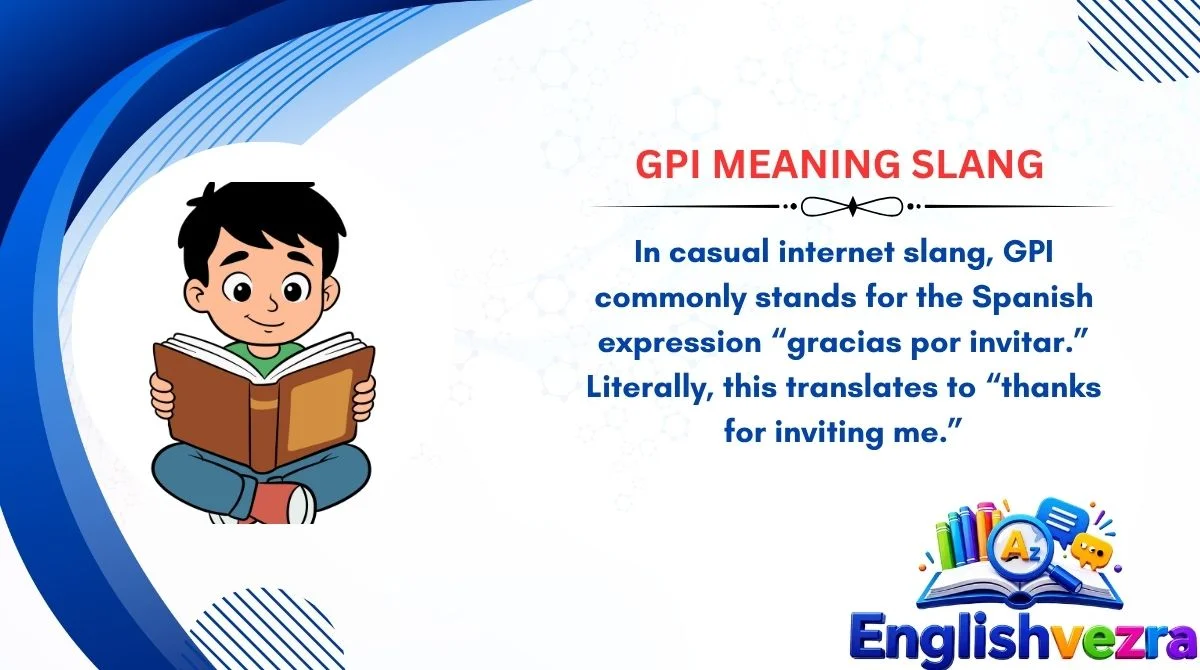
In casual internet slang, GPI commonly stands for the Spanish expression “gracias por invitar.” Literally, this translates to “thanks for inviting me.”
At first, that translation may sound friendly and straightforward. However, online users frequently use GPI in a humorous or sarcastic way. For example, imagine that three friends post pictures from a restaurant while another friend was not invited. The person who was left out might comment:
“GPI 😂”
In this situation, the person usually is not genuinely thanking the others for an invitation. Instead, they are playfully pointing out that nobody invited them.
The expression can therefore communicate something like:
- “Thanks for inviting me…”
- “Nice of you to invite me!”
- “I see you went without me.”
- “Guess I wasn’t invited.”
- “Thanks for leaving me out.”
The exact interpretation depends on the context. A laughing emoji, teasing tone, or a picture of friends together can make the sarcastic meaning especially clear.
GPI is particularly associated with informal online communication rather than formal writing. It can appear in comments, group chats, private messages, captions, and conversations between friends.
It is also important to understand that GPI does not have one universal meaning everywhere. Acronyms can represent completely different terms in professional, technical, medical, or other settings. When someone asks specifically about GPI as slang, however, the Spanish internet expression is an important meaning to recognize.
Background
The expression behind GPI is “gracias por invitar,” which is Spanish for “thanks for inviting.” The abbreviation follows the first letters of the words:
- G = Gracias
- P = Por
- I = Invitar
There is no need to assume that GPI originated from a particular website, app, or single viral post. Its exact origin as internet slang is not clearly established, and it is safer not to assign a specific creator or date without reliable evidence.
Its popularity is connected to a broader internet habit of shortening phrases for faster and more playful communication. Spanish-speaking internet users commonly create abbreviations from the initial letters of familiar expressions.
The humorous use of GPI is especially easy to understand because being excluded from a social activity is a common situation. Someone can write three letters instead of a full sentence and still communicate the joke.
For example, a friend may upload photographs from a weekend trip. Another friend who was not included could simply write:
“GPI 😭”
The short response can communicate mock disappointment without requiring a serious explanation.
Over time, expressions like this can become recognizable within online communities. Their meaning may also shift slightly depending on country, age group, platform, and personal communication style.
Because slang changes quickly, not every Spanish-speaking person will use GPI in exactly the same way. Some may understand it immediately, while others may prefer the complete phrase “gracias por invitar.” Context remains the safest way to interpret it.
Usage in Different Contexts
The meaning and tone of GPI can change depending on where it appears.
In Chat
In private messages or group chats, GPI is often used as a playful reaction to being excluded.
Example:
Friend: “We went out for pizza last night.”
You: “GPI 😂”
Here, the message suggests that you noticed you were not invited.
On Social Media
GPI can appear in comments under photos, videos, stories, or posts showing a group of people doing something together.
For example:
“GPI 😭”
under a vacation picture can jokingly mean, “Thanks for inviting me—I guess.”
In Casual Conversations
Friends may use GPI as a teasing expression. The person writing it may not actually be upset. The humor comes from pretending to complain about being left out.
In Professional Fields
The slang meaning should not automatically be applied to every appearance of the letters GPI. In professional, technical, scientific, or organizational contexts, GPI may represent an unrelated abbreviation.
Therefore, if you see GPI in a report, workplace document, technical discussion, or specialist conversation, check the surrounding subject before interpreting it as internet slang.
Meaning in Chat, WhatsApp, Instagram, and TikTok
GPI can be particularly noticeable on platforms where people share pictures, videos, outings, celebrations, and group activities.
In WhatsApp chats, someone may send “GPI 😂” after seeing friends discussing plans they were not included in.
Example:
“Guys, we’re going bowling tonight.”
“GPI 😂”
The speaker is jokingly asking why they were not included.
On Instagram, GPI may appear as a comment beneath a group photo or story.
Example:
“GPI 😭😂”
This can mean something like, “So you all went without me?”
TikTok
On TikTok, users may use GPI in comments when a video shows friends attending an event, traveling, eating together, or doing another activity without them.
The abbreviation works particularly well in comments because it is short and immediately conveys a teasing reaction among people who understand the expression.
General Chat
The same idea can appear in ordinary texting:
“You guys went to the beach?”
“GPI.”
The tone may be playful rather than genuinely angry.
Because online communication lacks facial expressions and vocal tone, emojis such as 😂, 😭, or 🙄 may help communicate whether the message is intended as a joke.
Meaning in Physics, Medical, and Aircraft Terminology
GPI should not automatically be interpreted as “gracias por invitar” when it appears in a specialized field.
Physics
There is no single universal physics meaning that should automatically replace the slang interpretation in every situation. A physics-related use would need to be understood from the specific subject or document.
Medical Terminology
GPI can occur as an abbreviation in specialized medical or healthcare contexts, but abbreviations can vary between institutions and specialties. Therefore, the slang interpretation should not be assumed when GPI appears in medical material.
Aircraft and Aviation
Likewise, GPI may be used as an identifier or abbreviation in aviation-related contexts. Its meaning in such material depends on the specific system, location, document, or organization involved.
The important point is that the slang meaning and technical meanings should not be mixed together. If someone sends “GPI 😂” in a casual Spanish-language conversation, the slang interpretation is likely relevant. If GPI appears in a technical document, the surrounding terminology should determine its meaning.
Common Misconceptions
One common misunderstanding is assuming that GPI always has the same meaning everywhere. It does not.
The meaning “gracias por invitar” is associated with informal Spanish-language internet communication. It should not automatically be applied to every appearance of the letters GPI.
Another misconception is that GPI always expresses genuine gratitude. In slang conversations, it is frequently used sarcastically.
For example:
“Everyone went to the concert without me. GPI 😂”
The person is not necessarily thanking their friends. They are playfully highlighting the fact that they were excluded.
Another mistake is interpreting GPI without considering the language of the conversation. If the conversation is entirely in English and the people involved do not use Spanish slang, GPI could represent something completely different.
Finally, tone matters. “GPI” by itself can be ambiguous. Adding an emoji or looking at the preceding messages often makes the intended meaning much clearer.
Similar Terms & Alternatives
Several expressions can communicate a similar idea, especially when someone is joking about being excluded.
“Thanks for inviting me”
This is the full English phrase and can be used sincerely or sarcastically.
“Guess I wasn’t invited”
This directly communicates the feeling of being left out.
“Could’ve invited me”
This is another casual way of teasing friends about making plans without you.
“Next time, invite me”
This can be playful and may suggest that the person wants to be included in future plans.
“No invite?”
A short phrase that directly questions why someone was not included.
“Thanks for the invite”
This can also be sarcastic depending on the situation.
The important distinction is that these phrases are not exact replacements in every language or community. GPI is specifically tied to the Spanish expression “gracias por invitar,” while the alternatives above are English expressions with similar conversational functions.
How to Respond to It
If someone sends you GPI, the best response depends on whether they are joking, genuinely disappointed, or simply teasing.
If you understand that they are joking, you can respond playfully:
“Next time 😂”
Or:
“My bad! You’re invited next time.”
If you actually forgot to invite them, you could say:
“Sorry! We should’ve told you.”
If you want to tease them back:
“You never said you wanted to come 😂”
Another simple response is:
“Haha, you’re coming next time!”
There is no single required response to GPI. The abbreviation is usually informal, so a casual response generally fits the situation better than a formal explanation.
If you are unsure what the person means, you can simply ask:
“What do you mean by GPI?”
This is especially useful when the conversation is not clearly about being invited somewhere.
Differences From Similar Words
GPI is different from ordinary expressions of gratitude because its online use can carry sarcasm.
| Expression | Basic Meaning | Typical Tone |
|---|---|---|
| GPI | “Gracias por invitar” | Often playful or sarcastic |
| Thanks for inviting me | Gratitude for an invitation | Sincere or sarcastic |
| No invite? | Asking why you were excluded | Casual |
| Guess I wasn’t invited | Pointing out exclusion | Usually teasing |
| Could’ve invited me | Saying you wanted to be included | Casual/playful |
| See you next time | Referring to future plans | Friendly |
The biggest difference is language and context. GPI comes from a Spanish expression, while the other phrases are primarily English.
Another difference is length. GPI is extremely short, making it convenient for comments and quick messages.
Tone also matters. A person writing “GPI 😂” is likely communicating something different from someone writing “Thanks for inviting me.” The first may be playful internet slang, while the second can be sincere.
Relevance in Online Conversations & Dating Apps
GPI can appear naturally in modern online conversations whenever people discuss social plans, parties, trips, dinners, events, or group activities.
On social media, it may be used when someone sees a group of friends together and jokes that they were excluded. The same idea can appear in private chats when someone discovers that friends made plans without them.
On dating apps, GPI is less likely to have a special dating-specific meaning. If it appears in a dating conversation, its interpretation still depends on the surrounding messages.
For example, if someone sends a picture from a dinner with friends and the other person responds:
“GPI 😂”
the likely idea is still “thanks for inviting me,” used as a joke.
Relationship context can change the tone significantly. Close friends may use GPI as harmless teasing, while strangers may interpret the same message differently.
This is why it is useful to look at the entire conversation rather than interpreting three letters in isolation.
FAQs
What does GPI mean in text?
GPI commonly means “gracias por invitar,” which translates to “thanks for inviting me.” In texting, it is often used humorously when someone notices that friends made plans without including them. The phrase can be playful or sarcastic rather than genuine gratitude, so the surrounding conversation and emojis can help reveal the intended tone.
What does GPI mean in chat?
In casual chat, GPI commonly refers to “gracias por invitar.” Someone may type it after discovering that friends went somewhere without them. For example, if friends discuss a dinner they attended without you, replying “GPI 😂” can jokingly communicate, “Thanks for inviting me!” even though you were not actually invited.
Is GPI a slang term?
Yes, GPI can function as informal internet slang when it is used as the abbreviation of “gracias por invitar.” It is most useful in casual conversations rather than formal writing. Its meaning should still be judged from context because the letters GPI can represent other things in technical, professional, or organizational settings.
What does GPI mean on Instagram?
On Instagram, GPI commonly means “gracias por invitar,” especially when someone comments on a post showing friends together at an event, restaurant, trip, or activity. The comment is often teasing or sarcastic and suggests that the commenter wishes they had been included.
How do you respond to GPI?
You can respond to GPI casually if the person is joking about being left out. Natural responses include “Next time 😂,” “My bad!”, or “You’re invited next time!” If you genuinely forgot to invite the person, a more direct response such as “Sorry, we should have invited you” may be appropriate.
Can GPI have different meanings?
Yes, GPI can have different meanings depending on the context. In Spanish internet slang, it commonly refers to “gracias por invitar.” However, the same three letters can be used as an abbreviation in other fields or organizations. Always consider the language, topic, and surrounding words before deciding what GPI means.
Does GPI mean “thanks for inviting me”?
Yes, in Spanish slang, GPI is commonly used for “gracias por invitar,” which literally means “thanks for inviting me.” Online, the phrase is frequently sarcastic because the person saying it may actually be complaining that they were not invited.
What does GPI mean when someone comments it on a photo?
When someone comments “GPI” on a photo showing friends together, it often means they are jokingly saying, “Thanks for inviting me.” The person may be pointing out that they were left out of the activity. Emojis such as 😂 or 😭 can make the playful meaning even clearer.
Conclusion
GPI is a short piece of Spanish internet slang that commonly comes from “gracias por invitar,” meaning “thanks for inviting me.”
In online conversations, however, the expression is often used humorously or sarcastically when someone notices that they were not included in a social activity.
You may encounter GPI in WhatsApp messages, Instagram comments, TikTok discussions, group chats, and other casual online conversations.
Its meaning is usually easy to recognize when the surrounding conversation involves friends, plans, parties, trips, meals, or other activities.
At the same time, GPI is not a universal abbreviation with only one definition. In technical, medical, aviation, professional, or other specialized contexts, the letters may represent something completely different. That is why context is always important.
If you see “GPI 😂” in a casual Spanish-language conversation, it is generally best understood as a playful way of saying, “Thanks for inviting me!”—often when the person was not invited at all.

Samuel Hartwell is an English language educator and word enthusiast who enjoys explaining meanings in simple, clear ways. He creates helpful content to make English vocabulary easier to understand and learn.