Texting has made conversations faster, and abbreviations are a big part of that change. Instead of typing a complete question, people often use a few letters to keep a conversation moving.
One abbreviation you may see in texts, comments, direct messages, or social media conversations is HBU.
If someone sends you “HBU?” after telling you something about themselves, they are usually inviting you to share your answer too.
The abbreviation is especially common in casual conversations because it saves time and sounds natural in a quick message.
People often search for this term after receiving it in a text or seeing it on platforms such as Instagram, TikTok, Snapchat, or WhatsApp.
Understanding it is simple once you know the phrase behind the letters. However, the exact tone can depend on the conversation and your relationship with the person using it.
Quick Answer
HBU meaning in text is “How about you?” It is a casual abbreviation used when someone wants to ask the same question back to you. For example, if someone says, “I’m doing great, HBU?” they mean, “I’m doing great, how about you?” It is common in texting, chats, and social media.
Meaning & Definition
HBU stands for “How about you?”
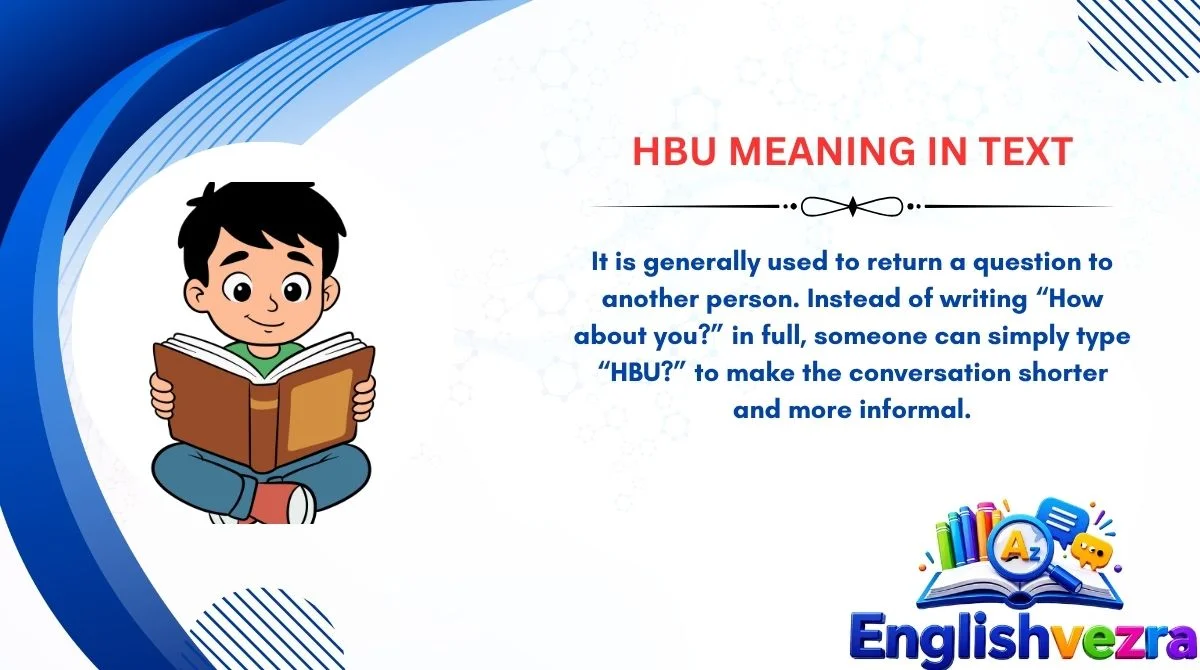
It is generally used to return a question to another person. Instead of writing “How about you?” in full, someone can simply type “HBU?” to make the conversation shorter and more informal.
For example:
Person A: I’m watching a movie. HBU?
Person B: I’m playing a game.
Here, the first person is saying what they are doing and then asking what the other person is doing.
The abbreviation can be used after many different types of statements:
- “I’m fine, HBU?”
- “I love pizza. HBU?”
- “My weekend was pretty good, HBU?”
- “I’m from Texas, HBU?”
- “I’m studying right now, HBU?”
The meaning remains essentially the same: “And what about you?” or “What is your answer?”
HBU is normally associated with informal communication. It is appropriate when chatting with friends, classmates, online acquaintances, or people you are comfortable texting casually.
The abbreviation itself does not automatically indicate a particular emotion. It can sound friendly, curious, neutral, or conversational depending on the surrounding messages.
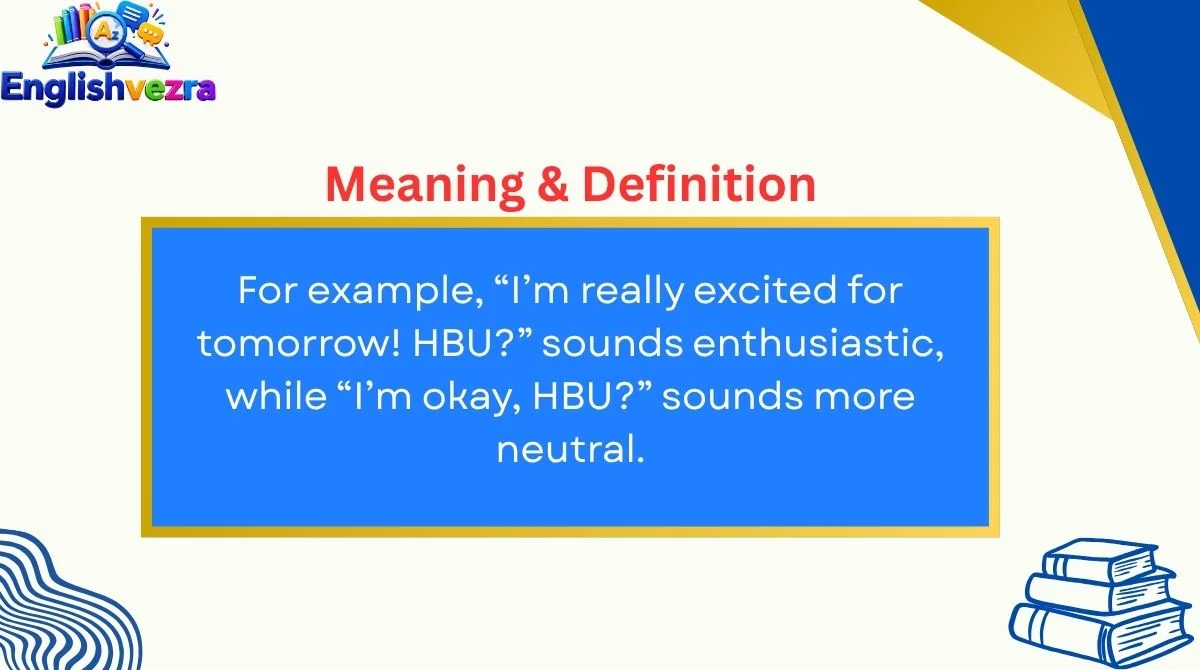
For example, “I’m really excited for tomorrow! HBU?” sounds enthusiastic, while “I’m okay, HBU?” sounds more neutral.
One useful thing to remember is that HBU usually does not introduce a completely new topic. Instead, it turns the focus back toward the other person and encourages them to participate in the conversation.
Background
HBU is formed from the first letters of “How About You?” It belongs to the broader group of internet and texting abbreviations that became popular as people began communicating through short digital messages.
The exact date or person responsible for creating HBU is not clearly established. It is better to treat it as a naturally developed texting abbreviation rather than attributing it to a specific inventor.
Short forms became particularly useful in environments where people wanted to type quickly, including text messaging, instant messaging, online chat rooms, forums, and social networking platforms. As digital conversations became more casual, abbreviations such as HBU became familiar to many users.
The phrase itself is much older than the abbreviation. People have long used expressions such as “How about you?” in ordinary conversation. Digital communication simply shortened the phrase into three letters.
HBU also fits a common pattern in online language: users frequently remove unnecessary words while keeping enough letters for the intended meaning to remain understandable.
For example:
- “How are you?” may become “hru?”
- “What are you doing?” may become “wyd?”
- “How about you?” may become “hbu?”
These shortened expressions are generally understood through context.
Capitalization does not normally change the meaning. Someone might write HBU, hbu, or Hbu. All three usually communicate the same phrase.
Likewise, punctuation is flexible. “HBU?”, “hbu?”, and even “hbu” can mean the same thing.
Because texting language changes over time, some abbreviations become less common while others remain popular. HBU continues to be understandable in casual digital communication because the phrase it represents is simple and frequently useful.
Usage in Different Contexts
In Chat
HBU is particularly useful when two people are exchanging personal information.
Example:
“I’m from Chicago. HBU?”
The sender is asking where the other person is from.
It can also follow an answer:
“I’m 22, HBU?”
The person is asking the other person’s age.
On Social Media
People may use HBU in comments, direct messages, replies, or group conversations.
For example:
“I prefer summer. HBU?”
The user is asking another person about their preference.
In Professional Fields
HBU is not generally considered formal professional language. In workplace emails, official documents, business proposals, or formal communication, writing “How about you?” or a more specific question is usually clearer and more appropriate.
However, coworkers who already communicate casually through workplace messaging platforms may use HBU informally.
In Casual Conversations
Casual conversation is where HBU fits most naturally. Friends and acquaintances may use it after discussing hobbies, plans, preferences, locations, experiences, or feelings.
The abbreviation works because both people already understand that the question is being returned to them.
Meaning in Chat, WhatsApp, Instagram, and TikTok
Across messaging and social platforms, HBU generally keeps the same meaning: “How about you?”
Someone might write:
“I’m free tonight, HBU?”
They want to know whether you are free too.
In an Instagram DM, someone could say:
“I usually listen to rap. HBU?”
They are asking about your music preference.
TikTok
If someone is discussing a creator, trend, hobby, or video, HBU can be used to invite your opinion:
“I actually like this trend 😂 HBU?”
The sender wants to know whether you agree or have the same preference.
Group Chats
HBU can also be directed toward one person in a group:
“I’m staying home tonight. HBU, Jake?”
Here, the sender is specifically asking Jake what he plans to do.
The tone is usually casual and conversational. It does not necessarily mean the sender is especially interested in you romantically. The surrounding conversation is important when interpreting the intent.
Meaning in Physics, Medical, and Aircraft Terminology
Physics
HBU is not a standard, widely recognized physics abbreviation with the everyday meaning “How about you?” If you encounter these letters in a physics-related document, their meaning would need to be determined from that specific document or field.
Medical Terminology
HBU is not a universally standard medical term that can automatically be interpreted as “How about you?” Medical abbreviations can vary between institutions and specialties, so an unfamiliar abbreviation in a clinical context should be checked against the relevant documentation rather than assuming the texting meaning.
Aircraft and Aviation
HBU does not have a single universal aviation meaning that should automatically be assumed whenever the letters appear. Aviation uses many specialized abbreviations and codes, so the surrounding document or communication would determine the intended meaning.
In short, HBU is overwhelmingly familiar in casual digital communication as “How about you?”, while specialized contexts may use the same letters differently.
Common Misconceptions
One common misunderstanding is thinking that HBU is a separate slang word. It is more accurately described as a texting abbreviation or shorthand expression.
Another mistake is assuming that HBU always has a romantic meaning. It does not. Friends, classmates, coworkers, online acquaintances, and dating-app matches can all use it.
For example:
“I’m studying computer science, HBU?”
This could simply be a normal conversational question.
Another misconception is that capitalization changes the meaning. HBU, hbu, and Hbu generally mean the same thing.
People may also confuse HBU with other short abbreviations because texting language contains many three-letter combinations. The surrounding sentence usually makes the intended meaning clear.
Finally, HBU does not necessarily mean “What do you think?” in every situation. Its more direct meaning is “How about you?” The specific question being returned depends on what was discussed immediately before it.
Similar Terms & Alternatives
Several expressions can perform a similar conversational function.
| Term | Meaning | Typical Use |
|---|---|---|
| HBU | How about you? | Casual texting |
| WBU | What about you? | Casual texting |
| And you? | Asking the same question back | Casual conversation |
| What about you? | Returning the question | Casual or neutral |
| How about yourself? | Asking about the other person | Slightly more formal |
| You? | Very short return question | Informal texting |
HBU and WBU are particularly easy to confuse. In many everyday conversations, they perform almost the same function.
For example:
“I’m tired. HBU?”
and
“I’m tired. WBU?”
Both generally ask for the other person’s situation.
The difference is mainly the wording behind the letters: HBU = How About You, while WBU = What About You.
How to Respond to It
The easiest way to respond to HBU is to answer the question that was just returned to you.
For example:
Them: “I’m doing good, HBU?”
You: “I’m doing good too!”
Or:
Them: “I love basketball. HBU?”
You: “I’m more into football.”
You can also use HBU yourself to keep the conversation going:
“I’m going out with friends tonight. HBU?”
If you do not want to give a detailed answer, a short response is perfectly natural:
- “Same here!”
- “Pretty good!”
- “Not bad.”
- “I’m tired today 😂”
- “I’m into it too.”
- “I actually prefer something else.”
If the original question is unclear, you can ask for clarification rather than guessing what the person means.
Differences from Similar Words
The closest abbreviations to HBU are WBU and phrases such as “And you?”
HBU vs. WBU
Both normally return a question to the other person.
HBU: “How about you?”
WBU: “What about you?”
There is usually little practical difference in casual texting.
HBU vs. “And you?”
“And you?” is a complete phrase, while HBU is an abbreviation. The meaning can be almost identical.
“I’m from Canada. And you?”
is functionally similar to:
“I’m from Canada. HBU?”
HBU vs. “What do you think?”
These are not always interchangeable. HBU usually asks about the other person’s corresponding situation, preference, or experience. “What do you think?” specifically asks for an opinion.
For example:
“I’m going to the gym. HBU?”
asks what you are doing.
“I think this movie is great. What do you think?”
asks for your opinion.
Relevance in Online Conversations & Dating Apps
HBU is common in online conversations because it helps prevent a chat from becoming one-sided. When someone shares information about themselves and adds “HBU?”, they are giving the other person an opportunity to respond.
On dating apps, you might see:
“I love hiking on weekends, HBU?”
The person is asking whether you also enjoy hiking or what you usually do on weekends.
Another example could be:
“I’m looking for something serious. HBU?”
Here, the meaning is still “How about you?”, but the context makes the question more specific: the sender wants to know what you are looking for.
This shows why context matters. HBU itself does not establish romantic interest, friendliness, seriousness, or any particular intention. The surrounding messages and relationship between the people provide that information.
A person using HBU with a close friend may simply be chatting casually. The same abbreviation on a dating app may be part of a conversation about interests, lifestyle, or relationship expectations.
FAQs
What does HBU mean in text?
HBU means “How about you?” in text messages. It is commonly used after someone shares information about themselves and wants the other person to answer the same type of question. For example, “I’m doing great, HBU?” means “I’m doing great, how about you?” It is informal and commonly used in casual digital conversations.
What does HBU mean in chat?
In chat, HBU means “How about you?” It is a quick way to return a question to another person. If someone says, “I’m watching Netflix, HBU?”, they are asking what you are doing. The abbreviation is especially useful in fast conversations where people prefer short, informal messages.
Is HBU a slang term?
HBU is best described as a texting abbreviation or internet shorthand rather than a traditional slang word. It represents the phrase “How about you?” People commonly use it in casual messages, social media conversations, and online chats. It is generally not appropriate for formal writing where complete phrases are preferred.
How do you respond to HBU?
You can respond to HBU by answering the question the other person has just returned to you. For example, if someone says, “I’m feeling good, HBU?”, you could say, “I’m doing good too!” Your response depends on the original topic, so HBU itself does not require one specific answer.
What does HBU mean on social media?
On social media, HBU generally means “How about you?” It can appear in comments, direct messages, replies, or group conversations. Someone might write, “I prefer summer, HBU?” to ask about your preference. The meaning usually remains the same across platforms such as Instagram, TikTok, Snapchat, and similar services.
Can HBU have different meanings?
HBU can potentially have different meanings in specialized contexts, but in ordinary texting and social media conversations it normally means “How about you?” If you see the abbreviation in a technical, medical, aviation, or other specialized document, you should use the surrounding context or relevant terminology to determine its intended meaning.
Does HBU mean “What about you”?
Yes, HBU and “What about you?” can often serve the same conversational purpose. HBU technically expands to “How about you?”, while WBU commonly represents “What about you?” In everyday texting, the distinction is usually minor because both expressions invite the other person to share their corresponding answer or experience.
Does HBU mean someone likes you?
HBU by itself does not prove that someone likes you romantically. It simply means “How about you?” The person could be a friend, acquaintance, coworker, or dating-app match. To understand the tone or intention, consider the complete conversation rather than interpreting the abbreviation alone.
Conclusion
HBU is a simple and widely understandable texting abbreviation that stands for “How about you?” People use it to return a question, invite another person’s answer, and keep a conversation moving without typing the full phrase.
You may encounter HBU in text messages, WhatsApp chats, Instagram DMs, TikTok conversations, group chats, and other informal online communication.
It can follow questions about feelings, activities, interests, preferences, locations, plans, or experiences.
The abbreviation usually has a neutral and casual tone. It does not automatically indicate friendship, romantic interest, or any particular emotion.
Context determines how the overall message should be understood.
The most important distinction is between HBU and similar expressions such as WBU. While their wording differs slightly, they often serve the same purpose in everyday texting.
When you receive “HBU?”, simply answer the question that the other person has returned to you.

Samuel Hartwell is an English language educator and word enthusiast who enjoys explaining meanings in simple, clear ways. He creates helpful content to make English vocabulary easier to understand and learn.