Have you ever received a message with the 🥱 emoji and wondered what the person was trying to say? The yawning face is commonly used in texts, chats, comments, and social media posts to show tiredness, sleepiness, boredom, or a lack of interest.
However, its exact meaning can change depending on the conversation and the relationship between the people involved.
Unlike many slang abbreviations, 🥱 is a visual emoji, so people often use it to communicate a feeling without writing a full sentence.
Someone might send it because they are actually tired, while another person may use it jokingly to show that something is boring or predictable.
Understanding the surrounding message is important because the same emoji can carry a slightly different tone in different situations.
In casual conversations, it can be playful, sarcastic, or simply descriptive. On social media, it may also be used as a reaction to repetitive content or an uninteresting opinion.
Quick Answer
🥱 meaning in text usually indicates that someone is sleepy, tired, bored, or uninterested. The yawning face emoji can describe a person’s actual tiredness or suggest that something feels boring or unexciting. Its exact tone depends on the conversation, so it can be sincere, playful, sarcastic, or mildly dismissive.
Meaning & Definition
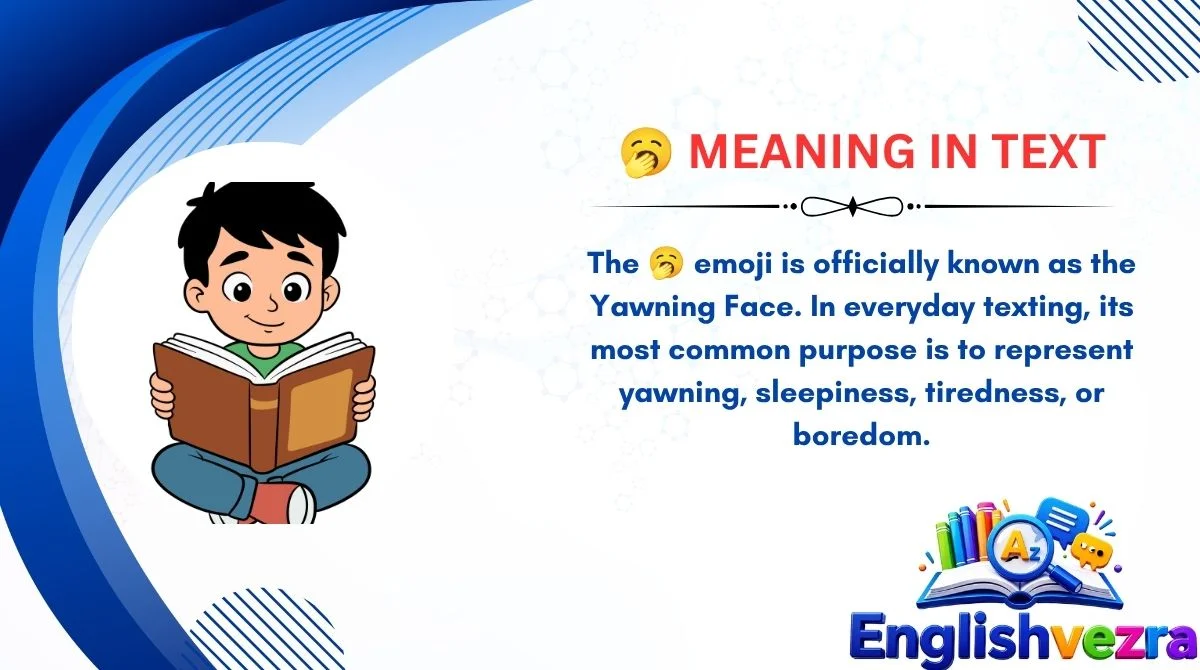
The 🥱 emoji is officially known as the Yawning Face. In everyday texting, its most common purpose is to represent yawning, sleepiness, tiredness, or boredom.
When someone sends 🥱 by itself, they may simply be saying, “I’m tired” or “I’m sleepy.” For example, if a friend messages you late at night and sends 🥱, the most natural interpretation is that they are feeling sleepy.
The emoji can also communicate boredom. If someone is listening to a long explanation and responds with 🥱, they may be jokingly suggesting that the conversation is becoming boring.
Another common use is to show a lack of excitement. For example:
- “Another meeting tomorrow 🥱”
- “That same story again 🥱”
- “Nothing interesting happened today 🥱”
- “I need to sleep 🥱”
In these examples, the emoji adds an emotional tone that words alone might not fully express.
Common meanings of 🥱
| Meaning | What it can communicate |
|---|---|
| Sleepy | “I’m ready to sleep.” |
| Tired | “I’m exhausted.” |
| Bored | “This is boring.” |
| Uninterested | “I’m not really interested.” |
| Unexcited | “This isn’t exciting.” |
| Playful sarcasm | “Here we go again.” |
The emoji does not automatically mean that the sender is literally falling asleep. Context matters.
For example, if someone says, “You really think that was funny? 🥱,” they may be using the emoji sarcastically to suggest that they were not impressed.
Therefore, the safest interpretation is to look at the words surrounding the emoji. The 🥱 symbol generally communicates sleepiness, boredom, tiredness, or low enthusiasm, but the precise message depends on how it is being used.
Background
The 🥱 emoji represents a person yawning, with closed or partly closed eyes and a hand covering the mouth. Its visual design makes its basic idea relatively easy to understand: someone is tired, sleepy, or yawning.
The emoji is part of the standardized Unicode emoji system. It was introduced as the Yawning Face in Unicode 12.0 and became part of the growing collection of modern emojis used across digital communication.
Unlike internet abbreviations such as “LOL” or “BRB,” 🥱 does not come from a shortened phrase. It is a visual symbol designed to communicate an expression or reaction.
Over time, users have naturally expanded its conversational meaning. A real yawn can indicate tiredness, but people also yawn when they are bored or when something fails to hold their attention. Because of this, the emoji developed several closely connected meanings in everyday online communication.
Its use is particularly easy to understand because yawning is a familiar human expression. People can recognize the basic emotion without needing a written explanation.
For example, someone might post:
“Stayed up until 3 AM finishing this project 🥱”
Here, the emoji reinforces the idea of tiredness.
But another person might comment:
“Same argument for the tenth time 🥱”
In this situation, it is more likely expressing boredom or annoyance with repetition.
The important point is that there is no single hidden definition that applies to every message. The emoji has a central idea—yawning, tiredness, or boredom—and users adapt that idea to different situations.
Its meaning has therefore become broader than simply “I am yawning.” In modern digital communication, it can also function as a reaction that says something is dull, predictable, repetitive, or lacking excitement.
Usage in Different Contexts
The meaning of 🥱 can shift depending on where and how it appears. The same emoji can be friendly in one conversation and slightly dismissive in another.
In Chat
In private messages, 🥱 often means the sender is sleepy or tired.
Example:
“I’m going to bed now 🥱”
Here, the meaning is straightforward.
It can also be used when someone is bored:
“This movie is taking forever 🥱”
On Social Media
On social platforms, the emoji can work as a reaction to content that a person considers boring, repetitive, or uninteresting.
For example:
“Another post about the same topic 🥱”
In this case, it may have a sarcastic or dismissive tone.
In Professional Conversations
The emoji is less appropriate in formal workplace communication. In a casual team chat, however, someone might use it to joke about a long meeting:
“Two-hour meeting tomorrow 🥱”
In a formal email to a manager or client, using 🥱 could potentially sound disrespectful or uninterested, so it is generally better avoided.
In Casual Conversations
Among friends, 🥱 can be playful.
Someone might say:
“You woke up at noon again? 🥱”
This does not necessarily mean the person is genuinely tired. It may simply be teasing.
In Comments
A comment containing 🥱 can sometimes mean:
- “This is boring.”
- “I’ve heard this before.”
- “Not impressed.”
- “Nothing new here.”
Because comments lack the facial expressions and voice tone of face-to-face conversations, context becomes especially important.
Meaning in Chat, WhatsApp, Instagram, and TikTok
The 🥱 emoji is widely suitable for casual digital communication because it quickly communicates an emotional reaction without requiring a full sentence.
On WhatsApp, people commonly use 🥱 to say they are sleepy or tired.
Example:
“Long day at work 🥱”
It can also be sent alone as a simple reaction.
On Instagram, 🥱 may appear in comments, captions, stories, or direct messages. In comments, it can sometimes communicate boredom or lack of excitement.
For example:
“Nothing new here 🥱”
This can sound sarcastic depending on the situation.
TikTok
TikTok users may use 🥱 when reacting to repetitive trends, predictable content, or something they find uninteresting.
For example:
“Another version of the same trend 🥱”
The emoji adds a visual reaction that can make the comment feel more expressive.
Private Chats
Between close friends, 🥱 is often harmless and playful.
Example:
“You still haven’t watched that movie? 🥱”
The sender could be joking rather than criticizing.
When Sent Alone
A single 🥱 can be ambiguous. It might mean:
- “I’m sleepy.”
- “I’m tired.”
- “I’m bored.”
- “This is boring.”
- “I’m not impressed.”
Look at the messages before and after it before assuming the strongest interpretation.
Meaning in Physics, Medical, and Aircraft Terminology
The 🥱 emoji itself does not have a standard technical meaning in physics, aviation, or medical terminology.
Physics
There is no recognized physics concept represented by the 🥱 emoji. It is an emoji used for digital communication rather than a scientific symbol.
Medical Terminology
Yawning itself is a real physiological behavior, but the 🥱 emoji is not a medical abbreviation or diagnostic symbol.
In ordinary communication, it simply represents the visual idea of yawning or being sleepy. A medical professional would not normally use the emoji as a formal medical term.
Aircraft or Aviation Terminology
The emoji has no standard aviation meaning. If you see 🥱 in an aviation-related chat, its meaning would normally depend on the person’s conversational context rather than an aviation definition.
For example, a pilot joking about a very early flight might write:
“5 AM departure 🥱”
Here, the emoji simply communicates tiredness.
It is important not to confuse the visual representation of yawning with a specialized technical term. The emoji remains a conversational symbol even when it appears in discussions about science, medicine, or aviation.
Common Misconceptions
One common misconception is that 🥱 always means “I’m going to sleep.” That is only one possible interpretation.
The emoji can also mean that someone is bored, unimpressed, uninterested, or joking about something being repetitive.
Another misunderstanding is assuming that 🥱 is automatically rude. It can be dismissive in certain situations, particularly when someone uses it in response to another person’s opinion or serious message. However, among friends, the same emoji may be completely playful.
For example:
“You are telling that story again 🥱”
This could be friendly teasing.
But:
“Your opinion is boring 🥱”
could sound more openly dismissive.
Another misconception is treating 🥱 as an abbreviation or slang word. It is actually an emoji representing a facial expression and action.
Finally, some people may assume that the emoji always communicates negative feelings. That is not necessarily true. Someone may simply be tired after a long day and use 🥱 without criticizing anything.
The surrounding words, timing, relationship, and conversation topic all help determine the intended tone.
Similar Terms & Alternatives
Several emojis, words, and expressions can communicate ideas that overlap with 🥱, but they are not exactly the same.
😴 Sleeping Face
😴 usually has a stronger connection with sleeping or being asleep.
Example:
“I’m going to sleep 😴”
This is more directly about sleep than boredom.
😪 Sleepy Face
😪 often suggests tiredness, sleepiness, or exhaustion. It can feel more emotionally tired than 🥱.
😑 Expressionless Face
😑 can communicate annoyance, lack of enthusiasm, awkwardness, or a blank reaction. It does not specifically indicate tiredness.
🙄 Rolling Eyes
🙄 often communicates annoyance, disbelief, frustration, or sarcasm. It can sometimes accompany boredom, but its meaning is different from yawning.
“I’m tired”
This is the direct written equivalent when someone genuinely feels physically or mentally tired.
“I’m bored”
This directly communicates a lack of interest or entertainment.
“Not impressed”
This phrase is stronger than simply saying someone is tired. It can communicate disappointment or a negative reaction.
“Here we go again”
This expression can have a similar sarcastic feeling when 🥱 is used to react to something repetitive.
Understanding these differences helps prevent overinterpreting a simple emoji.
How to Respond to It
Your response should depend on what the sender probably means.
If they appear tired, you can respond supportively:
- “You should get some rest 😴”
- “Long day?”
- “Go get some sleep!”
- “Sounds like you’re exhausted.”
If they seem bored, you can make the conversation more interesting:
- “Okay, I’ll try to make it less boring 😂”
- “Wait until you hear the good part.”
- “What would make this more interesting?”
- “Haha, I know you’re bored.”
If the emoji seems sarcastic, a playful response can work:
- “Oh, you’re not impressed? 😂”
- “Give me a chance!”
- “Here we go again, huh?”
- “Okay, okay, I get the message.”
If you are unsure what the person means, you can simply ask:
“Are you tired or bored? 😂”
This is especially useful when the emoji appears by itself.
The relationship between the two people also matters. A close friend may use 🥱 jokingly, while the same emoji from someone you barely know could feel more dismissive.
Differences from Similar Words
The easiest way to understand 🥱 is to compare it with related expressions.
| Expression | Common meaning | Typical tone |
|---|---|---|
| 🥱 | Sleepy, tired, bored, or uninterested | Casual/playful |
| 😴 | Sleeping or very sleepy | Neutral/casual |
| 😪 | Tired or sleepy | Soft/emotional |
| 🙄 | Annoyed, sarcastic, or frustrated | Often negative |
| “I’m tired” | Physically or mentally tired | Direct |
| “I’m bored” | Lack of interest or entertainment | Direct |
| “Not impressed” | Lack of approval or excitement | More dismissive |
| “Here we go again” | Repetition or predictable behavior | Often sarcastic |
The biggest difference is that 🥱 is flexible. It can represent an actual physical state or become a reaction to something happening in the conversation.
For example:
“I didn’t sleep last night 🥱”
probably communicates genuine tiredness.
But:
“Another argument about the same thing 🥱”
probably communicates boredom or frustration with repetition.
Therefore, the emoji should not be interpreted independently from the surrounding message.
Relevance in Online Conversations & Dating Apps
The 🥱 emoji can appear in modern online conversations, including dating apps, direct messages, comments, and social media.
On dating apps, its interpretation can depend heavily on the conversation. If someone says:
“Long day at work 🥱”
they are probably expressing tiredness.
But if someone responds to a dating conversation with only:
“🥱”
it could potentially suggest boredom or a lack of enthusiasm. It might also simply mean that they are tired. There is not enough information to determine the exact intention from the emoji alone.
This is why context matters especially in dating conversations. A short emoji response can be interpreted differently depending on what was said immediately before it.
For example:
Person A: “I finally finished my exams!”
Person B: “🥱”
This could be playful teasing, but it might also suggest that Person B is not particularly excited about the topic.
On the other hand:
Person A: “I’m exhausted. Going to sleep.”
Person B: “Same 🥱”
Here, the meaning is clearly related to tiredness.
The emoji can therefore communicate different levels of emotion without changing its basic visual meaning.
When reading online messages, consider the complete conversation rather than assigning a fixed definition to 🥱.
FAQs
What does 🥱 mean in text?
🥱 usually means that someone is sleepy, tired, bored, or uninterested. The exact meaning depends on the surrounding conversation. If someone sends it while talking about going to bed, it probably means they are tired. If they send it in response to a repetitive story or opinion, it may instead mean that they are bored or unimpressed.
What does 🥱 mean in chat?
In chat, 🥱 commonly communicates tiredness or sleepiness, but it can also be used to show boredom. Friends may use it playfully when a conversation becomes repetitive. If the emoji appears after someone makes a predictable statement, it may carry a sarcastic “here we go again” feeling rather than literally saying the person is sleepy.
Is 🥱 a slang term?
No, 🥱 is not a slang term or abbreviation. It is an emoji called the Yawning Face. People use it as a visual reaction to communicate ideas such as sleepiness, tiredness, boredom, or low enthusiasm. Its meaning comes from the expression represented by the emoji rather than from a shortened word or phrase.
What does 🥱 mean on social media?
On social media, 🥱 can mean tiredness, boredom, lack of excitement, or being unimpressed. Someone might use it in a comment when they think a topic is repetitive or uninteresting. However, the emoji can also be completely harmless, such as when a person posts about staying awake late or having a tiring day.
How do you respond to 🥱?
You can respond based on the context. If the person seems tired, say something like “Get some rest!” If they seem bored, you can make a joke or change the subject. If you’re unsure, asking “Tired or bored? 😂” is an easy way to clarify the intended meaning without overthinking the emoji.
Can 🥱 have different meanings?
Yes, 🥱 can have several closely related meanings. It may indicate sleepiness, physical tiredness, boredom, lack of excitement, or mild disinterest. The words surrounding it usually reveal which meaning is intended. A message about going to bed suggests sleepiness, while a response to repetitive content may suggest boredom or sarcasm.
What does 🥱 mean from a girl or guy?
The basic meaning of 🥱 does not change based on whether the sender is a girl or a guy. It usually communicates tiredness, sleepiness, boredom, or low enthusiasm. In a personal or dating conversation, the context matters more than the sender’s gender. Avoid assuming romantic interest, rejection, or annoyance from the emoji alone.
Does 🥱 mean someone is bored with you?
Not necessarily. 🥱 can mean that someone is genuinely tired rather than bored with the conversation or with you. If it appears after a repetitive topic or a long conversation, boredom may be intended. Look at the person’s other messages and overall behavior before deciding that the emoji is a personal reaction.
Conclusion
The 🥱 emoji is a simple but flexible way to express tiredness, sleepiness, boredom, or a lack of excitement in digital conversations. Its most direct meaning comes from the action it represents: yawning.
In texts and chats, it can simply mean “I’m sleepy” or “I’m tired.” On social media, it may also be used sarcastically to suggest that something is boring, repetitive, predictable, or unimpressive.
Among friends, it is often playful, while in professional or unfamiliar conversations it can sometimes sound dismissive.
The emoji does not have a standard technical definition in physics, medicine, or aviation. It remains a conversational symbol whose meaning depends on context.
If you receive 🥱, pay attention to the surrounding words and the situation rather than assuming one fixed interpretation.
Understanding the conversation as a whole is the best way to determine whether the sender is tired, bored, joking, or simply reacting casually.

Samuel Hartwell is an English language educator and word enthusiast who enjoys explaining meanings in simple, clear ways. He creates helpful content to make English vocabulary easier to understand and learn.