Slang can be confusing because a familiar word may take on a completely different meaning in casual conversations, online messages, or popular culture.
“Shank” is one such word. You may see it in a text message, social media comment, movie, gaming conversation, or discussion about prison culture and wonder what the person actually means.
In ordinary English, shank can refer to the lower part of a leg or a long, narrow part of an object.
However, in slang, the word is often associated with a homemade or improvised stabbing weapon. It can also be used as a verb meaning to stab someone, particularly in informal British or prison-related language.
Because the word can have different meanings depending on context, understanding the surrounding conversation is important. Someone discussing shoes or anatomy may be using the standard meaning, while a crime-related joke or threatening message may use the slang meaning.
Quick Answer
Shank meaning slang usually refers to an improvised knife or other sharp weapon, especially one associated with prison slang. As a verb, “to shank” means to stab someone. The word can sound threatening, but its exact meaning depends on the conversation and context.
Meaning & Definition
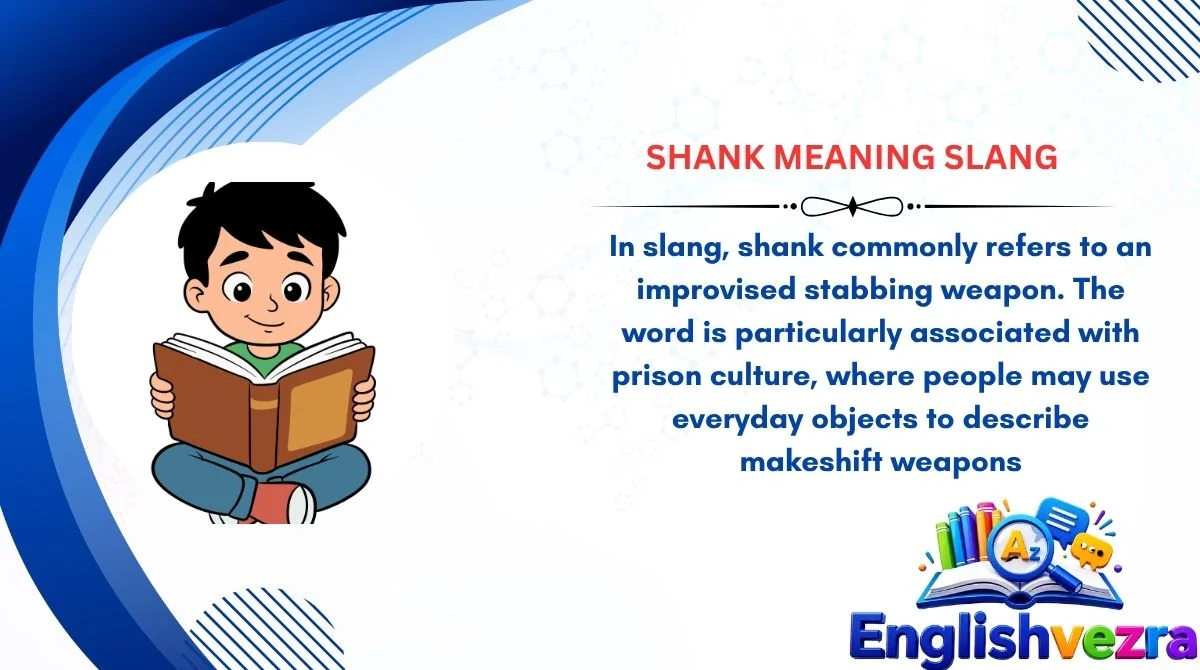
In slang, shank commonly refers to an improvised stabbing weapon. The word is particularly associated with prison culture, where people may use everyday objects to describe makeshift weapons. A shank is generally understood as something sharp or pointed that has been adapted or fashioned for use as a weapon.
The word can also function as a verb. If someone says, “He got shanked,” they generally mean that the person was stabbed. Similarly, “They threatened to shank him” means they threatened to stab him.
The slang meaning is therefore quite different from the ordinary dictionary senses of the word. Context is essential.
For example:
- “He was carrying a shank.” → A makeshift weapon.
- “He got shanked.” → He was stabbed.
- “They said they would shank him.” → They threatened to stab him.
Online, however, people sometimes use the term jokingly or dramatically. A gamer might use it while describing an imaginary attack, or friends might exaggerate a situation for humor.
That does not make the word harmless in every situation. If someone uses shank in a direct threat, it can communicate a serious intention of violence.
The noun and verb forms are useful to distinguish:
Noun: “A shank” can mean an improvised weapon.
Verb: “To shank” means to stab someone.
When you encounter the word without context, don’t automatically assume it is referring to violence. The surrounding words usually reveal whether the speaker means the slang usage or one of the ordinary meanings.
Background
The word shank is much older than its modern slang use. In traditional English, shank has been used for a lower leg or the lower part of a limb. It can also describe a long, narrow section of an object, such as part of a tool or piece of hardware.
The slang sense developed separately from these everyday meanings. The exact historical path into criminal and prison slang is not something that should be presented as one certain, simple origin. However, the association between shank and an improvised stabbing weapon became strongly established in prison-related language and later spread into popular culture.
Movies, television shows, books, music, and internet discussions have helped make the slang sense widely recognizable. As a result, someone who has never encountered prison slang may still recognize shank as a reference to a makeshift weapon.
The verb shank developed from the same slang association. In informal speech, “to shank” means to stab someone.
Over time, the word also became common in fictional and exaggerated situations. Characters in crime dramas may threaten to “shank” someone, while gamers or internet users may use the expression humorously when talking about fictional combat.
It is important not to confuse the slang meaning with every use of the word. Shank remains a legitimate ordinary English word with nonviolent meanings. For example, in anatomy, it can refer to the lower part of a leg, while in manufacturing or tools, it may describe a narrow supporting part.
Therefore, the meaning is determined by context rather than by the word alone.
Usage in Different Contexts
The meaning of shank can change considerably depending on where and how it is used.
Chat
In casual chat, “shank” can refer to stabbing or an improvised weapon. Someone might say, “He’ll shank you,” as a serious threat or as exaggerated joking language between friends.
Social Media
On social media, the term can appear in memes, jokes, fictional discussions, crime-related content, or comments about movies and television. Users sometimes use violent slang metaphorically or humorously.
For example:
“That character is definitely going to shank somebody.”
This could simply be a comment about a fictional character rather than a real-world threat.
Professional Fields
In professional settings, shank may have completely different meanings. In anatomy, it can relate to the lower leg. In manufacturing, engineering, tools, and similar fields, a shank can mean a narrow portion or shaft of an object.
Therefore, seeing the word in a professional document does not automatically indicate slang.
Casual Conversations
Among friends, the slang meaning may appear in jokes, storytelling, gaming, or discussions about movies. Tone matters greatly. A phrase such as “Don’t shank me” might be playful in one conversation but genuinely threatening in another.
The safest approach is to look at the complete sentence and relationship between the speakers before deciding what the word means.
Meaning in Chat, WhatsApp, Instagram, and TikTok
On messaging and social platforms such as WhatsApp, Instagram, and TikTok, shank usually keeps its basic slang meaning when it is used as a verb or noun. However, online users may use it in fictional, humorous, exaggerated, or gaming-related contexts.
For example:
- “Bro is about to shank him 💀”
→ The speaker may be joking about someone looking extremely angry. - “He got shanked in the movie.”
→ The speaker means a character was stabbed. - “Don’t make me shank you 😂”
→ Depending on the relationship, this could be exaggerated joking rather than a literal threat. - “That prison scene had a shank in it.”
→ The word refers to an improvised weapon shown in the scene.
TikTok comments may also use the word as part of humor surrounding fictional characters, memes, movies, or dramatic situations.
Emojis and surrounding language can provide clues. Laughing emojis, gaming references, or obviously fictional situations can indicate playful usage. However, emojis alone cannot prove that a threatening statement is harmless.
If someone sends the word directly to you without context, you should consider the entire conversation before interpreting it. A single slang word can be ambiguous.
Meaning in Physics, Medical, and Aircraft Terminology
Physics
Shank is not a standard fundamental physics term with the slang meaning of a weapon. If you encounter the word in a physics-related context, it may belong to the name or description of a physical object rather than slang.
Medical Terminology
In anatomy and medical contexts, shank can refer to the lower portion of the leg in certain usage. This is completely different from the slang meaning involving stabbing.
Therefore, a medical text containing the word does not automatically have anything to do with criminal slang.
Aircraft or Aviation Terminology
There is no standard aviation meaning of “shank” that corresponds to the slang meaning of an improvised weapon. Aviation and aircraft-related uses should be interpreted from the technical context in which the word appears.
This distinction is important because English words can have several specialized meanings. A technical use should not automatically be interpreted as internet slang.
If you see shank in a technical document, examine the surrounding terminology rather than assuming it refers to violence.
Common Misconceptions
One common misconception is that shank always means a weapon. That is incorrect. The word has ordinary and technical meanings unrelated to violence.
Another misunderstanding is that shank always means “stabbed.” Technically, the noun and verb uses are different. A shank can refer to an improvised weapon, while to shank means to stab someone.
People also sometimes assume that every use of the word is a serious threat. Online slang is frequently used in fictional, humorous, or exaggerated contexts. A movie review, gaming conversation, or meme may use the word without describing a real event.
Another mistake is confusing shank with words that sound or look similar. The intended meaning must be determined from the sentence.
Finally, the word is sometimes associated almost exclusively with prisons because of its strong connection with prison slang and popular culture. While that association is common, the word itself has older and broader meanings.
Similar Terms & Alternatives
Several words may appear similar to shank, but they are not always interchangeable.
- Stab — A general verb meaning to pierce someone or something with a pointed object.
- Stabbing — The act of attacking someone with a pointed weapon or object.
- Knife — A general term for a bladed tool or weapon.
- Blade — A sharp-edged part of a knife or another cutting object.
- Weapon — A broad term covering many objects used to cause harm.
- Shiv — Slang for an improvised knife or sharp weapon, particularly associated with prisons.
- Threaten — To communicate an intention to cause harm; it does not specifically mean stabbing.
- Attack — A broad term that can involve many forms of physical aggression.
The closest slang alternatives are shiv and, depending on the sentence, stab. However, they should not automatically be treated as exact synonyms.
How to Respond to It
Your response should depend on why the person used the word.
If someone is clearly joking with you, a light response may be appropriate:
- “Bro, calm down 😂”
- “What did I even do?”
- “Okay, okay, I surrender!”
If the message appears to be a genuine threat, don’t encourage the situation or respond aggressively. A neutral response could be:
- “Are you serious?”
- “I don’t want any trouble.”
- “Let’s keep this conversation respectful.”
If you do not understand the context, simply ask:
“What do you mean by ‘shank’?”
When a message seems genuinely threatening, prioritize your safety rather than trying to win an argument online. Consider ending the conversation and using the platform’s reporting or blocking features when appropriate.
Differences from Similar Words
The biggest difference is between shank, shiv, and stab.
A shank is commonly a noun for an improvised stabbing weapon and can also be a verb meaning to stab.
A shiv is another slang term for an improvised sharp weapon, particularly associated with prison environments.
A stab is a more general English word. It describes the action rather than specifically naming an improvised weapon.
For example:
- “He had a shank.” → Refers to an improvised weapon.
- “He had a shiv.” → Also refers to an improvised weapon.
- “He was stabbed.” → Describes what happened to someone.
The tone also differs. Shank and shiv often sound more like slang, while stab is ordinary English and can be used in formal descriptions.
Context determines whether shank sounds humorous, fictional, threatening, or simply technical.
Relevance in Online Conversations & Dating Apps
The word can occasionally appear in modern online conversations and dating-app messages, although it is not a typical dating abbreviation or romantic expression.
Someone might use it while making a joke about a movie, discussing a fictional character, talking about crime dramas, or using exaggerated humor. For example, a person could jokingly write, “Don’t steal my fries or I’ll shank you 😂.”
In that situation, the surrounding tone strongly suggests playful exaggeration.
However, a direct statement such as “I’ll shank you” should not automatically be dismissed as harmless just because it was sent online. The relationship between the people, previous messages, and overall circumstances matter.
On dating apps, unexpected violent slang may be a warning sign if it appears aggressive or threatening. You do not need to continue a conversation that makes you uncomfortable.
The important point is that shank is not a standard dating acronym. If someone uses it in a dating conversation, its meaning normally comes from ordinary slang rather than a special dating-app definition.
FAQs
What does shank mean in text?
In text messages, shank usually means an improvised stabbing weapon or, as a verb, to stab someone. However, people sometimes use it jokingly when talking about fictional characters, movies, games, or exaggerated situations. The surrounding message is important because shank also has ordinary meanings unrelated to violence.
Is shank a slang term?
Yes, shank is commonly used as slang for an improvised weapon, especially in prison-related or crime-related language. It can also be used as a verb meaning “to stab.” However, shank is not exclusively slang because the word has older ordinary and technical meanings as well.
What does shank mean in chat?
In chat, shank generally refers to stabbing or an improvised stabbing weapon when it is being used as slang. Friends may also use it jokingly or dramatically. For example, “Don’t make me shank you 😂” may be playful, while a serious threat should be treated differently.
What does shank mean on social media?
On social media, shank can refer to an improvised weapon or the act of stabbing someone. It may appear in memes, movie discussions, gaming conversations, jokes, or crime-related content. Social-media users sometimes exaggerate violent language for humor, so the surrounding context should be considered before interpreting it literally.
Can shank have different meanings?
Yes, shank can have several meanings depending on context. As slang, it can refer to an improvised weapon or stabbing. In ordinary English, it can describe a lower part of a leg or a narrow part of an object. Technical and anatomical contexts can therefore produce meanings completely unrelated to slang.
What is the difference between shank and shiv?
Shank and shiv can both refer to improvised sharp weapons, particularly in prison-related slang. They are often used similarly, although regional and contextual preferences can differ. Neither word should automatically be assumed to mean the same thing every time because both can appear in fictional, joking, or crime-related conversations.
How do you respond if someone says “shank” to you?
If someone uses shank jokingly, you can respond casually or ask what they mean. If the message appears threatening, avoid escalating the situation. A simple response such as “Are you serious?” can clarify intent. If you feel genuinely threatened, prioritize your safety and consider blocking or reporting the account.
Does shank have a dating-app meaning?
No, shank does not have a standard dating-app meaning or romantic abbreviation. If it appears on a dating platform, it is usually being used in its ordinary slang sense, a joke, or a reference to fictional or crime-related content. The exact interpretation depends on the conversation surrounding the word.
Conclusion
The slang word shank most commonly refers to an improvised stabbing weapon, while the verb to shank means to stab someone.
The term is strongly associated with prison and crime-related slang, but it has also become familiar through movies, television, gaming, memes, and online conversations.
Importantly, shank does not always have a violent meaning. The word has older ordinary and technical uses, including references to parts of the body or parts of objects. That is why context matters whenever you encounter it.
In a chat or social-media comment, the tone can also change the interpretation. A person may use the term seriously, jokingly, or while discussing fictional events. On dating apps, it is not a standard romantic abbreviation.
If you see shank in a message, look at the complete sentence, surrounding conversation, and relationship between the people involved before deciding what it means.

Samuel Hartwell is an English language educator and word enthusiast who enjoys explaining meanings in simple, clear ways. He creates helpful content to make English vocabulary easier to understand and learn.