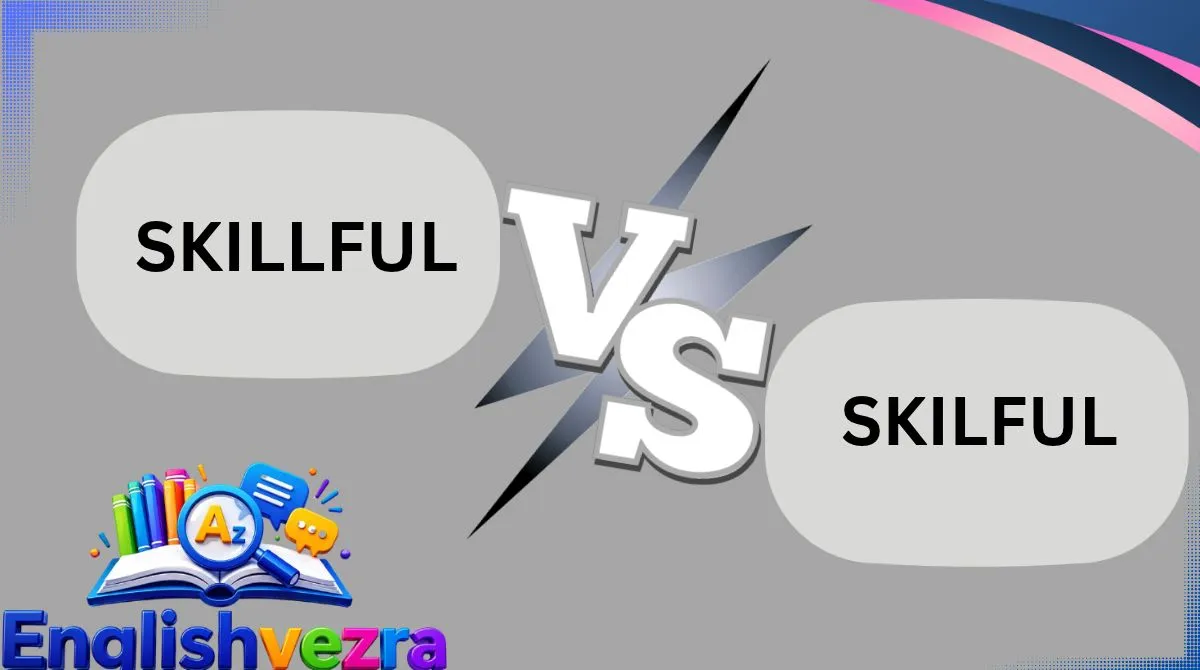
Have you ever seen the words skilful and skillful and wondered which one is correct? You are not alone. Many English learners get confused when they see these two spellings because they look almost the same and have exactly the same meaning.
The difference is not about grammar or pronunciation. It is mainly about British English and American English. Both spellings are correct, but they are used in different parts of the English-speaking world.
For example, a writer in the United Kingdom may write, “She is a skilful painter.” However, an American writer will usually write, “She is a skillful painter.”
This small spelling difference is important when you write school assignments, emails, reports, articles, or other formal documents. Using the right spelling helps your writing look natural and consistent.
The good news is that you do not need to learn two different meanings. Both words describe someone who has good abilities, knowledge, or experience in doing something.
By understanding the spelling rules, regional differences, and everyday examples, you can easily remember when to use each word. You will also learn how to avoid common spelling mistakes and choose the right form for your audience.
What Does “Skilful” Mean?
Skilful is an adjective that describes someone who can do something well because they have learned, practiced, or developed a particular ability.
It is the British English spelling of the word. People in the United Kingdom and many other countries that follow British spelling often use this form.
For example, imagine a person who can cook delicious meals, repair cars, paint beautiful pictures, or play the piano very well. You can describe that person as skilful.
The word comes from skill, which means the ability to do something well. The ending “-ful” means full of something or having a particular quality.
Therefore, a skilful person is someone who has a high level of ability in a certain activity.
When Should You Use Skilful?
Use “skilful” when writing in British English. It is common in British schoolbooks, newspapers, books, and everyday writing.
You can use it to describe many types of abilities, including:
- Physical abilities, such as playing football or swimming.
- Creative abilities, such as painting, drawing, and writing.
- Professional abilities, such as teaching, building, and designing.
- Mental abilities, such as solving problems and making decisions.
- Practical abilities, such as cooking, repairing, and driving.
Remember that the word does not only describe people. It can also describe an action, performance, or method that shows a high level of ability.
Grammar Rule for Skilful
“Skilful” is an adjective. It describes a noun, such as a person, action, or performance.
You can place it before a noun:
- She is a skilful artist.
- He is a skilful driver.
You can also use it after linking verbs such as “is,” “was,” “looks,” and “seems.”
- The player is skilful.
- Her work looks skilful.
The word can also be used in its comparative and superlative forms:
- More skilful
- Most skilful
For example:
“Ali is more skilful than his brother.”
Examples of Skilful in Sentences
Here are eight simple examples to help you understand how this spelling works.
- She is a skilful teacher who explains difficult lessons in simple words.
- My father is a skilful carpenter who makes beautiful wooden furniture.
- The football player made a skilful move and scored a goal.
- He is very skilful at repairing old computers.
- The artist created a skilful painting of a mountain.
- Our team won because of the skilful work of its players.
- A skilful driver always pays attention to the road.
- The young chef prepared a skilful and creative meal.
Notice that every sentence uses the British spelling. The meaning stays the same in each example.
Common Learner Confusion About Skilful
Some learners think “skilful” is incorrect because it has only one letter “l” before the ending “-ful.”
However, this spelling is correct in British English.
The confusion happens because the base word is “skill,” which has two letters “l.” When the ending “-ful” is added, British English normally drops one “l” in this word.
That is why the British spelling is “skilful,” not “skillful.”
What Does “Skillful” Mean?
Skillful is an adjective that describes someone who has the ability, training, or experience to do something very well.
It has exactly the same meaning as “skilful.” The only difference is its spelling.
“Skillful” is the standard American English spelling. It is widely used in the United States and in American books, newspapers, websites, and professional documents.
For example, an American writer may say:
“She is a skillful musician.”
This sentence means that she plays music very well because she has developed strong musical abilities.
The word can describe a person who is good at a particular task. It can also describe an action or performance that requires talent, practice, and careful work.
When Should You Use Skillful?
Use “skillful” when writing in American English.
It is the preferred spelling in the United States. If your readers are mainly American, this is usually the spelling you should choose.
You can use it in many situations, such as:
- Describing a talented sports player.
- Talking about a person who performs a job well.
- Explaining someone’s creative abilities.
- Describing careful and successful work.
- Praising someone who handles a difficult situation.
For example, an American newspaper might write:
“The skillful goalkeeper saved three difficult shots.”
This means the goalkeeper used strong abilities and good technique to stop the shots.
Grammar Rule for Skillful
“Skillful” is also an adjective. It describes a noun and gives more information about a person, action, or thing.
You can use it before a noun:
- He is a skillful player.
- She is a skillful writer.
You can also use it after a linking verb:
- The doctor is skillful.
- His work seems skillful.
Like “skilful,” it can be used in comparative and superlative forms:
- More skillful
- Most skillful
For example:
“Sarah is the most skillful player on our team.”
Examples of Skillful in Sentences
Here are eight examples using the American spelling.
- My brother is a skillful basketball player.
- The skillful doctor helped the patient feel better.
- She is a skillful writer who creates interesting stories.
- The artist made a skillful drawing of a beautiful garden.
- He is skillful at solving difficult maths problems.
- The company hired a skillful computer programmer.
- A skillful cook knows how to prepare food properly.
- The player showed skillful control of the ball during the match.
These sentences show that “skillful” works in the same way as “skilful.” Only the spelling changes.
Common Learner Confusion About Skillful
Some learners believe that “skillful” is the only correct spelling because it contains the complete word “skill.”
This spelling is correct, but it is mainly the American English form.
The extra “l” is part of the spelling difference between the two regional forms.
You should not think that one spelling is better or more grammatical than the other. Both are accepted English words.
Difference Between Skilful and Skillful (Detailed)
The main difference between skilful and skillful is the regional spelling convention.
“Skilful” is used in British English, while “skillful” is used in American English.
Both words describe someone who has a good ability to perform a task. They have the same pronunciation, meaning, and grammatical function.
The difference is simply one extra letter “l” in the American spelling.
Comparison Table
| Feature | Skilful | Skillful |
|---|---|---|
| English variety | British English | American English |
| Meaning | Having good ability | Having good ability |
| Grammar | Adjective | Adjective |
| Spelling | One “l” before “-ful” | Two “l”s before “-ful” |
| Pronunciation | Same | Same |
| Usage | UK and British-style writing | US and American-style writing |
| Correctness | Correct | Correct |
| Example | A skilful player | A skillful player |
1. Difference in Usage
The first difference is where the spelling is commonly used.
British writers generally prefer “skilful.” American writers generally prefer “skillful.”
For example:
British English: “The skilful artist painted a beautiful picture.”
American English: “The skillful artist painted a beautiful picture.”
Both sentences are correct. They communicate the same idea.
2. Difference in Spelling
The second difference is the number of letters “l.”
The British spelling has one “l” before “-ful”:
Skil + ful = Skilful
The American spelling keeps both letters from the base word “skill”:
Skill + ful = Skillful
This is a spelling convention that you should remember rather than a change in meaning.
3. Difference in Grammar
There is no difference in grammar between these words.
Both are adjectives. Both can describe people, actions, performances, and abilities.
For example:
- She is a skilful dancer.
- She is a skillful dancer.
Both sentences are grammatically correct.
You can also use both forms after verbs such as “be,” “seem,” and “become.”
4. Difference in Meaning
There is no difference in meaning.
Both words describe someone or something that shows a high level of ability.
For example:
“The skilful mechanic repaired the engine.”
“The skillful mechanic repaired the engine.”
Both sentences tell us that the mechanic was good at repairing engines.
5. Difference in Sentence Structure
The sentence structure also stays the same.
You can use either word before a noun:
- A skilful worker
- A skillful worker
Or after a linking verb:
- The worker is skilful.
- The worker is skillful.
You do not need to change any other part of the sentence when switching between the two spellings.
Which One Should You Choose?
The best choice depends on your audience.
If you are writing for readers in the United Kingdom, choose “skilful.”
If you are writing for readers in the United States, choose “skillful.”
If you are writing for an international audience, choose one English style and use it consistently throughout your work.
Consistency is more important than mixing both forms in the same document.
Grammar Rules You Must Remember
Understanding a few simple rules will help you use both spellings correctly.
Rule #1: Follow Your English Style
Choose the spelling that matches the type of English you are using.
Use “skilful” for British English and “skillful” for American English.
Example:
British: He is a skilful football player.
American: He is a skillful soccer player.
Both spellings are correct in their respective English varieties.
Rule #2: Both Words Are Adjectives
Remember that both forms are adjectives. They describe people, actions, and things.
You can place them before nouns or after linking verbs.
Example:
“She is a skilful musician.”
“He is a skillful musician.”
Both sentences describe someone’s musical ability.
Rule #3: Do Not Change the Meaning
Never think that one spelling describes a better level of ability than the other.
Both words have the same meaning.
Example:
“That was a skilful performance.”
“That was a skillful performance.”
Both sentences praise the performance.
Rule #4: Use the Same Spelling Throughout Your Writing
Do not switch between British and American spelling without a reason.
If you start with “skilful,” continue using British spelling in the same document. If you start with “skillful,” keep the American form.
Example:
Incorrect style mixing: “She is a skilful artist, and her skillful work is famous.”
Better British style: “She is a skilful artist, and her skilful work is famous.”
Better American style: “She is a skillful artist, and her skillful work is famous.”
This makes your writing look more professional.
Common Mistakes Students Make
Many English learners make small spelling mistakes when using these words. Most of these mistakes happen because they do not know the difference between British and American English.
Here are some common problems and easy ways to fix them.
Mistake 1: Thinking One Spelling Is Wrong
Some students believe that “skilful” is incorrect because it has only one “l.”
Others think “skillful” is wrong because it has an extra letter.
Both beliefs are incorrect.
Wrong idea: Only skillful is correct.
Correct understanding: Both spellings are correct, but they belong to different English varieties.
Mistake 2: Mixing Both Spellings
A common mistake is using both forms in the same paragraph or document.
Example:
“She is a skilful teacher who uses skillful methods.”
Although the meaning is clear, the spelling is inconsistent.
Better British English:
“She is a skilful teacher who uses skilful methods.”
Better American English:
“She is a skillful teacher who uses skillful methods.”
Mistake 3: Confusing Spelling With Meaning
Some students think the words have slightly different meanings.
For example, they may believe “skillful” means highly talented while “skilful” means simply experienced.
There is no such difference.
Both words describe someone who can do something well.
Mistake 4: Adding Unnecessary Letters
Some learners create incorrect forms because they are unsure how to add the ending “-ful.”
For example:
Incorrect: Skillfull
Correct: Skillful or skilful, depending on the English variety.
Remember that the ending is spelled “-ful,” with one “l” at the end.
Mistake 5: Ignoring the Target Audience
If you are writing for an American school, using British spelling may look unusual. The same can happen when writing for a British audience using American spelling.
This does not always make the writing wrong, but it can make your spelling style inconsistent with your audience’s expectations.
Easy correction tip: Before writing a long assignment or article, decide whether you are using British or American English. Then follow that style from beginning to end.
Easy Trick to Remember the Difference
You do not need a difficult grammar rule to remember these spellings. A simple trick can help you choose the correct form.
Remember the Extra L
Think about the spelling of the two words:
- British English: Skilful (one L before “-ful”)
- American English: Skillful (two Ls before “-ful”)
The American spelling keeps the double “l” from the word “skill.”
The British spelling uses only one “l” before the ending “-ful.”
Connect It With Your Audience
Here is another easy trick:
If you are writing for the UK, use “skilful.”
If you are writing for the USA, use “skillful.”
Think about the people who will read your writing.
For example, if you are preparing an assignment for a British school, use the British spelling. If you are writing an article for an American website, use the American spelling.
A Simple Classroom Example
Imagine two students describing the same football player.
A British student writes:
“Harry is a skilful football player.”
An American student writes:
“Harry is a skillful soccer player.”
The sentences use different spellings and slightly different sports vocabulary, but the main idea is the same.
Once you connect the spellings with their English varieties, you will find it much easier to remember them.
Daily Life Examples
You may see these words in conversations, schoolwork, sports reports, and professional writing.
Here are ten everyday examples that show how to use them naturally.
Example 1: Talking About a Teacher
British: “Our teacher is very skilful at explaining grammar.”
American: “Our teacher is very skillful at explaining grammar.”
Both sentences praise the teacher’s ability to explain lessons.
Example 2: Talking About Cooking
British: “My mother is a skilful cook.”
American: “My mother is a skillful cook.”
Both describe someone who cooks very well.
Example 3: Talking About Sports
British: “He is a skilful football player.”
American: “He is a skillful soccer player.”
Both sentences describe a player with good ability.
Example 4: Talking About Art
British: “She is a skilful painter.”
American: “She is a skillful painter.”
Both describe a person who paints well.
Example 5: Talking About Driving
British: “My uncle is a skilful driver.”
American: “My uncle is a skillful driver.”
Both sentences describe someone who drives well.
Example 6: Talking About Work
British: “We need a skilful designer for this project.”
American: “We need a skillful designer for this project.”
Both sentences describe the type of person needed for the job.
Example 7: Talking About Music
British: “He is a skilful guitar player.”
American: “He is a skillful guitar player.”
Both sentences describe a person who plays the guitar well.
Example 8: Talking About Technology
British: “She is a skilful computer programmer.”
American: “She is a skillful computer programmer.”
Both describe someone with strong programming abilities.
Example 9: Talking About Problem-Solving
British: “The manager made a skilful decision.”
American: “The manager made a skillful decision.”
Both sentences describe a decision made with good judgment.
Example 10: Talking About a Performance
British: “The team gave a skilful performance.”
American: “The team gave a skillful performance.”
Both sentences praise the team’s performance.
Practice Section: Test Your Understanding
Now it is time to check what you have learned.
Choose the correct spelling for each sentence. Remember that the answer depends on the English variety mentioned.
Question 1
Which spelling is preferred in British English?
A. Skillful
B. Skilful
Question 2
Which spelling is preferred in American English?
A. Skillful
B. Skilful
Question 3
Complete the sentence using American English:
“She is a very ______ artist.”
A. Skilful
B. Skillful
Question 4
Complete the sentence using British English:
“He is a ______ football player.”
A. Skillful
B. Skilful
Question 5
Are both spellings grammatically correct?
A. Yes
B. No
Answers
- B — Skilful
- A — Skillful
- B — Skillful
- B — Skilful
- A — Yes
How did you do? If you answered all five correctly, you understand the main spelling difference. If you made a mistake, review the British and American spelling rule once more.
FAQs About Skilful vs Skillful
1. What Is the Difference Between Skilful and Skillful?
The difference is spelling, not meaning. “Skilful” is the British English form, while “skillful” is the American English form. Both words describe someone who has a good ability to do something. They are pronounced and used in the same way.
2. Is Skilful Correct English?
Yes, “skilful” is completely correct English. It is the standard British English spelling. It is commonly used in the United Kingdom and other places that follow British spelling rules. You can use it in formal and informal writing.
3. Is Skillful Correct in British English?
“Skillful” is understood by British readers, but “skilful” is the preferred British spelling. If you are following British English rules in an essay, report, or article, it is better to use “skilful.”
4. Is Skillful More Common in American English?
Yes, “skillful” is the standard spelling in American English. It appears in American books, newspapers, educational materials, and websites. American writers normally keep both letters “l” from the base word “skill.”
5. Do Skilful and Skillful Have the Same Pronunciation?
Yes, both words have the same standard pronunciation. The extra letter “l” in the American spelling does not change how the word is spoken. The difference is only visible when you write the words.
6. Which Spelling Should I Use in an English Exam?
You should follow the spelling style expected by your school, teacher, or examination board. If your exam follows British English, write “skilful.” If it follows American English, write “skillful.” Most importantly, avoid mixing the two styles in one answer.
Conclusion
Understanding skilful vs skillful is much easier when you know that both words have the same meaning. They describe someone who has the ability, knowledge, or practice to do something well.
The only real difference is their spelling. Skilful is the preferred British English form, while skillful is the standard American English form.
Neither spelling is wrong. You simply need to choose the one that matches your audience and writing style.
Remember the easy rule: use one “l” before “-ful” in British English and two “l”s in American English. Both words are adjectives, and both can describe people, actions, and performances.
Keep practicing with simple sentences, school assignments, and everyday writing. Once you become familiar with these regional spelling differences, choosing the correct form will feel natural.
Good English is not just about knowing words. It is also about knowing when and where to use them correctly.
Keep learning, keep practicing, and make every sentence count!

Samuel Hartwell is an English language educator and word enthusiast who enjoys explaining meanings in simple, clear ways. He creates helpful content to make English vocabulary easier to understand and learn.