If you have ever received a message ending with “TTYL”, you may have wondered what those four letters mean.
TTYL is a common texting abbreviation that appears in casual conversations, social media comments, direct messages, and online chats.
Because people often shorten phrases while messaging, abbreviations like TTYL can sometimes be confusing, especially for someone unfamiliar with internet slang.
The abbreviation is especially common when someone wants to end a conversation temporarily without making the goodbye sound formal or final.
It is generally friendly and informal, so you are more likely to see it in messages between friends, family members, classmates, coworkers in casual conversations, or people communicating online.
Understanding TTYL text meaning is useful because the expression can tell you not only that someone is leaving the conversation but also that they expect to communicate with you again later.
Quick Answer
TTYL text meaning is “talk to you later.” It is an informal abbreviation people use when ending a conversation temporarily while suggesting they will communicate again later. You may see TTYL in text messages, chats, social media DMs, and other casual online conversations.
Meaning & Definition
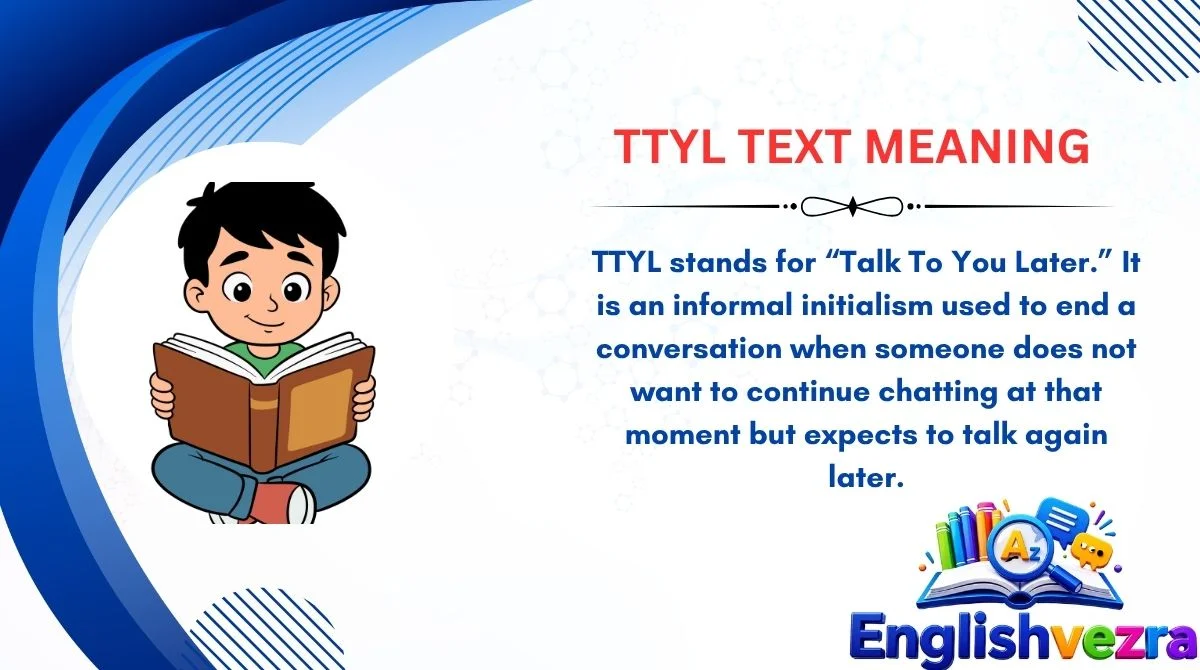
TTYL stands for “Talk To You Later.” It is an informal initialism used to end a conversation when someone does not want to continue chatting at that moment but expects to talk again later.
For example:
“I have to finish my homework. TTYL!”
The person is essentially saying, “I need to go now, but I’ll talk to you later.”
The phrase does not normally indicate a permanent goodbye. Instead, it suggests a temporary pause in communication. The exact amount of time before the next conversation is not defined. “Later” could mean later that day, the next day, or simply another time in the future.
TTYL is generally friendly and relaxed. It is commonly used between people who are comfortable communicating informally. Depending on the conversation, it can sound warm, casual, or simply practical.
For example, a friend might say:
“My battery is almost dead. TTYL!”
Someone might also use it after making plans:
“I’ll let you know when I get home. TTYL.”
The abbreviation is usually written in capital letters as TTYL, although lowercase ttyl is also extremely common in modern messaging.
It is important to understand that TTYL does not automatically communicate a strong emotional message. If someone sends “TTYL,” the safest interpretation is simply that they are ending the current conversation and intend to communicate again later.
Its meaning can still depend slightly on context. A close friend might use it casually, while someone you have just met may use it as a straightforward way to end a chat.
Background
TTYL developed from the longer phrase “talk to you later.” Like many internet and texting abbreviations, it became useful because people wanted shorter ways to communicate while typing messages.
The exact individual origin of the abbreviation is not something that should be treated as a single confirmed invention. However, its development fits the broader history of abbreviated language used in digital communication, where longer phrases are reduced to their initial letters.
Similar abbreviations became widespread as online chatting, instant messaging, texting, and social media grew. Instead of typing an entire phrase, users could write a few letters that were easily understood by other people familiar with online slang.
TTYL follows a simple pattern:
- T = Talk
- T = To
- Y = You
- L = Later
Its usefulness comes from its simplicity. Four letters can communicate the same basic idea as a four-word phrase.
The abbreviation also became part of the informal language associated with texting and internet culture. Unlike highly technical abbreviations, TTYL does not require specialist knowledge. It is primarily a conversational expression.
Today, people can use it on smartphones, computers, social networks, messaging services, and other digital platforms. Some users write TTYL, while others prefer ttyl because lowercase typing is common in casual messages.
The expression has remained understandable even as communication platforms have changed. Its basic purpose is still the same: letting another person know that the current conversation is ending for now and that communication may continue later.
Usage in Different Contexts
In Chat
In private chats, TTYL usually means that the person is leaving the conversation temporarily.
“I need to go eat dinner. TTYL!”
It can be used without any negative meaning.
On Social Media
On social platforms, TTYL may appear in direct messages, comments, or casual conversations. Its meaning remains “talk to you later.”
“I’m heading out now, ttyl!”
The lowercase form is particularly natural in informal online communication.
In Professional Fields
TTYL is generally not considered formal business language. In a professional email, report, official message, or formal workplace communication, writing “I’ll speak with you later” or “I’ll contact you later” is usually clearer and more appropriate.
However, coworkers who already communicate casually may use TTYL in informal workplace chats.
In Casual Conversations
Casual conversations are where TTYL fits most naturally. Friends, relatives, classmates, gaming partners, and online acquaintances may use it when leaving a conversation.
For example:
“I have class now, TTYL.”
The tone is usually relaxed rather than formal.
Meaning in Chat, WhatsApp, Instagram, and TikTok
On messaging and social media platforms, TTYL generally keeps the same meaning: “talk to you later.”
On WhatsApp, someone might write:
“I’m going to sleep now, ttyl.”
On Instagram, it could appear in a direct message:
“Gotta finish some work. TTYL!”
On TikTok, users may use TTYL in comments or direct messages when ending a conversation.
The platform does not normally change the basic definition. What changes is the surrounding context.
For example, compare these messages:
“Okay, ttyl ❤️”
and:
“Busy right now, ttyl.”
Both communicate that the conversation is ending temporarily, but the first may feel warmer because of the heart emoji and surrounding wording.
The relationship between the people also matters. A close friend using TTYL may simply be saying goodbye for now. Someone you have recently started talking to might use it more neutrally.
It is also common to see variations in capitalization:
- TTYL
- ttyl
- Ttyl
These normally carry the same meaning.
A person may also add punctuation or emojis:
“TTYL 😊”
“ttyl!”
“Okay, ttyl.”
These additions can influence the tone without changing the abbreviation’s basic meaning.
Meaning in Physics, Medical, and Aircraft Terminology
TTYL is primarily a texting and informal communication abbreviation, rather than a standard technical term.
Physics
TTYL does not have a commonly recognized standard meaning in mainstream physics terminology. If you encounter these letters in a physics-related document, their meaning would need to be determined from that specific context rather than automatically interpreting them as “talk to you later.”
Medical Terminology
TTYL is not a standard medical abbreviation for a commonly recognized diagnosis, treatment, body part, or medical procedure. Medical abbreviations can be highly context-dependent, so unfamiliar abbreviations in clinical material should not automatically be interpreted as internet slang.
Aircraft or Aviation
TTYL is not a standard aviation communication term meaning “talk to you later.” Aviation has specialized terminology and standardized communication procedures, so an abbreviation encountered in an aviation document should be interpreted according to that specific document or system.
In ordinary texting, however, TTYL means “talk to you later.”
Common Misconceptions
One common misunderstanding is thinking that TTYL means someone does not want to talk anymore. Usually, it means the opposite: the person is ending the current conversation while leaving the possibility of talking again later.
Another misconception is that TTYL always means the person will return within a specific amount of time. It does not. “Later” is intentionally vague.
Someone might say:
“TTYL tonight.”
This gives a more specific timeframe, but TTYL by itself does not.
People may also mistake TTYL for a formal expression. It is generally informal and works best in casual digital communication.
Another misunderstanding involves tone. TTYL is not automatically rude, cold, romantic, or emotional. The surrounding message provides more information about the person’s intended tone.
For example:
“Sorry, I have to go. TTYL!”
sounds different from:
“Fine. TTYL.”
The abbreviation itself has not changed, but the surrounding wording can affect how the message feels.
Finally, capitalization does not usually create a different definition. TTYL and ttyl generally mean the same thing.
Similar Terms & Alternatives
Several expressions can serve a similar purpose in casual communication.
BRB
BRB means “Be Right Back.” It usually suggests that the person expects to return shortly.
GTG
GTG commonly means “Got To Go.” It focuses on the person’s need to leave.
BBL
BBL means “Be Back Later.” Like TTYL, it indicates that the person is leaving and expects to return later.
CU Later
“See you later” has a similar conversational purpose but is written as a phrase rather than an initialism.
Talk Later
“Talk later” is the direct, non-abbreviated alternative to TTYL.
Goodbye
“Goodbye” can signal the end of a conversation without necessarily suggesting another conversation soon. TTYL usually has a more temporary feel.
How to Respond to It
When someone sends you TTYL, you do not need to provide a complicated response. A short, friendly reply is usually enough.
You could say:
“Sure, ttyl!”
Or:
“Okay, talk later!”
If you are close to the person, you might respond more casually:
“Yep, catch you later!”
If the conversation involves plans, you can acknowledge them:
“Sounds good. Message me when you’re free.”
You can also simply respond with:
“Bye!”
The best response depends on your relationship and the conversation. If someone is clearly busy, there is usually no need to keep the conversation going.
If you want to continue talking later, you can also say:
“Sure, talk to you later 😊”
The important point is that TTYL normally signals a pause or ending of the current conversation, not necessarily the end of your relationship or communication.
Differences from Similar Words
| Term | Meaning | Typical Tone |
|---|---|---|
| TTYL | Talk to you later | Casual |
| BRB | Be right back | Casual, temporary pause |
| GTG | Got to go | Direct and casual |
| BBL | Be back later | Casual |
| Goodbye | Ending a conversation | Neutral to formal |
| See you later | Talk/meet again later | Friendly |
| Talk later | Continue the conversation later | Casual |
The biggest difference is the situation each expression emphasizes.
TTYL focuses on talking again later. BRB focuses more strongly on returning after a short absence. GTG emphasizes that the person needs to leave. Goodbye is more general and does not necessarily promise another conversation.
Relevance in Online Conversations & Dating Apps
TTYL can appear naturally in online conversations, including conversations between people who have met through social media or dating apps.
For example, someone chatting on a dating app might say:
“I have an early morning tomorrow, ttyl!”
This generally means they are ending the conversation for now.
Context is particularly important in dating conversations. TTYL by itself does not prove that someone is interested, uninterested, excited, annoyed, or romantically attracted. It simply communicates that the current conversation is ending and suggests talking again later.
The surrounding conversation provides more clues. For example:
“I’ve really enjoyed talking to you. TTYL 😊”
has a different overall tone from:
“I’m busy. TTYL.”
The abbreviation remains the same, but the additional wording changes the impression.
On social media, TTYL may also be used between friends, followers, gaming partners, or online communities. Its meaning remains largely consistent across these situations.
When interpreting a short message, it is better to consider the complete conversation instead of assigning a strong emotional meaning to four letters.
FAQs
What does TTYL mean in text?
TTYL means “talk to you later.” It is a casual texting abbreviation used when someone is ending a conversation temporarily. The expression normally suggests that the person expects to communicate with you again at some point, although it does not specify exactly when.
What does TTYL mean in chat?
In chat, TTYL means “talk to you later.” Someone may use it when they need to leave the conversation because they are busy, going somewhere, going to sleep, or simply finished chatting for the moment. It is generally informal and friendly.
Is TTYL a slang term?
TTYL is commonly considered an informal texting abbreviation or internet slang expression. It comes from the phrase “talk to you later” and is widely understood in casual digital communication. It is generally better suited to texts, DMs, and casual chats than formal emails or professional documents.
How do you respond to TTYL?
You can respond to TTYL with something simple such as “Sure, talk later!”, “Okay, ttyl!”, or “Catch you later!” If the person is busy, you can also simply acknowledge their message. Your response can be casual, friendly, or brief depending on your relationship.
What does TTYL mean on social media?
On social media, TTYL normally means “talk to you later.” It can appear in direct messages, comments, or casual conversations. The platform does not usually change its definition. However, emojis and surrounding words can make the message sound warmer, more casual, or more neutral.
Can TTYL have different meanings?
In ordinary texting, TTYL overwhelmingly means “talk to you later.” It is not normally treated as an abbreviation with multiple common slang meanings. If you encounter TTYL in a specialized document, however, you should check the surrounding context because technical abbreviations can vary between fields.
Is TTYL appropriate in professional messages?
TTYL can be understood in professional messaging, but it is generally informal. For formal emails, reports, or communication with someone you do not know well, phrases such as “I’ll speak with you later” or “I’ll contact you later” are usually clearer and more appropriate.
Does TTYL mean someone is ignoring you?
No, TTYL does not inherently mean someone is ignoring you. It normally means they are ending the current conversation and intend to talk later. The person’s actual intentions depend on the broader situation and their subsequent communication, so the abbreviation alone should not be treated as a definite emotional signal.
Conclusion
TTYL is a simple and widely used abbreviation meaning “talk to you later.” It is most commonly found in casual text messages, online chats, social media conversations, and direct messages.
The expression usually indicates that someone is leaving the current conversation temporarily while suggesting that communication can continue later.
Unlike formal communication, texting often relies on short expressions such as TTYL, BRB, GTG, and BBL to make conversations faster and more relaxed.
TTYL is generally friendly and informal, but its exact tone can depend on the surrounding message, relationship, and situation.
It is also important not to assign specialized meanings to TTYL in physics, medicine, or aviation without specific evidence from the relevant context. In everyday digital communication, though, its meaning is straightforward.
When you see TTYL, the natural interpretation is that the person is saying goodbye for now and expects to talk with you later.

Samuel Hartwell is an English language educator and word enthusiast who enjoys explaining meanings in simple, clear ways. He creates helpful content to make English vocabulary easier to understand and learn.