When someone sends a short abbreviation like “FWB” in a text message, it can be confusing if you do not already know the slang.
Unlike ordinary texting shortcuts such as “LOL” or “BRB,” FWB is usually connected to relationships, dating, and personal boundaries.
You may see it in private messages, dating profiles, social media comments, or conversations between people who are discussing their relationship.
The meaning can also depend on the conversation. In most casual texting situations, FWB stands for “friends with benefits.” It describes two people who maintain a friendship while also having a sexual relationship, without necessarily considering themselves a committed romantic couple.
People commonly search for this abbreviation because they receive it in a message, see it on a dating app, or encounter it in online discussions. Understanding the term helps you interpret the conversation correctly and respond according to the context.
Quick Answer
What does FWB mean in text? FWB usually means “friends with benefits.” It describes two people who are friends and also have a sexual relationship without necessarily being in a committed romantic relationship. The exact expectations can vary, so context and communication are important when someone uses FWB in a message.
Meaning & Definition
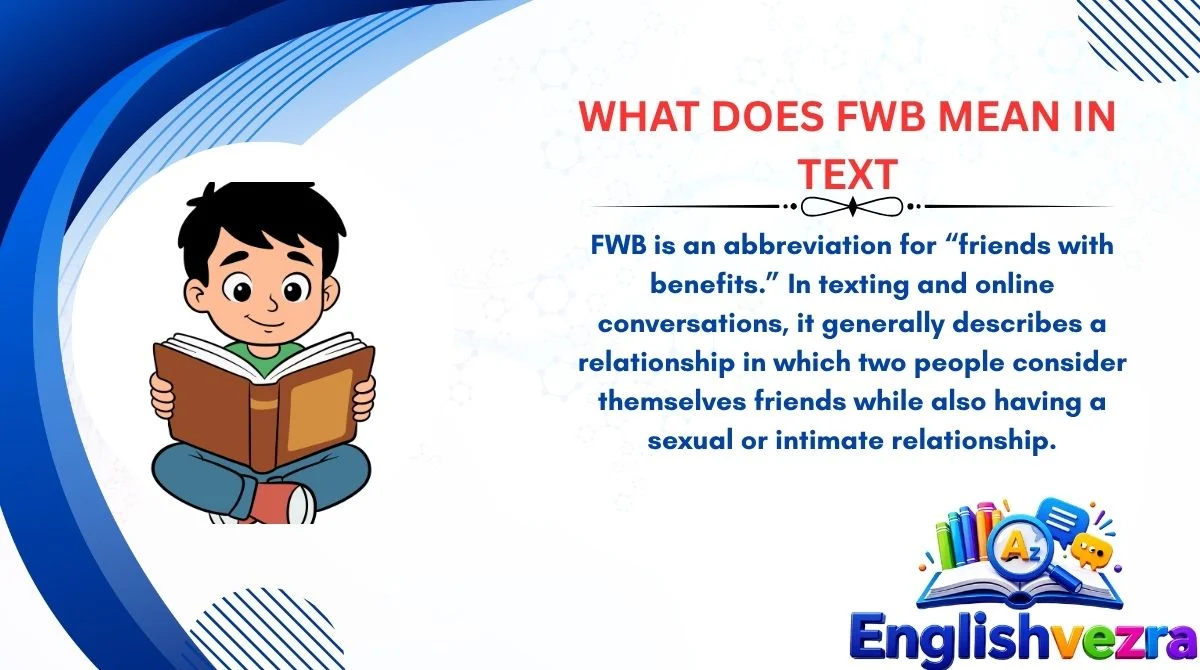
FWB is an abbreviation for “friends with benefits.” In texting and online conversations, it generally describes a relationship in which two people consider themselves friends while also having a sexual or intimate relationship.
The important part of the expression is that the people involved are usually not describing themselves as a traditional romantic couple. They may spend time together, talk regularly, socialize, or support each other as friends, while also having an intimate relationship.
However, FWB does not automatically describe the same arrangement for everyone. Some people may use the term to mean a casual sexual relationship between friends, while others may use it for an arrangement with clearly defined boundaries and limited emotional involvement.
For example, someone might text:
“We’re not dating. We’re just FWB.”
Here, the person is explaining that the relationship includes intimacy but is not being presented as a conventional dating relationship.
Another person might say:
“I’m looking for an FWB situation.”
In this context, they are usually saying that they want a casual arrangement involving friendship and intimacy rather than a traditional committed relationship.
It is also important to understand that FWB does not necessarily mean there are no feelings involved. People can develop emotional connections in casual relationships, and the boundaries of an FWB arrangement can change over time.
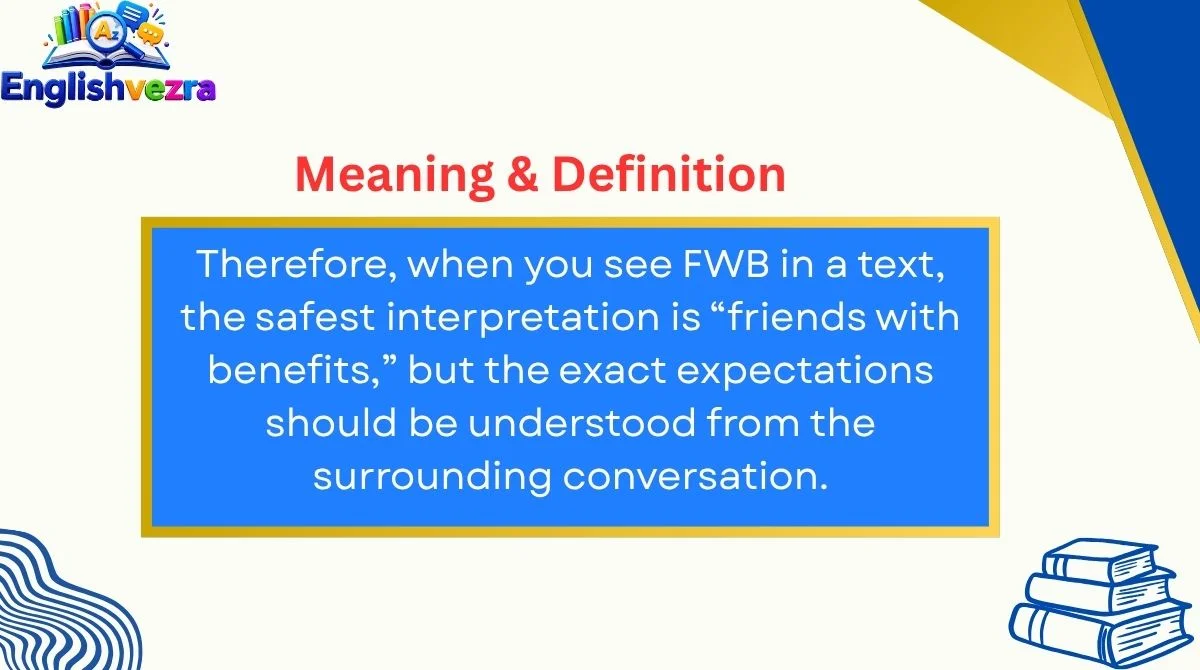
Therefore, when you see FWB in a text, the safest interpretation is “friends with benefits,” but the exact expectations should be understood from the surrounding conversation.
Background
The phrase “friends with benefits” became widely recognized as a description of casual relationships, particularly as modern dating culture and online communication developed. The exact origin of the expression is difficult to attribute to one specific person or moment.
The abbreviation FWB developed naturally from the first letters of the phrase. As texting, internet forums, social networking, and dating platforms became more common, abbreviations became an easy way to communicate longer expressions quickly.
FWB is part of a larger group of relationship and dating terminology that became increasingly common in online conversations. People often shorten phrases because messaging encourages quick, informal communication.
Unlike technical abbreviations with a clearly documented creator or official definition, FWB is primarily an informal expression. Its meaning comes from common social usage rather than from an official organization.
The popularity of dating apps and social media has also made relationship terminology more visible. Someone might use FWB in a dating profile, private message, discussion forum, or casual conversation to describe the type of relationship they are interested in.
The phrase does not necessarily communicate every detail of an arrangement. For example, FWB does not automatically tell you whether the people involved are exclusive, whether they have romantic feelings, or what boundaries they have established.
Those details depend on the individuals involved.
So, while the basic meaning of FWB is widely understood, the actual relationship represented by the term can vary significantly from one situation to another.
Usage in Different Contexts
The meaning of FWB is relatively consistent in casual communication, but the way people use it can differ depending on the situation.
In Chat
In private messages, FWB usually refers to a casual relationship involving friendship and sexual intimacy.
For example:
“Are you two dating?”
“No, we’re FWB.”
The abbreviation allows the person to explain the relationship quickly without writing the entire phrase.
On Social Media
FWB can appear in comments, posts, captions, or discussions about dating and relationships. Someone might use it when talking about their relationship status or explaining a situation involving another person.
Because social media conversations are often informal, FWB is usually understood as slang rather than formal language.
In Professional Fields
FWB is not generally used as a standard professional relationship term. If you encounter the letters FWB in a workplace, academic paper, or technical document, you should not automatically assume that they mean “friends with benefits.”
Professional and technical abbreviations can have completely different meanings depending on the field.
In Casual Conversations
Among friends, FWB is commonly used when discussing dating, relationships, or casual intimacy. The abbreviation can make the conversation shorter and less direct than spelling out the entire phrase.
Because the subject can be personal, some people may prefer using FWB rather than explicitly describing the relationship.
Meaning in Chat, WhatsApp, Instagram, and TikTok
On messaging and social media platforms, FWB generally keeps its common meaning: friends with benefits.
On WhatsApp, someone might write:
“Would you be okay with being FWB?”
The person is usually asking whether the other person would consider a friendship that also includes sexual intimacy.
On Instagram, the term may appear in direct messages, comments, dating-related content, or discussions about relationship situations.
On TikTok, FWB may appear in captions, comments, relationship stories, jokes, or videos discussing dating experiences.
The platform itself normally does not change the meaning. What matters more is the surrounding conversation.
For example:
Person A: “Are you guys together?”
Person B: “No, we’re FWB.”
This clearly uses FWB as “friends with benefits.”
However, abbreviations can occasionally have different meanings in specialized communities. If someone uses FWB in a conversation that has nothing to do with relationships, it is better to examine the surrounding messages before assuming what they mean.
Also, receiving FWB does not necessarily mean the sender is making a romantic proposal. They could simply be explaining their current relationship status, discussing another person, or talking about dating terminology.
Context matters.
Meaning in Physics, Medical, and Aircraft Terminology
FWB is primarily recognized in everyday relationship and internet slang, but the same three letters can appear in specialized contexts.
Physics
FWB is not a standard, universally recognized physics abbreviation with one commonly accepted meaning. If you encounter FWB in a physics document, its meaning would need to be determined from the specific subject, textbook, paper, or notation being used.
Therefore, it should not automatically be interpreted as “friends with benefits” in a scientific context.
Medical Terminology
In medical settings, FWB can mean “full weight bearing.” This is used particularly in orthopedic, rehabilitation, and physical therapy contexts to describe a situation where a person is permitted to put their full body weight through a limb, subject to the instructions of their healthcare professional.
This is completely different from the texting meaning.
For example, a medical note might use FWB in a mobility or rehabilitation context. There, the surrounding medical information makes the intended meaning clear.
Aircraft or Aviation Terminology
FWB does not have one universally standard aviation meaning that should automatically be assumed whenever the abbreviation appears.
Aviation uses many specialized abbreviations, and meanings can depend on the organization, document, aircraft system, or operational context. If you see FWB in an aviation document, the surrounding terminology or the document’s abbreviation list should be checked rather than assuming it means “friends with benefits.”
This is a good example of why abbreviations should always be interpreted according to context.
Common Misconceptions
One common misconception is that FWB always means two people have no feelings for each other. That is not necessarily true. The abbreviation describes the general type of relationship, but it does not determine how either person feels emotionally.
Another misunderstanding is assuming that FWB automatically means the relationship is exclusive. It does not establish exclusivity by itself. Different people can have different expectations about whether they see other people.
Some people also assume that FWB is exactly the same as dating. Generally, the term is used specifically to distinguish a casual arrangement from a conventional romantic relationship.
Another mistake is assuming that FWB has only one meaning everywhere. In texting and dating conversations, “friends with benefits” is the common interpretation. In medical contexts, however, FWB can mean “full weight bearing.”
The safest approach is to look at the conversation surrounding the abbreviation.
If someone sends only “FWB” without any explanation, the meaning may be obvious from previous messages, but if the context is unclear, asking for clarification is perfectly reasonable.
Similar Terms & Alternatives
Several terms can appear in conversations about dating and casual relationships.
Friends With Benefits (FWB)
This describes a friendship that also involves sexual intimacy without necessarily being a committed romantic relationship.
Casual Dating
Casual dating generally means seeing someone without necessarily having a serious or committed relationship. It does not necessarily imply a sexual relationship.
Hookup
“Hookup” is an informal expression that can refer to a sexual encounter or casual sexual relationship. Its exact meaning can vary depending on the speaker.
Situationship
A situationship usually describes a relationship that has romantic or emotional elements but does not have a clearly defined status or commitment.
Dating
Dating generally refers to spending time with someone with romantic interest. It can eventually develop into a committed relationship, although dating itself does not guarantee commitment.
These terms overlap, but they are not interchangeable. FWB specifically emphasizes the combination of friendship and benefits, while the other expressions can describe different relationship arrangements.
How to Respond to It
Your response to FWB depends on why the person used it and how you feel about the situation.
If someone asks:
“Would you be interested in being FWB?”
and you are interested, you could respond:
“I might be open to it. What exactly are you looking for?”
If you are unsure:
“What do you mean by FWB in this situation?”
If you are not interested:
“Thanks for being honest, but I’m looking for something different.”
If someone simply tells you:
“We’re FWB.”
you could respond:
“Got it. Thanks for explaining.”
Or, if you want clarification:
“So you mean friends with benefits?”
There is no single correct response. The best response depends on your relationship with the person, your boundaries, and what you want from the conversation.
Differences from Similar Words
FWB and dating are not necessarily the same thing. Dating usually involves romantic interest and may lead toward a committed relationship, while FWB generally emphasizes friendship combined with sexual intimacy without necessarily defining the relationship as romantic.
FWB is also different from a situationship. A situationship often involves unclear romantic expectations, whereas FWB usually communicates a more specific type of casual arrangement.
FWB and hookup are also not identical. A hookup may refer to a single sexual encounter or a casual sexual interaction, while FWB generally implies an ongoing connection between people who are also friends.
The biggest difference is therefore relationship structure and expectation.
The abbreviation itself does not tell you every rule of the relationship. People may have different boundaries concerning exclusivity, communication, emotional involvement, and whether the arrangement could eventually become romantic.
Relevance in Online Conversations & Dating Apps
FWB is particularly common in online dating and relationship conversations because people often want to communicate their relationship preferences quickly.
A person might mention FWB in a dating profile or private conversation to indicate that they are interested in a casual arrangement rather than a traditional committed relationship.
For example:
“I’m not looking for a serious relationship right now. I’m open to FWB.”
Here, the person is clearly communicating a preference for a casual arrangement.
The term can also appear when people explain their current relationship status:
“My ex and I are no longer dating, but we’re FWB.”
In that situation, the phrase communicates that the relationship has changed from dating to a different type of arrangement.
However, online communication can create misunderstandings because people may have different definitions of casual relationships. One person may use FWB to describe a friendship with occasional intimacy, while another may expect regular contact and a closer emotional connection.
For that reason, the abbreviation should not be treated as a complete explanation of someone’s expectations.
If the term comes up in a dating conversation, clear communication about boundaries, expectations, consent, and relationship status is more useful than relying on the abbreviation alone.
FAQs
What does FWB mean in text?
FWB usually means “friends with benefits” in text messages. It describes two people who are friends and also have a sexual relationship without necessarily considering themselves a committed romantic couple. The exact arrangement can vary between people, so the surrounding conversation is important when understanding what someone specifically means.
What does FWB mean in chat?
In chat, FWB generally means “friends with benefits.” Someone may use it when discussing a casual relationship that combines friendship with sexual intimacy. For example, if someone says, “We’re not dating, we’re FWB,” they are usually explaining that their relationship is casual rather than a traditional romantic partnership.
Is FWB a slang term?
Yes, FWB is generally considered an informal slang abbreviation for “friends with benefits.” It is commonly used in texting, online conversations, social media, and dating discussions. It is not normally used as formal relationship terminology in professional writing.
What does FWB mean on social media?
On social media, FWB usually means “friends with benefits.” It can appear in posts, comments, captions, or private messages about dating and casual relationships. The platform itself normally does not change the meaning, although the surrounding conversation should always be considered before interpreting an abbreviation.
How do you respond when someone says FWB?
You can respond according to the context and your own boundaries. If you are interested, you can ask what the person means or expects. If you are unsure, ask for clarification. If you are not interested, a simple response such as “I’m looking for something different” can communicate your position clearly.
Can FWB have different meanings?
Yes, FWB can have different meanings in specialized contexts. In casual texting, it usually means “friends with benefits.” In medical terminology, FWB can also mean “full weight bearing.” The correct interpretation depends on the subject and surrounding words.
Does FWB mean you are dating?
Not necessarily. FWB usually distinguishes a casual friendship-and-intimacy arrangement from conventional dating. However, individual relationships can have different boundaries and expectations. Someone using FWB may still have emotional feelings or spend significant time with the other person, so the abbreviation alone does not describe every aspect of the relationship.
What does FWB mean on a dating app?
On a dating app, FWB usually indicates that someone is interested in a friends-with-benefits arrangement rather than necessarily seeking a traditional committed relationship. Because dating preferences vary, it is useful to clarify what the person means by FWB before making assumptions about exclusivity, emotions, or expectations.
Conclusion
FWB most commonly means “friends with benefits” when it appears in texting, social media, online conversations, or dating discussions.
It generally describes two people who maintain a friendship while also having a sexual relationship without necessarily defining themselves as a committed romantic couple.
The abbreviation is useful because it communicates a relatively long phrase in just three letters, making it common in informal digital communication.
However, FWB does not establish every detail of a relationship. People can have different expectations regarding commitment, exclusivity, communication, and emotional involvement.
Context is especially important because FWB can have another meaning in specialized settings. In medical terminology, for example, it can mean “full weight bearing.”
So, when you see FWB in a message, look at the surrounding conversation before deciding what it means. In most dating or casual texting situations, “friends with benefits” is the intended interpretation, but asking for clarification is always appropriate when the context is unclear.

Samuel Hartwell is an English language educator and word enthusiast who enjoys explaining meanings in simple, clear ways. He creates helpful content to make English vocabulary easier to understand and learn.