Have you ever received the 🥸 emoji in a text message and wondered what the sender was trying to say? At first glance, this unusual face looks like someone wearing glasses, a fake nose, and a mustache.
However, its meaning goes beyond a funny disguise. People use it to express secrecy, playful deception, hidden identity, awkward humor, or pretending to be someone else.
The 🥸 emoji appears frequently in WhatsApp chats, Instagram comments, TikTok captions, Snapchat messages, and casual online conversations. Sometimes it suggests that someone is hiding something, while other times it adds humor to a joke or an embarrassing situation.
Understanding what does 🥸 mean in text can help you recognize the emotion behind a message.
Whether someone sends it while flirting, making a joke, or sharing a secret, the meaning depends on the surrounding words, the sender’s tone, and your relationship with that person.
Quick Answer
The 🥸 emoji means disguise, hidden identity, or pretending to be someone else. If you’re wondering what does 🥸 mean in text, people commonly use it to suggest secrecy, playful deception, embarrassment, or jokingly acting innocent. It can also express sarcasm or humor. Its exact meaning depends on the conversation.
Meaning & Definition of the 🥸 Emoji
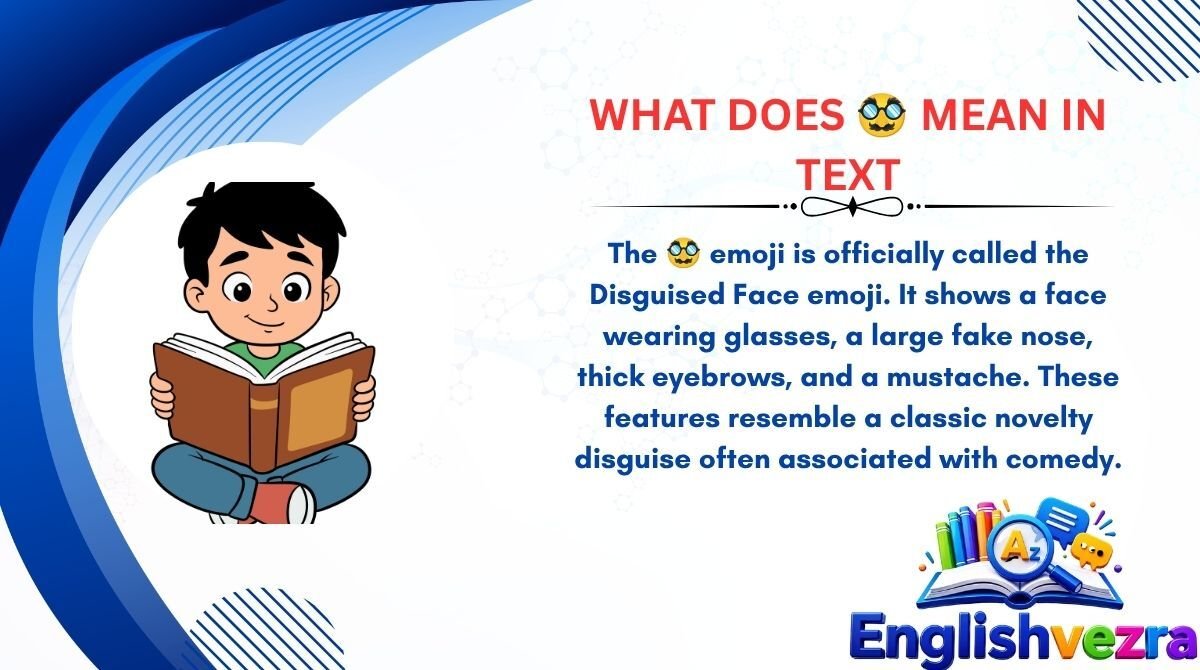
The 🥸 emoji is officially called the Disguised Face emoji. It shows a face wearing glasses, a large fake nose, thick eyebrows, and a mustache. These features resemble a classic novelty disguise often associated with comedy.
Its central meaning is disguise or pretending to be someone else. However, people use it in several creative ways in everyday texting.
1. Hiding Your Identity
Someone may use 🥸 when joking about staying anonymous or avoiding recognition.
Example:
“Nobody will recognize me at the party 🥸”
The emoji suggests that the sender is pretending to hide their identity.
2. Acting Innocent
People sometimes use this emoji when they have done something mischievous but want to pretend they know nothing about it.
Example:
“Who ate the last cookie? Definitely not me 🥸”
The emoji makes the denial sound playful and suspicious.
3. Keeping a Secret
The disguised face can suggest that someone knows something but does not want to reveal it.
Example:
“I might know who your secret admirer is 🥸”
Here, the sender hints at hidden information.
4. Sarcasm and Awkward Humor
The emoji can also accompany an obviously false statement or an awkward joke.
Example:
“Yes, I totally finished my homework three days early 🥸”
The disguised face suggests the speaker may not be telling the truth.
5. Pretending to Be Someone Else
In online conversations, 🥸 can represent role-playing, impersonation jokes, or acting differently from your usual personality.
Although the emoji has several interpretations, pretending, disguise, and playful secrecy connect most of its everyday uses.
It is not automatically negative. Most people use it for lighthearted humor rather than serious dishonesty.
Background and Origin of the Disguised Face Emoji
The 🥸 emoji became part of the Unicode emoji collection in 2020, when it was introduced with Unicode 13.0 and Emoji 13.0.
Its official name is Disguised Face.
The design draws on a familiar comedy disguise consisting of oversized glasses, a fake nose, eyebrows, and a mustache. Similar disguises have appeared in novelty costumes, theatrical comedy, cartoons, and humorous entertainment for many years.
The emoji does not represent a specific person or character. Instead, it communicates the broader idea of changing one’s appearance to avoid recognition.
How Its Meaning Developed Online
When the emoji became available on smartphones and messaging platforms, people began using it beyond its literal meaning.
Instead of referring only to costumes, users started adding it to messages about secrets, suspicious behavior, embarrassing moments, and playful lies.
For example:
“I accidentally liked their photo from 2018 🥸”
In this situation, the sender is not actually wearing a disguise. The emoji expresses embarrassment and the desire to disappear or avoid being noticed.
This type of creative usage is common with emojis. A picture originally designed to represent one idea can develop several related meanings through everyday communication.
Why People Like Using It
The disguised face stands out because it looks unusual compared with standard smiling or laughing emojis.
It allows someone to communicate a joke without directly explaining it.
A simple message such as “I know nothing 🥸” can immediately sound suspicious, funny, or sarcastic.
The emoji’s meaning has developed through informal online usage rather than through one official slang definition.
Usage in Different Contexts
The 🥸 emoji can communicate different feelings depending on where and how someone uses it.
In Text Messages
In personal texting, it often suggests secrecy, pretending, or playful dishonesty.
Example:
“I’m definitely not planning anything for your birthday 🥸”
The emoji hints that the sender may be hiding a surprise.
In Social Media Conversations
People use the disguised face in captions, memes, comments, and funny posts.
Example:
“Me checking their profile for the fifth time today 🥸”
This expresses humorous embarrassment about secretly looking at someone’s profile.
In Professional Communication
The emoji has no formal professional meaning.
In friendly workplace chats, someone might use it to joke about an unexpected mistake or awkward situation.
Example:
“Me pretending I understood the entire meeting 🥸”
However, it may be inappropriate in serious business emails, legal documents, or formal communication because its meaning can be ambiguous.
In Casual Conversations
Friends often use 🥸 when teasing each other or joking about suspicious behavior.
Example:
“Who told everyone about the surprise party? 🥸”
The emoji makes the conversation playful rather than necessarily accusatory.
In Gaming Communities
Players may use it when discussing disguises, secret identities, hidden strategies, or pretending to be another player.
For instance:
“They’ll never know it’s me 🥸”
The meaning depends on the game and conversation.
Across these settings, the common theme is hiding, pretending, or humorously avoiding attention.
🥸 Meaning in Chat, WhatsApp, Instagram, and TikTok
The disguised face emoji has no separate official meaning on individual social media platforms. However, the way people use it can vary.
🥸 Meaning in WhatsApp
On WhatsApp, 🥸 often suggests someone is joking, hiding a secret, or pretending to be innocent.
Example:
“Don’t ask me who broke the vase 🥸”
The sender may be humorously implying responsibility.
It can also appear in conversations about surprise parties, private jokes, or unexpected situations.
🥸 Meaning on Instagram
Instagram users may add 🥸 to captions or comments when discussing anonymous viewing, embarrassing interactions, or secretly admiring someone.
Example:
“Just casually watching every story they post 🥸”
The emoji suggests playful embarrassment or an attempt to remain unnoticed.
🥸 Meaning on TikTok
On TikTok, the emoji can appear in videos about awkward experiences, pretending to be innocent, or behaving differently around certain people.
Example:
“Me acting normal after saying something embarrassing 🥸”
Here, the emoji adds a layer of self-aware humor.
🥸 Meaning on Snapchat
On Snapchat, people may use it while sharing private jokes, disguises, or funny selfies.
Example:
“You didn’t see me online last night 🥸”
The emoji suggests a joking attempt to deny something.
Does the Meaning Change by Platform?
Not fundamentally.
Whether someone uses 🥸 on WhatsApp, Instagram, TikTok, or Snapchat, its main themes remain disguise, secrecy, pretending, and playful humor.
The surrounding message determines whether the sender is being sarcastic, embarrassed, flirtatious, or simply funny.
Meaning in Physics, Medical, and Aircraft Terminology
Although 🥸 appears in many online conversations, it does not have a recognized technical definition in most scientific or professional fields.
Meaning in Physics
The 🥸 emoji is not a standard physics symbol.
It does not represent an established physical quantity, scientific equation, measurement unit, or mathematical operation.
Someone discussing physics might use it humorously, but that would be an informal personal choice rather than a recognized scientific meaning.
Meaning in Medical Terminology
The disguised face emoji is not an official medical term or diagnostic symbol.
It does not identify a disease, treatment, medical condition, or clinical procedure.
A healthcare professional might use it informally in a personal message, but it should not be interpreted as medical terminology.
Meaning in Aircraft and Aviation
The 🥸 emoji has no standard technical meaning in aviation.
It is not an established aircraft warning symbol, navigation code, or aviation abbreviation.
If it appears in an aviation-related chat, it is most likely being used for humor or personal expression.
Therefore, the emoji should be understood as a communication symbol rather than a technical term.
Common Misconceptions About 🥸
People sometimes misunderstand the disguised face emoji because its appearance is unusual.
Misconception 1: It Always Means Someone Is Lying
The emoji can suggest pretending or playful dishonesty, but it does not automatically mean the sender is seriously lying.
Someone might use it simply because they are joking.
Misconception 2: It Is Always About Spying
The glasses and fake mustache can create a mysterious appearance, but 🥸 is not specifically a spy emoji.
It may suggest secrecy, but its meaning is broader.
Misconception 3: It Means Someone Is Angry
The disguised face does not normally express anger.
Its expression is more closely connected with disguise, awkwardness, and humor.
Misconception 4: It Always Means Flirting
Some people use 🥸 in romantic conversations, but the emoji is not inherently romantic.
It can appear in ordinary jokes between friends or family members.
Misconception 5: It Has a Secret Universal Code
There is no single hidden slang definition that applies to every use.
The emoji’s meaning develops from the surrounding words and situation.
Misconception 6: It Means the Same Thing as 🤓
Although both emojis feature glasses, they communicate different ideas.
The 🤓 emoji is associated with a nerdy or studious appearance, while 🥸 represents disguise and pretending.
Understanding these differences helps prevent unnecessary confusion in online conversations.
Similar Emojis and Alternatives
Several emojis communicate ideas related to secrecy, humor, or unusual behavior.
- 🤫 Shushing Face: Suggests silence, secrecy, or keeping information private.
- 🤥 Lying Face: More directly suggests dishonesty or telling a lie.
- 🫣 Face with Peeking Eye: Often expresses embarrassment, nervous curiosity, or wanting to look while hiding.
- 🕵️ Detective: Represents investigation, detective work, or searching for clues.
- 🤓 Nerd Face: Commonly associated with studying, intelligence, or nerdy humor.
- 😏 Smirking Face: Can express confidence, teasing, or suggestive humor.
- 👀 Eyes: Often means watching, noticing something, or showing curiosity.
- 🙈 See-No-Evil Monkey: Frequently expresses embarrassment, shyness, or playful avoidance.
Although these emojis sometimes overlap in online conversations, each has a different central meaning.
For example, 🤫 focuses on keeping quiet, while 🥸 focuses on disguise or pretending.
Similarly, 🤥 directly suggests lying, whereas 🥸 may simply make an innocent joke sound suspicious.
How to Respond to the 🥸 Emoji
Your response should match the tone of the message.
If someone uses 🥸 while joking, you can respond playfully.
Example:
Friend: “I definitely didn’t eat your pizza 🥸”
You: “Sure, very believable 😂”
If someone appears to be hiding a surprise, you might respond:
“Okay, now I’m suspicious 👀”
If the emoji follows an embarrassing confession, a supportive reply may be more appropriate.
Example:
Friend: “I waved at someone who wasn’t waving at me 🥸”
You: “We’ve all done that 😂”
If you are unsure what the sender means, you can ask directly:
“What does the disguise mean? 😂”
You can also respond using another emoji.
For instance, 👀 can communicate curiosity, while 🤫 can suggest that you understand the secret.
The main goal is to recognize whether the sender is joking, teasing, hiding something, or expressing embarrassment.
There is no required response to 🥸. Sometimes a simple laugh or short message is enough.
Differences Between 🥸 and Similar Emojis
| Emoji | Common Meaning | Typical Tone |
|---|---|---|
| 🥸 | Disguise, pretending, hidden identity | Playful, secretive |
| 🤫 | Keep quiet, don’t tell anyone | Secretive |
| 🤥 | Lying or dishonesty | Teasing, suspicious |
| 🫣 | Embarrassment, nervous curiosity | Shy, awkward |
| 🕵️ | Investigation or detective work | Curious, mysterious |
| 🤓 | Nerdy or studious behavior | Funny, self-aware |
| 😏 | Smugness, teasing, possible flirting | Confident, suggestive |
| 👀 | Watching, curiosity, attention | Curious, playful |
🥸 vs. 🤫
The disguised face suggests hiding your identity or pretending. The shushing face focuses on keeping information secret.
🥸 vs. 🤥
The lying face directly represents dishonesty. The disguised face can imply playful deception without necessarily accusing anyone of lying.
🥸 vs. 🤓
The nerd face is associated with a studious or nerdy personality. The disguised face represents concealment or acting like someone else.
🥸 vs. 🫣
The peeking face expresses nervous curiosity or embarrassment. The disguised face suggests pretending or trying not to be recognized.
These distinctions can help you choose the emoji that best matches your intended message.
Relevance in Online Conversations and Dating Apps
The 🥸 emoji can add humor, mystery, or playful teasing to online conversations.
On dating apps such as Tinder, Bumble, or Hinge, someone might use it when making a joke about secretly admiring another person or trying to hide their interest.
Example:
“Me pretending I wasn’t waiting for your reply 🥸”
In this situation, the emoji suggests playful embarrassment and possible romantic interest.
Another example is:
“I definitely didn’t check your profile twice 🥸”
The sender may be joking about being curious or attracted to the other person.
However, 🥸 is not automatically a flirting emoji.
Its romantic meaning depends on the relationship and the surrounding message.
Among close friends, it may simply be a humorous way of pretending to be innocent.
Between two people who are flirting, it can add a playful or slightly mysterious tone.
If someone uses it after an awkward message, they may be trying to make the situation feel less serious.
The emoji can also soften teasing because it signals that the sender may not want the statement taken literally.
Still, an emoji cannot guarantee someone’s intentions. The most reliable clues are their words, previous messages, and usual communication style.
FAQs
1. What does 🥸 mean when someone sends it in a text?
The 🥸 emoji usually means disguise, pretending, or hiding something in a playful way. Someone may send it when joking about being innocent, keeping a secret, or trying not to be noticed. It can also suggest embarrassment or sarcasm. The meaning becomes clearer when you read the surrounding messages.
2. What does 🥸 mean from a girl?
When a girl sends 🥸, she may be joking, acting innocent, hiding a surprise, or expressing playful embarrassment. It can sometimes be flirtatious if the conversation is romantic, but it does not automatically indicate attraction. Her message, tone, and relationship with the recipient determine the most likely interpretation.
3. What does 🥸 mean from a guy?
When a guy sends 🥸, he may be suggesting that he is pretending, keeping something secret, or making a sarcastic joke. In a flirtatious conversation, it might express playful awkwardness or hidden interest. However, it is not a reliable sign of romantic feelings without additional context.
4. Is 🥸 a flirting emoji?
The 🥸 emoji can be used while flirting, but it is not specifically a romantic emoji. Someone might use it when pretending not to have a crush or joking about checking another person’s profile. In ordinary conversations, it more commonly communicates disguise, humor, or playful secrecy.
5. What does 🥸 mean on Instagram stories?
On Instagram stories, 🥸 often suggests playful secrecy, pretending, or humorous embarrassment. A person might use it when posting something unexpected, making a joke about their behavior, or pretending that nobody will recognize them. The story’s image, caption, and surrounding content help explain the intended meaning.
6. Does 🥸 mean someone is lying?
The 🥸 emoji can suggest playful dishonesty, but it does not necessarily mean someone is lying. People often use it when making an obviously exaggerated statement or jokingly denying something. If someone wants to communicate lying more directly, the 🤥 emoji may be a clearer choice.
7. What does 🥸 mean when used alone?
When 🥸 appears alone, it usually suggests disguise, mystery, or playful suspiciousness. The sender might be jokingly acting innocent or hinting that they know something. Without surrounding words, however, the meaning is uncertain. Looking at the previous conversation can help you understand the intended message.
8. How do you reply to 🥸 in a funny way?
You can reply to 🥸 with playful suspicion, humor, or another emoji. Responses such as “Who are you hiding from? 😂”, “Very convincing disguise 👀”, or “I know what you’re up to!” work well in casual conversations. Choose a response that fits your relationship with the sender and the original message.
Conclusion
The 🥸 emoji, officially known as the Disguised Face emoji, represents disguise, hidden identity, and pretending to be someone else. In modern texting, people also use it to express playful secrecy, sarcasm, awkward humor, embarrassment, or joking dishonesty.
You may encounter it in WhatsApp conversations, Instagram comments, TikTok captions, Snapchat messages, or dating app chats. Although its basic meaning stays consistent, the emotion behind it can change depending on the situation.
When someone sends 🥸, they may be hiding a surprise, acting innocent, making a joke, or teasing another person. It can sometimes appear in flirting, but it is not automatically a sign of romantic interest.
The best way to understand the emoji is to consider the surrounding words, previous messages, and relationship between the people involved. Once you recognize its playful nature, interpreting the disguised face becomes much easier.

Samuel Hartwell is an English language educator and word enthusiast who enjoys explaining meanings in simple, clear ways. He creates helpful content to make English vocabulary easier to understand and learn.