If you have seen someone write “mog,” “mogged,” or “mogging” in a text, comment, or social media post, you may wonder what they are talking about.
The word is especially common in online communities where people discuss appearance, confidence, competition, fashion, fitness, or social status. It can sound confusing because “mog” is not usually used like a traditional English word in everyday conversation.
Online slang often changes quickly, and a short expression can carry a very specific meaning depending on the situation.
In many modern internet conversations, “mog” is used to say that one person noticeably outshines or outclasses another person, particularly in physical appearance. However, the exact interpretation can change with context.
Understanding the surrounding conversation is therefore important. A comment about someone’s outfit may use “mog” differently from a joke between friends.
This guide explains what the term means, where it comes from, how people use it online, and how you can respond when you encounter it.
Quick Answer
What does mog mean in text?
“Mog” is internet slang meaning to noticeably outshine, outperform, or dominate someone, often in appearance or physical presence. For example, saying “He mogged everyone” usually means that person looked significantly better or stood out compared with the others. The meaning depends on the context and can sometimes be used jokingly.
Meaning & Definition
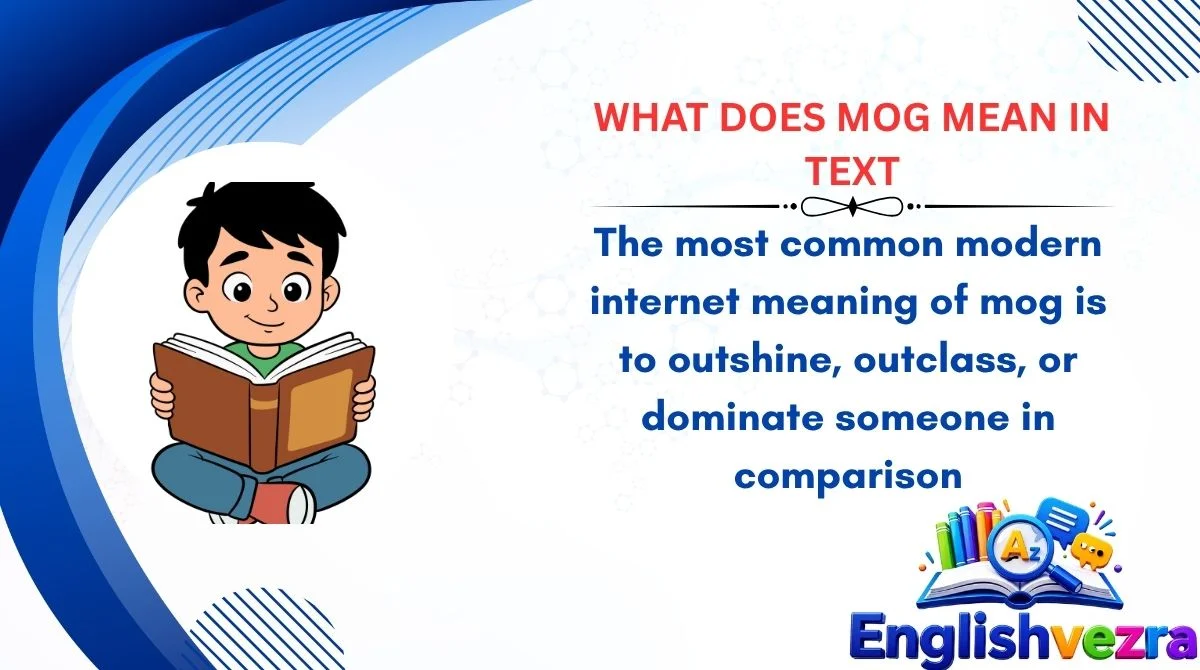
The most common modern internet meaning of mog is to outshine, outclass, or dominate someone in comparison. The comparison is often related to physical appearance, height, facial features, physique, clothing, confidence, or overall presence.
For example, if someone posts a group photo and another person comments, “He mogged everyone,” they usually mean that one person appeared noticeably more impressive than the others.
The word can also be used more broadly. Someone might say that a person “mogged” another person because they performed better, looked more confident, or simply attracted more attention. In these cases, the exact meaning comes from the surrounding conversation.
“Mog” is commonly associated with internet slang rather than formal English. It may appear as a verb, noun-like expression, or part of related forms such as mogged and mogging.
Common Forms of the Word
- Mog — to outshine or dominate someone in comparison.
- Mogged — describes someone who has been outshined or outclassed.
- Mogging — describes the act of outshining someone.
- Mogger — an informal term for someone who consistently “mogs” others.
For instance:
“That guy totally mogged me in the photo.”
This suggests that the speaker believes the other person looked considerably better or more impressive.
The expression can be serious, playful, exaggerated, or humorous. Online users often use slang dramatically for entertainment, so “mog” does not necessarily indicate an objective comparison.
It is also worth remembering that slang changes between communities. A gaming community, meme page, fitness group, or general social-media audience may use the term somewhat differently.
Background
The modern use of mog developed through internet culture and online communities rather than from a standard formal English definition. Its popularity is particularly associated with online spaces where users compare appearance, physical features, attractiveness, physique, or social presence.
The exact history of the slang is not completely straightforward, so it is better not to claim a single definitive origin for every modern use. The term became increasingly visible through online communities and meme culture before spreading into broader social-media conversations.
Today, “mogging” is particularly recognizable in discussions involving appearance and comparison. It may be used when comparing people in photographs, videos, fitness settings, fashion posts, or social situations.
The term is also connected with online “looks” discussions, where users evaluate visual characteristics such as height, facial structure, body proportions, hairstyle, clothing, or general presentation. Because of this association, someone unfamiliar with internet slang may encounter “mog” and assume it is simply a random abbreviation.
However, modern usage is broader than appearance alone. People sometimes use the word humorously to describe someone who dominates another person in almost any noticeable way.
For example:
- “She mogged everyone with that outfit.”
- “He mogged the whole team during the presentation.”
- “That player mogged the competition.”
The first example clearly focuses on appearance, while the latter examples use the word more loosely to mean outperforming or outshining others.
Because slang develops organically across different online communities, there is no single situation in which “mog” must always be interpreted identically. Context remains important.
Usage in Different Contexts
The meaning of mog can change slightly depending on where it appears. The central idea is generally comparison: one person is perceived as noticeably superior, more impressive, or more dominant than another.
In Chat
In private messages, friends may use “mog” as casual slang. Someone might send a photograph and joke, “You mogged me,” meaning the other person looked better in the picture.
It can also be playful rather than serious.
On Social Media
Social-media users frequently use “mog,” “mogged,” and “mogging” in comments, captions, memes, and short videos. Appearance is a common subject, particularly when people compare outfits, hairstyles, physiques, or photographs.
In Professional Conversations
“Mog” is not standard professional terminology. It would generally sound informal or inappropriate in formal workplace writing.
If someone says, “He mogged the other candidates,” in a casual workplace conversation, they may simply mean that he significantly outperformed or impressed people. However, the expression is still slang.
In Casual Conversations
Friends may use the term jokingly to describe almost any comparison. For example, someone might say, “You mogged me at bowling,” meaning the other person performed much better.
The key idea is that “mog” normally expresses a noticeable difference between two people or things. The specific area of comparison—appearance, performance, style, confidence, or something else—comes from context.
Meaning in Chat, WhatsApp, Instagram, and TikTok
On messaging and social-media platforms, mog is usually used as casual internet slang. Its meaning is often easiest to understand by looking at what is being discussed immediately before the word.
On WhatsApp, friends might use it in a conversation about photographs:
“Bro, you mogged me in that picture 😂”
Here, the speaker is probably joking that the other person looked better in the photo.
On Instagram, the term may appear in comments beneath photographs, fashion posts, fitness content, or comparison-style posts:
“He absolutely mogged this whole group.”
The commenter is suggesting that one person stood out compared with everyone else.
On TikTok, “mogging” may appear in memes, edits, fitness content, appearance-related videos, or humorous comparison clips. TikTok slang is often exaggerated, so the term may be used simply for comedic effect.
You may also see expressions such as:
- “Bro got mogged.”
- “He is mogging everyone.”
- “Who mogged who?”
- “That outfit mogs the other one.”
- “I got mogged in this photo.”
The tone can range from genuine comparison to friendly teasing.
It is also possible for people to use “mog” outside appearance-related discussions. For example, a gamer might say, “He mogged me,” after losing badly. In that case, the intended meaning is closer to outplaying or dominating someone.
Therefore, don’t interpret every use as a comment about attractiveness. Look at the topic, the people involved, and the tone of the conversation.
Meaning in Physics, Medical, and Aircraft Terminology
“Mog” does not have one universally recognized technical meaning in physics, medical terminology, or aircraft terminology that should automatically be assumed when you encounter the word in ordinary text.
Physics
“Mog” is not a standard everyday physics abbreviation that should be automatically interpreted as the internet slang described above. If it appears in a physics document, the surrounding terminology should be checked to determine whether it is part of a specific notation, abbreviation, or name.
Medical Terminology
The internet slang meaning of “mog” should not be confused with medical terminology. Medical writing uses many abbreviations, and an unfamiliar abbreviation should always be interpreted according to the specific medical context rather than assumed to mean internet slang.
Aircraft or Aviation Terminology
“Mog” is not something that should automatically be interpreted as aviation slang simply because it appears in a technical document. Aviation has its own standardized terminology and abbreviations, so the surrounding document and official terminology would be necessary to determine a technical meaning.
In short, if you encounter “mog” in a normal text, comment, meme, or social-media post, the internet-slang meaning is generally the relevant starting point. In a specialized technical document, context should determine the interpretation.
Common Misconceptions
One common misunderstanding is assuming that mog always means “look better than someone.” Appearance is one of its most common modern uses, but online speakers can use the word more broadly to mean outshine, dominate, or outperform.
Another misconception is that “mog” is always insulting. It can be used negatively, but friends often use it as playful teasing.
For example:
“You mogged me in that selfie 😂”
This could simply be a humorous way of saying that one person looked better in the photograph.
People can also confuse “mog” with a normal abbreviation. Internet slang does not always follow conventional abbreviation rules, so the word may not have a single expanded form.
Another important point is that “mogged” does not automatically mean someone was objectively better. Internet comments often represent someone’s personal opinion, exaggeration, or joke.
The context also matters when someone says they were “mogged.” They may be referring to:
- Appearance
- Height
- Physique
- Clothing
- Confidence
- Performance
- Social presence
- A humorous comparison
Therefore, it is better to interpret the entire message rather than translating the word in isolation.
Similar Terms & Alternatives
Several internet expressions can overlap with the meaning of “mog.”
Outshine
Outshine means to appear more impressive or noticeable than someone else. It is a normal English word and is less slang-heavy than “mog.”
Outclass
Outclass means to be clearly superior in quality, ability, or performance. It can be used in both casual and formal English.
Dominate
Dominate suggests having a strong advantage over someone, especially in competition.
Flex
Flex usually means showing off something, such as money, appearance, clothing, achievements, or possessions. Unlike “mog,” it does not necessarily require a direct comparison between two people.
Cooked
In some online contexts, cooked can describe someone who is in trouble, has performed badly, or has been heavily criticized. Its meaning is different from “mog,” although both can appear in humorous comparison-based conversations.
Ratio
On social media, ratio can refer to a situation where a post receives a particular engagement pattern that is interpreted as a negative reaction. It is not synonymous with “mog.”
Understanding these differences can help prevent confusion when reading modern internet slang.
How to Respond to It
Your response to “mog” depends on whether the person is joking, complimenting someone, teasing you, or making a serious comparison.
If someone says:
“You mogged everyone in that photo.”
You could respond:
- “Haha, I’ll take that as a compliment.”
- “Bro, you’re exaggerating 😂”
- “No way, we all looked good.”
- “Thanks 😂”
- “You’re just trolling me.”
If someone says:
“I got mogged.”
You might respond:
- “Nah, you looked fine.”
- “It was a good picture for both of us.”
- “Bro, stop comparing 😂”
- “You definitely didn’t get mogged.”
- “It was just a bad angle.”
If the person is using “mog” competitively, you could answer:
- “Wait for the rematch.”
- “Enjoy it while it lasts.”
- “You got lucky 😂”
There is no special response required. Since the word is informal slang, a casual response usually works best.
If you are unsure what someone means, the simplest option is to ask:
“What do you mean by mog?”
That is especially useful when the conversation does not provide enough context.
Differences From Similar Words
The main difference between mog and ordinary words such as “outshine,” “outperform,” and “dominate” is tone and context.
| Term | General Meaning | Typical Tone |
|---|---|---|
| Mog | Outshine or dominate someone in comparison | Internet slang |
| Outshine | Be more impressive or noticeable | Neutral |
| Outclass | Be clearly superior | Neutral/formal |
| Dominate | Have strong control or superiority | Strong |
| Outperform | Achieve better results | Neutral/professional |
| Flex | Show off something | Casual/slang |
| Beat | Defeat someone | General |
“Mog” is particularly associated with visual or personal comparison, especially appearance. “Outperform,” on the other hand, is more naturally used for measurable results, such as grades, sports, sales, or work performance.
For example, “She outperformed everyone on the test” sounds normal in formal English. “She mogged everyone on the test” would sound like internet slang or a joke.
Similarly, “He outshone everyone at the event” is broadly understandable, while “He mogged everyone” carries a more online, meme-like tone.
Relevance in Online Conversations & Dating Apps
“Mog” can appear in online dating conversations, particularly when people discuss photographs, appearance, height, style, or physical presentation.
For example, someone might comment:
“He mogs every guy in this group photo.”
In a dating-related discussion, this usually suggests that the speaker thinks one person stands out physically compared with others.
However, the word should not automatically be interpreted as a serious statement about attractiveness. Online dating discussions often contain jokes, exaggeration, teasing, and subjective opinions.
The relationship between the people also matters. Friends may use “mog” playfully, while strangers may use it as a blunt comparison.
On dating apps or social platforms, context can come from:
- Profile photographs
- Group pictures
- Clothing and style
- Height discussions
- Fitness content
- Dating memes
- Appearance comparisons
- Comments from friends
If someone tells you that you “mogged” another person, they are generally saying that they believe you stood out compared with that person. Whether they mean appearance, confidence, style, or something else depends on the surrounding conversation.
Because online slang can be exaggerated, it is better not to treat every use as a serious judgment. The safest interpretation comes from the actual context and tone of the message.
FAQs
What does mog mean in text?
Mog means to outshine, outclass, or noticeably dominate someone in a comparison. In modern internet slang, it is especially common when people compare physical appearance, height, physique, style, or overall presence. However, people can also use it jokingly to mean outperforming or dominating someone in another situation.
What does mog mean in chat?
In chat, mog usually means that one person noticeably outshines another. Friends may use it when talking about photos, outfits, appearance, gaming, sports, or other competitions. The expression is informal and is often used humorously. “You mogged me” can therefore mean “you made me look worse by comparison” or simply “you outdid me.”
Is mog a slang term?
Yes, mog is commonly used as internet slang. It appears especially in social-media communities, memes, appearance-related discussions, and casual conversations. The related forms “mogged” and “mogging” are also common. Because it is slang, it is generally better suited to informal conversations than professional emails, academic writing, or formal documents.
What does mog mean on social media?
On social media, mog usually means outshining or dominating someone in a comparison. It is frequently used with photographs, videos, fashion, fitness, appearance, or group pictures. Someone commenting “he mogged everyone” is generally saying that one person stood out noticeably compared with the others.
How do you respond to someone saying you mogged them?
You can respond casually because mog is usually informal slang. If it is a compliment, you could say “Haha, thanks” or “You’re exaggerating 😂.” If it is a joke, you can joke back. If you are unsure what they mean, simply ask, “What do you mean by mog?” Context will usually make the intended meaning clear.
Does mog always refer to appearance?
No, mog does not always refer to appearance. Appearance is one of its most common modern uses, but people also use it more broadly for outperforming, outshining, or dominating someone. For example, a person might say someone “mogged” them in a game or competition. The surrounding conversation determines what is being compared.
What is the difference between mog and outshine?
Mog and outshine can have a similar basic meaning, but mog is much more informal and internet-focused. “Outshine” is a standard English verb that can be used in everyday or professional writing. “Mog” is slang and is especially associated with online conversations, memes, social media, and appearance-based comparisons.
What does mogged mean?
Mogged means being outshined, outclassed, or dominated by someone in a comparison. For example, “I got mogged in that photo” could mean the speaker thinks another person looked noticeably better. In a gaming or competitive context, “I got mogged” could instead mean that someone completely outplayed them.
Conclusion
“Mog” is a modern internet slang term generally used to describe one person noticeably outshining, outclassing, or dominating another person.
It is especially common in appearance-related conversations, where people compare photographs, physiques, height, clothing, style, or overall presence.
The word can also be used more broadly and humorously. Someone might say they were “mogged” after losing a game, being outperformed, or being outdone by a friend.
Related forms such as “mogged,” “mogging,” and “mogger” can appear across social media, chats, memes, and online communities.
The most important thing to remember is that context determines the exact meaning. “Mog” is informal slang rather than a standard professional term, and it should not automatically be interpreted as an objective judgment.
If you see the word in a message, look at what the conversation is actually discussing before deciding what the speaker means.

Samuel Hartwell is an English language educator and word enthusiast who enjoys explaining meanings in simple, clear ways. He creates helpful content to make English vocabulary easier to understand and learn.