If you spend time chatting online, browsing social media, or messaging friends, you have probably seen the abbreviation PFP.
People commonly use it when discussing profile pictures, asking someone to change their photo, or talking about how their online accounts look. However, if you are unfamiliar with internet slang, this short abbreviation might leave you wondering what it actually means.
Understanding online expressions makes digital conversations easier, especially when people use shortened words instead of complete sentences.
PFP is one of those abbreviations that appears in comments, direct messages, gaming communities, and everyday conversations.
The meaning is usually straightforward, but the situation in which someone uses it can help you understand the message more clearly. You might see it in a sentence about a new Instagram photo, a gaming profile, or someone’s appearance online.
In this guide, we will explain the meaning of PFP in text, how people use it on popular platforms, its possible interpretations, and how you can respond naturally when someone mentions it.
Quick Answer
PFP means “profile picture” in text messages and online conversations. It refers to the image displayed on someone’s social media account, messaging profile, or gaming account. People commonly use PFP when discussing profile photos, asking about someone’s picture, or suggesting that they change their online image.
Meaning & Definition of PFP
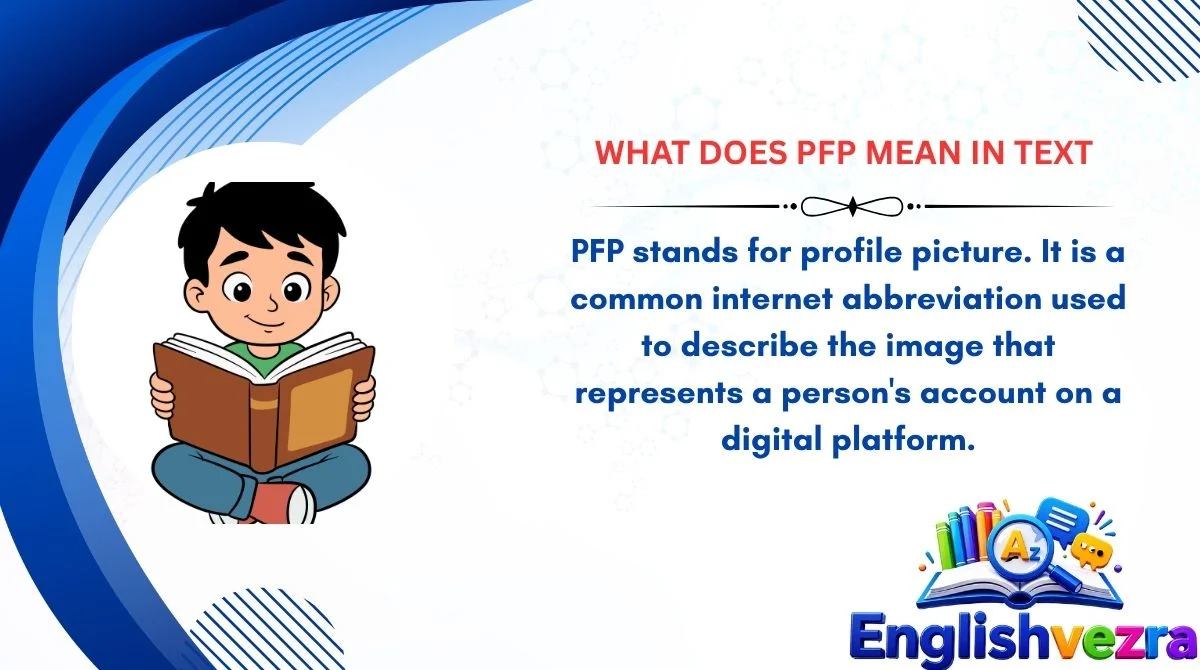
PFP stands for profile picture. It is a common internet abbreviation used to describe the image that represents a person’s account on a digital platform.
A profile picture helps other people recognize an account. It might be a photograph of the account owner, a cartoon character, an avatar, a pet, a logo, or another image that represents their personality or interests.
Instead of typing the complete phrase “profile picture,” people often write PFP because it is shorter and easier to use in quick conversations.
Examples of PFP in Text Messages
Here are some natural examples that show how people use the abbreviation:
- “Your PFP looks amazing!” — The person likes your profile picture.
- “Change your PFP.” — Someone is suggesting that you choose a different profile picture.
- “Who’s in your PFP?” — Someone wants to know who or what appears in your profile image.
- “I need a new PFP.” — The person wants to update their profile picture.
- “Your old PFP was better.” — Someone prefers your previous profile image.
In each example, PFP refers to the image associated with an online account.
Why Do People Use PFP Instead of Profile Picture?
Online conversations often prioritize speed and convenience. Writing three words can take longer than using a familiar abbreviation, particularly when someone is sending short messages or commenting on a post.
PFP is also widely understood in online communities, making it a convenient way to discuss account images without explaining the phrase every time.
However, not everyone knows internet abbreviations. If you are talking to someone unfamiliar with PFP, writing “profile picture” may make your message clearer.
Background: Where Did PFP Come From?
PFP developed as part of the broader habit of shortening common expressions used in digital communication. Its meaning comes directly from the phrase “profile picture,” which describes the image associated with an online user profile.
There is no single, reliably established person or event that can be identified as the inventor of PFP. It is more accurate to understand it as an abbreviation that became useful as online profiles and digital communication became increasingly common.
How Profile Pictures Became Important
Early online communities used usernames and basic account information to identify their members. As websites, messaging services, gaming platforms, and social networks developed, profile images became another way to recognize people and express individuality.
A profile picture could communicate someone’s interests, sense of humor, favorite characters, or personal style without requiring a long introduction.
As these images became a familiar part of online identity, people needed convenient ways to discuss them. Abbreviations such as PFP fit naturally into short messages and comments.
How PFP Became Common Online
The abbreviation is now used across many types of digital communities, including social media, online gaming, discussion forums, and messaging applications.
For example, a gamer might ask a friend to rate their new PFP, while a social media user might comment on someone’s new profile image.
The abbreviation is especially convenient when the conversation is already about online accounts. In that setting, people generally understand what PFP means without additional explanation.
Although the abbreviation is common today, its popularity should not be attributed to one specific platform or a single documented origin. Its widespread use reflects the general evolution of internet language.
Usage in Different Contexts
PFP usually means “profile picture,” but the way people use it can vary depending on the conversation.
1. PFP in Chat Messages
In private conversations, PFP often appears when friends discuss profile images or suggest changes.
Examples:
- “Send me your new PFP.”
- “I like your PFP.”
- “Why did you change your PFP?”
- “That PFP suits you.”
These messages refer to the image associated with an account. The tone may be friendly, curious, playful, or complimentary.
2. PFP on Social Media
On social platforms, people may discuss profile pictures in comments, captions, or direct messages.
For example, someone might write, “New PFP, what do you think?” to invite opinions about a recently uploaded image.
People may also use PFP when discussing a creator’s recognizable profile image or comparing different account pictures.
3. PFP in Professional Communication
PFP can occasionally appear in workplace chats, online communities, or discussions about professional profiles.
For example:
“Please update your PFP so clients can recognize your account.”
In a professional setting, the abbreviation is understandable to many people, but spelling out “profile picture” may be more appropriate in formal emails, official instructions, and business documents.
4. PFP in Casual Conversations
Friends might use PFP when joking about an image, discussing a favorite character, or commenting on someone’s online identity.
For example:
“Your PFP is literally your personality.”
This is a playful comment suggesting that the image reflects the person’s interests or behavior.
The key point: PFP normally refers to a profile picture, while the surrounding message tells you whether the person is complimenting it, asking about it, or suggesting a change.
PFP Meaning on Chat, WhatsApp, Instagram, and TikTok
PFP has the same general meaning across most popular messaging and social media platforms. The main difference is how users interact with their profile images on each service.
PFP on WhatsApp
On WhatsApp, PFP refers to the image displayed on someone’s profile. People may use the abbreviation when discussing a contact’s photo or asking why someone changed it.
Examples:
- “Your WhatsApp PFP is cute.”
- “Why is your PFP blank?”
- “Can you see my new PFP?”
Although people may use PFP in messages about WhatsApp, the app itself commonly refers to the image as a profile photo.
PFP on Instagram
On Instagram, PFP means the profile picture displayed on an account. It can be a selfie, a logo, an illustration, or another image.
Examples:
- “Rate my new PFP.”
- “Your PFP matches your feed.”
- “I can’t recognize you with that PFP.”
The abbreviation is especially useful when discussing account appearance or asking for feedback on a new image.
PFP on TikTok
On TikTok, PFP refers to the small profile image associated with a user’s account. People may use photographs, illustrations, characters, or other recognizable designs.
Examples:
- “Your TikTok PFP is so funny.”
- “I changed my PFP again.”
- “That creator has an iconic PFP.”
The meaning remains the same whether someone is talking about their own account or another user’s profile.
PFP in Gaming and Online Communities
PFP is also common in gaming communities and discussion groups. Players often choose characters, team logos, animated images, or custom artwork to represent themselves.
For example, “Your PFP matches your gaming username” means that the profile image suits the name or gaming identity.
Across these platforms, PFP generally means profile picture rather than a separate form of slang.
Meaning of PFP in Physics, Medical, and Aircraft Terminology
Although PFP is widely recognized as an internet abbreviation, letter combinations can have different meanings in specialized industries. It is important not to assume that the online meaning applies everywhere.
PFP in Physics
PFP does not have one universal, standard meaning in physics that applies across the entire field. Specialized research, technical documents, or individual organizations may use the letters for a particular term, but the intended definition depends on the subject and source.
If you encounter PFP in a physics textbook or research paper, check the surrounding explanation, glossary, or list of abbreviations before interpreting it.
PFP in Medical Terminology
In medical writing, PFP may be used as an abbreviation for different terms depending on the specialty and clinical context. It should not automatically be interpreted as “profile picture” when reading medical notes or health-related material.
Medical abbreviations can be ambiguous, so the correct interpretation depends on the document and the terminology used by the healthcare professional or institution.
If the abbreviation appears in personal medical records, ask the relevant healthcare professional to clarify its meaning rather than guessing.
PFP in Aircraft and Aviation Terminology
PFP is not a single universal aviation term with one meaning across all aircraft operations. It may appear in specialized documentation, internal procedures, or particular technical contexts.
The meaning should be established from the relevant aviation manual, glossary, or document in which it appears.
For everyday online conversations, however, there is usually no reason to apply a technical interpretation. If someone comments on your social media account or sends you a message about your PFP, they almost certainly mean your profile picture.
Common Misconceptions About PFP
Because online abbreviations can be unfamiliar or context-dependent, people sometimes misunderstand PFP.
Misconception 1: PFP Means Only a Personal Photograph
PFP does not have to be a real photograph of a person. It can be a cartoon, an avatar, a pet, a favorite character, a logo, or an abstract design.
For example, a gamer using a superhero image as their PFP is still using a profile picture.
Misconception 2: PFP Is a Special Type of Internet Slang
PFP is an abbreviation rather than a slang expression with a separate hidden meaning. People use it informally, but its basic definition remains “profile picture.”
Misconception 3: PFP Has the Same Meaning Everywhere
The meaning depends on context. In social media conversations, it normally refers to a profile picture. In technical documents, the same letters may represent something different.
Misconception 4: Someone Mentioning Your PFP Is Flirting
A comment about your profile picture does not automatically indicate romantic interest. Someone might be complimenting your image, joking with you, or simply asking a question.
For example, “Cool PFP!” can be a friendly comment without any romantic intention.
Misconception 5: Changing Your PFP Always Sends a Message
Some people change their profile pictures to express a mood, support a cause, or reflect a new interest. Others simply like a different image. You cannot reliably determine someone’s intentions from the change alone.
Understanding these distinctions helps you interpret messages without making unnecessary assumptions.
Similar Terms and Alternatives
Several online abbreviations are associated with profile images, account identities, or visual content. Understanding the differences can help you follow digital conversations more easily.
Commonly Related Terms
1. DP — Display Picture
DP is commonly used to mean “display picture,” especially in some regional online communities. It refers to the image displayed on a user’s account and is often used similarly to PFP.
2. Avatar
An avatar is a digital image or character that represents a user. It may serve as a profile picture, but it can also represent someone inside a game or virtual environment.
3. Profile Photo
Profile photo is the full phrase for a photograph or image displayed on an account. Some platforms use this wording in their settings.
4. Icon
An icon is a small image or symbol. It may represent a person, application, group, or account, so its meaning is broader than PFP.
5. Username
A username identifies an account through text rather than an image. People may use a username and a PFP together to create a recognizable online identity.
6. Bio
A bio is the short description displayed on many social media profiles. It describes the user or account rather than serving as its main image.
7. Header or Cover Photo
A header or cover photo is a larger image displayed across part of a profile page. Unlike a PFP, it generally occupies a separate area of the account.
These terms are related, but they are not interchangeable in every situation. PFP specifically refers to the image used to represent an account.
How to Respond to PFP in a Message
Your response depends on what the other person says about your profile picture. In most situations, you can reply naturally without treating PFP as a complicated expression.
If Someone Compliments Your PFP
If a friend says, “Your PFP looks great,” they are complimenting your profile image.
Possible replies include:
- “Thank you!”
- “Glad you like it.”
- “Appreciate it!”
- “I just changed it yesterday.”
If Someone Asks About Your PFP
If someone asks, “Who’s in your PFP?” they want to know who or what appears in the image.
You could respond with:
- “That’s my favorite character.”
- “It’s a picture of me.”
- “That’s my favorite artist.”
- “It’s just a random picture I liked.”
Choose an answer that accurately describes your image.
If Someone Tells You to Change Your PFP
If someone says, “Change your PFP,” you can decide whether to follow the suggestion.
Possible responses include:
- “Why? What’s wrong with it?”
- “Maybe I’ll change it later.”
- “I actually like this one.”
- “Send me a better idea.”
You do not need to change your image just because someone asks.
If You Do Not Understand the Message
If the context is unclear, ask a simple question such as, “Do you mean my profile picture?”
This is especially useful when the conversation involves a technical subject or an unfamiliar abbreviation. A short clarification is usually better than guessing.
Differences Between PFP and Similar Words
PFP is easy to confuse with other terms related to online profiles. The following comparisons explain how they differ.
| Term | Full meaning | Main purpose |
|---|---|---|
| PFP | Profile picture | Identifies or represents an account visually |
| DP | Display picture | Describes an image displayed on an account |
| Avatar | Digital representation | Represents a user, often through a character or illustration |
| Username | Account name | Identifies an account using text |
| Bio | Biography or profile description | Provides information about a person or account |
| Cover photo | Cover or header image | Adds a larger visual element to a profile |
| Icon | Small graphic or symbol | Represents an account, application, group, or other item |
PFP vs. DP
PFP and DP are often used interchangeably when discussing an account’s main image. The main difference is the wording: PFP stands for “profile picture,” while DP stands for “display picture.”
The preferred abbreviation can vary by community, region, and platform.
PFP vs. Avatar
An avatar is a digital representation of a person or account. It can be used as a PFP, but the word avatar also applies to characters used in games and virtual environments.
For example, your gaming character may be your avatar, while the small image displayed on your messaging account is your PFP.
PFP vs. Username
A PFP is visual, while a username is written text. A user might recognize someone by their image, their username, or both.
These elements work together but serve different purposes.
PFP vs. Bio
A PFP represents an account through an image, whereas a bio provides a written description. Someone might use a photograph as their PFP and a sentence about their interests as their bio.
Knowing these differences makes it easier to understand discussions about account settings and online identity.
Relevance in Online Conversations and Dating Apps

PFP plays an important role in online communication because profile images are often among the first things people notice when viewing an account.
On social networks, a PFP can help people recognize friends, creators, businesses, and public accounts. Users may select an image that reflects their personality, hobbies, favorite characters, or professional identity.
PFP in Online Friendships
Friends frequently comment on each other’s profile pictures. A new image can start a conversation, inspire a joke, or prompt someone to ask where the picture came from.
For example:
“New PFP? That looks so much better!”
This message indicates that the sender noticed the change and has an opinion about the new image. The tone depends on the relationship and the conversation.
PFP on Dating Apps
On dating apps, profile images can influence first impressions because users often see photographs before reading a full profile description.
Someone might mention a PFP while discussing an image on a linked social account or chatting with a match.
For example:
“Your PFP is cute. Is that your dog?”
This message uses the abbreviation to refer to the image and asks a question about its content. It may be friendly or flirtatious, but the wording alone does not prove romantic interest.
Can a PFP Send a Message?
Sometimes, people deliberately choose profile images to communicate an interest, mood, or personal preference. However, the image alone rarely provides enough information to determine someone’s intentions.
A person might use a favorite musician’s photo simply because they enjoy the music. Another person might choose a selfie because they like how it looks.
When interpreting comments about a PFP, consider the exact wording, the relationship between the people, and the broader conversation.
Ultimately, PFP is a practical abbreviation for an image used in digital identity. It can appear in friendly, professional, playful, or romantic interactions without changing its basic meaning.
FAQs
1. What does PFP mean in text messages?
PFP means “profile picture” in text messages. It refers to the image displayed on someone’s online account, such as a messaging profile or social media page. People use it when asking about a picture, complimenting an image, or discussing an account update. For example, “I like your PFP” means “I like your profile picture.”
2. What does PFP mean in chat?
In chat, PFP usually refers to a person’s profile picture. Someone might ask you to change your PFP, compliment your image, or ask who appears in it. The abbreviation is common in informal digital conversations because it is shorter than the complete phrase. In technical or specialized conversations, the surrounding context may indicate another meaning.
3. Is PFP considered internet slang?
PFP is an internet abbreviation commonly used in informal communication. Although people sometimes describe it as internet slang, its meaning is a shortened version of the ordinary phrase “profile picture.” It does not usually carry a hidden or offensive meaning. The abbreviation is useful in chats, comments, gaming communities, and discussions about social media accounts.
4. What does PFP mean on Instagram and TikTok?
On Instagram and TikTok, PFP means the profile picture displayed on a user’s account. It might be a selfie, illustration, logo, cartoon, or another image. When someone says “Nice PFP,” they are complimenting the image. If someone asks you to rate their PFP, they want your opinion about their profile picture.
5. What is the difference between PFP and DP?
PFP stands for “profile picture,” while DP stands for “display picture.” Both terms commonly refer to the image displayed on a person’s account, and many users treat them as interchangeable. Which abbreviation someone prefers can depend on their location, online community, or platform. Neither term necessarily means that the image must be a real photograph.
6. How should I reply when someone says they like my PFP?
You can respond with a simple thank-you when someone compliments your PFP. For example, say “Thanks!”, “Glad you like it,” or “I just updated it.” If you want to continue the conversation, you could explain where you found the image or why you chose it. A compliment about your profile picture does not automatically mean the person is flirting.
7. Does PFP mean something different in professional or technical fields?
Yes, PFP may have specialized meanings in particular technical or professional documents, depending on the field. In ordinary social media messages, it generally means “profile picture.” In medical, scientific, or aviation material, you should consult the document’s glossary or ask a qualified professional rather than assume the internet meaning applies.
8. Can a PFP be a cartoon, logo, or gaming character?
Yes, a PFP can be almost any suitable image used to represent an online account. People often choose cartoons, gaming characters, pets, business logos, illustrations, or personal photographs. The abbreviation describes the image’s role as a profile picture, not the type of image itself. A profile picture does not have to show the account owner.
Conclusion
PFP means “profile picture” in most text messages, social media conversations, and online communities. It describes the image that represents someone’s account on platforms such as WhatsApp, Instagram, TikTok, and gaming services.
People use the abbreviation to compliment a picture, ask who appears in it, suggest an update, or discuss their online identity. It is a convenient term for everyday digital communication and generally does not have a hidden meaning.
PFP is closely related to terms such as DP, avatar, username, and bio, but each describes a different part of an online profile.
It is also important to remember that the same letters may have specialized meanings in technical documents, so context matters.
When someone mentions your PFP, focus on the message surrounding the abbreviation to understand their intention. Whether the conversation is friendly, professional, or romantic, a simple and natural response is usually enough.
Understanding this common abbreviation can help you communicate more confidently and follow online conversations without confusion.

Samuel Hartwell is an English language educator and word enthusiast who enjoys explaining meanings in simple, clear ways. He creates helpful content to make English vocabulary easier to understand and learn.