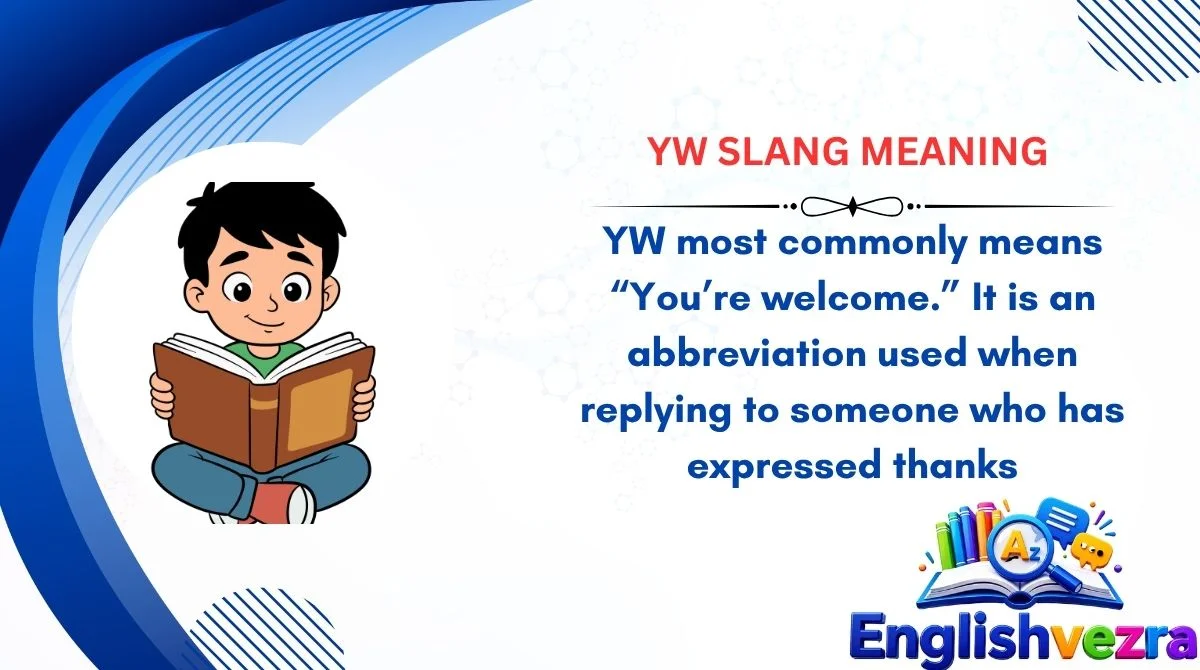
If someone sends you “YW” after you thank them, there is usually no reason to wonder what they mean. In everyday texting, YW is a short form of “You’re welcome.”
It is commonly used in text messages, online chats, comments, and social media conversations when someone wants to respond to “thank you” quickly.
As texting has become faster and more informal, people often shorten common phrases into a few letters.
Expressions such as “TY” for “thank you” and “YW” for “you’re welcome” make conversations quicker without changing the basic message.
People often search for the yw slang meaning because abbreviations can sometimes have different interpretations depending on the conversation.
Understanding the context is therefore important. In most casual conversations, however, YW is a friendly and convenient way to acknowledge someone’s thanks.
Quick Answer
YW slang meaning is “You’re welcome.” It is commonly used in texts, chats, comments, and social media after someone says “thank you.” YW is an informal abbreviation that makes a response quick and simple. Its tone is usually friendly, casual, and polite, although the exact feeling can depend on the conversation and the relationship between the people.
Meaning & Definition
YW most commonly means “You’re welcome.” It is an abbreviation used when replying to someone who has expressed thanks. Instead of typing the complete phrase, a person can simply write “YW” to acknowledge the appreciation.
For example:
Person 1: Thanks for helping me with my homework.
Person 2: YW!
Here, YW has exactly the same basic function as “You’re welcome.”
The abbreviation is especially common in informal digital communication. Texting encourages people to use shorter expressions because typing a few letters is faster than writing a complete sentence. YW fits naturally into this style.
The expression can also appear with punctuation or emojis:
- “YW 😊”
- “yw!”
- “YW!!”
- “yw lol”
- “YW, anytime!”
Although the letters are normally understood as “you’re welcome,” capitalization is not important. Someone might type YW, yw, or Yw, and the intended meaning is generally the same.
The tone can vary slightly. A simple “yw” may feel brief and relaxed, while “YW 😊” can sound warmer or friendlier. “You’re welcome!” may feel more expressive or formal than the abbreviation.
YW does not normally carry a complicated hidden meaning. If it appears directly after “thanks,” “thank you,” or another expression of gratitude, the intended interpretation is usually obvious.
It is also useful to remember that abbreviations are highly dependent on context. While “you’re welcome” is the standard texting interpretation, a person should consider the surrounding conversation before assuming what an abbreviation means.
In ordinary messaging, though, YW is best understood as a quick, casual response to someone’s thanks.
Background
The exact point at which YW became popular is difficult to identify because internet slang develops gradually through everyday communication rather than having one clearly documented creator or starting event.
Its structure is straightforward. Y represents “you,” while W represents the beginning of “welcome.” The abbreviation is based on the familiar phrase “you’re welcome,” which has long been used as a response to expressions of gratitude.
As digital communication became more widespread, people began shortening frequently used phrases. Text messaging, online chatrooms, instant messaging, forums, and later social media all encouraged quick communication. Short expressions became especially convenient when users wanted to respond without typing a full sentence.
YW belongs to the same general family of texting abbreviations as:
- TY — Thank you
- THX — Thanks
- TYSM — Thank you so much
- NP — No problem
- NVM — Never mind
- BRB — Be right back
- LOL — Laughing out loud
The important point is that YW is not a complicated modern word with a secret origin. It is essentially a shortened form of an ordinary English expression.
Its popularity is connected to the natural tendency to make repetitive digital communication more efficient. When someone receives a message saying “Thanks!”, typing “YW” takes much less effort than writing “You’re welcome.”
Over time, abbreviations like this became recognizable to many internet users, particularly in informal conversations.
However, not everyone uses texting abbreviations in exactly the same way. Some people prefer complete sentences, while others use short forms almost constantly. Age, online community, platform, personal writing style, and relationship can all affect how frequently someone uses YW.
Therefore, there is no special requirement that YW must be written in capital letters. Lowercase “yw” is equally understandable in most casual conversations.
The safest interpretation remains simple: when someone thanks you and you answer “YW,” you are normally saying “You’re welcome.”
Usage in Different Contexts
YW in Chat
In private chats, YW is generally used as a quick response after receiving thanks.
Example:
Friend: Thanks for sending me the notes.
You: YW!
It can be useful when the favor was small and there is no need for a longer response.
YW on Social Media
On social platforms, someone may use YW when responding to a thank-you comment.
Example:
Follower: Thanks for sharing this!
Creator: YW 😊
The abbreviation can keep the interaction short and friendly.
YW in Casual Conversations
YW is most comfortable in informal communication between friends, classmates, family members, gaming partners, or online acquaintances.
For example:
“Thanks for covering for me.”
“yw!”
The short response suggests that the person is not making the exchange overly formal.
YW in Professional Fields
YW can appear in workplace messaging, but its suitability depends on the workplace culture.
In a relaxed team chat, someone might write:
“Thanks for sending that file.”
“YW!”
In a formal email, however, “You’re welcome” or another professional response is usually more appropriate.
A short abbreviation can sometimes appear too casual in formal communication. This is why knowing the audience matters.
YW Between Friends
Among friends, YW may be used without any concern about formality.
“Thanks bro!”
“YW 😂”
Here, the abbreviation simply keeps the conversation moving.
Overall, YW is most natural when communication is quick, informal, and conversational. It is not normally necessary to use it when a longer, more professional response would be expected.
Meaning in Chat, WhatsApp, Instagram, and TikTok
The basic meaning of YW generally remains the same across popular messaging and social media platforms: “You’re welcome.”
On WhatsApp, someone might send YW after receiving a thank-you message:
“Thanks for picking me up!”
“YW.”
On Instagram, YW can appear in comments or direct messages:
“Thank you for the recommendation!”
“YW 😊”
On TikTok, the abbreviation can be used in comments or private messages when users are having a casual conversation.
For example:
“Thanks for tagging me!”
“yw!!”
The platform itself does not normally change what YW means. The surrounding conversation is more important than whether the message appears on WhatsApp, Instagram, TikTok, or another service.
Tone can be communicated through additional text, punctuation, capitalization, or emojis.
Compare these examples:
- “YW” — simple and direct
- “yw!” — casual and upbeat
- “YW 😊” — friendly and warm
- “yw lol” — playful or relaxed
- “You’re welcome!” — more complete and expressive
A person should not automatically interpret a short “yw” as rude. Digital conversations often use abbreviations because people want to communicate quickly. A brief answer does not necessarily indicate a negative attitude.
However, context can influence the emotional impression. If someone has been having a serious or formal conversation and suddenly replies with a very short abbreviation, it might feel less warm than a full sentence.
On social media, YW can also be part of a longer response:
“YW! Glad it helped.”
This combines the abbreviation with a friendly explanation.
The key takeaway is that YW usually keeps its standard meaning across these platforms. If it follows “thanks,” “thank you,” or a similar expression, it is almost certainly being used as a shortened version of “you’re welcome.”
Meaning in Physics, Medical, and Aircraft Terminology
YW does not have one universal technical meaning in physics, medicine, or aviation that should automatically be assumed whenever the letters appear.
YW in Physics
There is no standard everyday physics definition of YW that replaces its common texting meaning. If YW appears in a physics document, its interpretation would depend on the specific notation, textbook, research material, or context.
A technical abbreviation should therefore not be interpreted as “you’re welcome” simply because that is the common internet meaning.
YW in Medical Terminology
YW is not a standard medical abbreviation with one universally recognized definition that applies across medical communication.
Medical abbreviations can vary between institutions and specialties, so an unfamiliar abbreviation in a medical document should be checked against the relevant terminology or source rather than guessed.
YW in Aircraft or Aviation Terminology
YW does not have one broadly applicable aviation meaning that should be assumed in every aircraft-related context.
Aviation uses many specialized abbreviations, codes, and identifiers. If YW appears in an aviation document, its meaning could depend on the particular system or source.
This distinction is important because online slang and technical abbreviations are different categories. The fact that YW commonly means “you’re welcome” in texting does not mean those letters have the same meaning in every professional field.
For ordinary text messages, chats, and social media, the conversational context is the strongest clue. For technical documents, the surrounding terminology and official documentation should be considered instead.
In short, do not invent a specialized definition simply because an abbreviation exists. When YW appears in a technical setting, verify the context before interpreting it.
Common Misconceptions
One common misunderstanding is assuming that YW always has one meaning in every situation. In everyday texting, “you’re welcome” is by far the most natural interpretation when the abbreviation follows thanks. However, abbreviations can sometimes have different meanings in specialized contexts.
Another misconception is that YW is rude because it is shorter than “you’re welcome.” Usually, that is not the case. People frequently use short forms simply because texting is informal and fast. A person writing “yw” may be communicating exactly the same friendliness as someone writing “you’re welcome.”
Tone is another area where confusion can occur. Compare:
“YW 😊”
with:
“yw.”
The first might appear warmer because of the emoji, while the second is more minimal. However, punctuation and capitalization alone do not prove that someone is annoyed or unfriendly.
People can also confuse YW with other abbreviations. For example, someone who has never encountered it might wonder whether it refers to a person’s initials, a technical term, or another slang expression.
Context usually solves this problem.
If the conversation looks like this:
“Thanks for your help!”
“YW.”
the intended meaning is clear.
Another misconception is that YW must always be capitalized. It does not. YW, yw, and Yw can all be used informally.
Some people also assume that every person who uses YW is trying to sound trendy. That is unnecessary. Many abbreviations simply become convenient habits in digital communication.
Finally, YW should not be confused with an obligation to continue the conversation. Someone can say “YW” and leave the exchange there. It is often simply a polite acknowledgment of thanks.
The best approach is to interpret the abbreviation according to the surrounding conversation rather than assigning a dramatic meaning to two letters.
Similar Terms & Alternatives
Several abbreviations and phrases can appear in the same type of conversation as YW.
TY — Thank You
TY means “thank you.” It usually works in the opposite direction from YW.
Example:
“TY for helping me!”
“YW!”
TYSM — Thank You So Much
TYSM is a stronger version of TY and means “thank you so much.”
Example:
“TYSM for the gift!”
“YW 😊”
THX — Thanks
THX is an informal shortened form of “thanks.” It is often used when someone wants to express appreciation quickly.
NP — No Problem
NP means “no problem.” It can also be used as a response to thanks.
Example:
“Thanks!”
“NP!”
Although NP and YW can serve similar conversational purposes, they are not literally the same phrase.
Anytime
“Anytime” can communicate that the speaker was happy to help and would be willing to do so again.
Example:
“Thanks for helping me.”
“Anytime!”
No Problem
“No problem” is another natural alternative to “you’re welcome.” It often sounds relaxed and reassuring.
You’re Welcome
The complete phrase is the clearest alternative to YW. It works in both casual and more formal communication, although other responses may sound more natural depending on the situation.
The main difference among these expressions is usually tone rather than basic function. YW is short and informal, while “you’re welcome” is complete and neutral. “Anytime” can sound warmer, and “no problem” often emphasizes that the favor was not an inconvenience.
How to Respond to It
If someone sends you YW after you have thanked them, you usually do not need to send another message. The conversation can naturally end there.
For example:
You: Thanks for helping me!
Them: YW!
You: 😊
A simple emoji can be enough.
If you want to continue the conversation, you can respond naturally:
- “Appreciate it!”
- “Thanks again!”
- “You’re awesome!”
- “I really appreciate your help.”
- “Glad you could help!”
- “😊”
- “Thanks!”
However, there is no special response required for YW.
If someone sends “YW” in a casual conversation, you can simply move on to the next topic.
For example:
Friend: I sent you the document.
You: Thanks!
Friend: YW.
You: I’ll check it now.
The important thing is not to overthink the abbreviation. YW normally closes the thank-you exchange rather than creating a new question.
If you are unsure whether the person meant “you’re welcome,” look at the message immediately before it. If you had thanked them, the meaning is generally clear.
In a professional conversation, you may want to respond more formally if needed:
“Thank you again. I appreciate it.”
In a casual conversation, something much shorter is perfectly natural.
The response should match the relationship and the situation. Friends may use emojis, slang, or one-word replies, while professional contacts may prefer complete sentences.
Differences from Similar Words
YW, NP, TY, and “you’re welcome” can all appear around expressions of gratitude, but they perform different roles.
| Term | Meaning | Typical Use | Tone |
|---|---|---|---|
| YW | You’re welcome | Reply to thanks | Casual |
| You’re welcome | You’re welcome | Reply to thanks | Neutral |
| NP | No problem | Reply to thanks | Casual |
| TY | Thank you | Express gratitude | Casual |
| TYSM | Thank you so much | Strong gratitude | Casual |
| THX | Thanks | Express gratitude | Informal |
| Anytime | Happy to help again | Reply to thanks | Friendly |
The clearest difference is between TY and YW.
TY is what someone says when they are receiving help or appreciating something.
YW is what someone says when they have received that thanks.
For example:
Person A: TY for the advice.
Person B: YW!
NP is slightly different because it literally communicates that the favor was not a problem.
Person A: Thanks for waiting.
Person B: NP!
“You’re welcome” is the full version of YW. The two expressions communicate essentially the same idea in ordinary casual conversation, but the full phrase can feel more polished.
“Anytime” can go a little further by suggesting that the person would be happy to help again.
Understanding these differences makes it easier to choose the right expression based on the situation rather than using abbreviations automatically.
Relevance in Online Conversations & Dating Apps
YW can appear in online conversations and dating apps for the same basic reason it appears in ordinary texting: people often prefer quick, informal replies.
For example, on a dating app:
Person A: Thanks for the recommendation!
Person B: YW 😊
Here, the abbreviation is simply a casual acknowledgment.
The meaning does not automatically become romantic because it appears on a dating platform. Context, previous messages, tone, and the relationship between the people are much more important.
If someone sends:
“YW 😊”
it may feel friendly or warm, but it does not necessarily indicate romantic interest.
Similarly, a short:
“yw”
should not automatically be interpreted as disinterest. Some people naturally use very brief messages, while others prefer detailed replies.
Online communication also makes tone harder to judge because facial expressions and voice are absent. A person may intend a neutral “you’re welcome,” while the recipient interprets the short message differently.
The best way to understand YW on a dating app is therefore to look at the whole conversation.
If the person has been engaging actively, asking questions, making jokes, and continuing the conversation, YW is simply one short response within that interaction.
If they consistently send extremely brief replies and never continue the conversation, the overall communication pattern may tell you more than the abbreviation itself.
The same principle applies to social media and other online spaces. YW usually means “you’re welcome,” but its emotional tone depends on the surrounding conversation.
FAQs
What does YW mean in text?
YW means “you’re welcome” in most casual text conversations. It is commonly sent after someone says “thank you” or “thanks.” The abbreviation is simply a faster way to type the complete phrase. For example, if someone says, “Thanks for helping me,” the other person might reply, “YW!” The tone is usually casual and friendly.
What does YW mean in chat?
In chat, YW generally means “you’re welcome.” It is used when someone wants to respond quickly after receiving thanks. You may see it in conversations between friends, classmates, family members, gaming partners, or online acquaintances. The lowercase form “yw” has the same common meaning as the uppercase form “YW.”
Is YW a slang term?
YW is commonly considered an informal texting abbreviation or internet shorthand rather than traditional slang. It represents the phrase “you’re welcome” and is especially useful in quick digital conversations. People may use it in text messages, social media comments, direct messages, and casual online chats.
How do you respond to YW?
You usually do not need to respond to YW because it already serves as a response to your thanks. If you want to continue talking, you can say “Thanks again,” add an emoji, or move naturally to another topic. For example, after “YW 😊,” you could simply say, “I really appreciate it!”
What does YW mean on social media?
On social media, YW normally means “you’re welcome.” It can appear in comments, direct messages, or replies when someone has thanked another person. For example, after a follower says, “Thanks for sharing this,” the other person may answer, “YW!” Social media does not normally change the abbreviation’s basic meaning.
Can YW have different meanings?
YW can potentially have other interpretations in specific contexts, but “you’re welcome” is the standard interpretation in casual texting when it follows an expression of thanks. If the abbreviation appears in a technical document, professional system, or specialized discussion, the surrounding context should be checked before deciding what it means.
Is YW rude in a text message?
YW is not normally rude. It is a short and casual way of saying “you’re welcome.” Some people may prefer the complete phrase because it feels warmer or more formal, but the abbreviation itself does not usually express disrespect. Tone can depend on punctuation, emojis, the conversation, and the relationship between the people.
What is the difference between YW and NP?
YW means “you’re welcome,” while NP means “no problem.” Both can be used after someone says thanks, so they often perform a similar conversational function. YW directly acknowledges the person’s gratitude, while NP emphasizes that helping them was not difficult or inconvenient. Both are common in informal digital communication.
Conclusion
The most common yw slang meaning is “you’re welcome.” It is a simple texting abbreviation used to respond when someone says “thanks” or “thank you.” You can encounter it in private messages, group chats, social media comments, gaming conversations, and other forms of casual online communication.
YW is popular because digital conversations often favor short, convenient expressions. Its capitalization does not usually matter, so “YW,” “yw,” and “Yw” can all communicate the same basic message.
The abbreviation is generally friendly and informal, although the exact tone can depend on the surrounding conversation. It should not automatically be considered rude just because it is short.
YW should also be distinguished from abbreviations such as TY, TYSM, and NP. While these expressions may appear in similar conversations, they have different meanings.
Most importantly, context matters. In an ordinary text following “thank you,” YW almost certainly means “you’re welcome.” In a specialized technical setting, however, the surrounding terminology should be considered before assigning a meaning.

Samuel Hartwell is an English language educator and word enthusiast who enjoys explaining meanings in simple, clear ways. He creates helpful content to make English vocabulary easier to understand and learn.