Online conversations are full of short forms, abbreviations, and slang that can be confusing if you have not seen them before. One abbreviation you may come across in texts, comments, social media posts, or private messages is DTS.
Like many internet abbreviations, its meaning is not always fixed. The intended meaning can change depending on the conversation, the people involved, and the words surrounding it.
People often search for the meaning of DTS because they receive it in a message and are unsure how to interpret it.
Someone might use it casually with friends, while another person could use it in a dating or social-media conversation with a completely different intention.
Understanding the context is therefore important. Instead of assuming that every use of DTS has one universal definition, it is better to look at the conversation around it. Below, we will explain the most common interpretations, possible misunderstandings, and how to respond naturally.
Quick Answer
DTS meaning slang most commonly depends on context. In casual texting, DTS can mean “don’t think so,” while in some online or dating conversations it may be used as shorthand for other phrases. Because the abbreviation is ambiguous, check the surrounding message and conversation before deciding what the sender intended.
Meaning & Definition of DTS
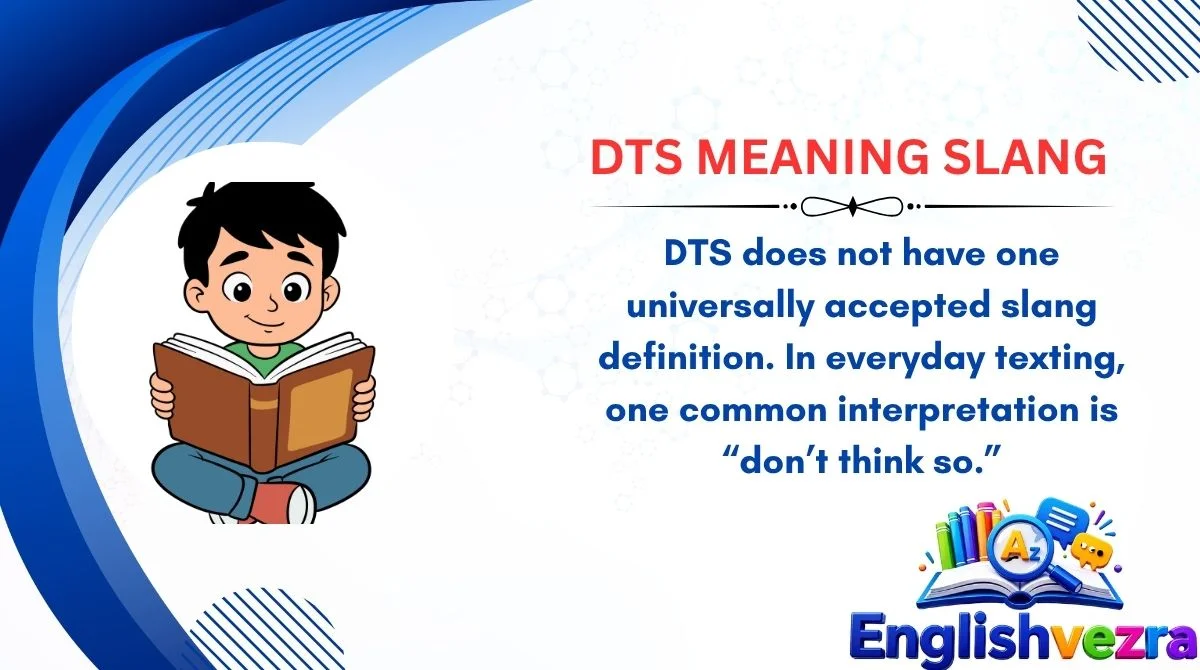
DTS does not have one universally accepted slang definition. In everyday texting, one common interpretation is “don’t think so.” This is generally used when someone disagrees, doubts something, or does not believe that something is likely to happen.
For example:
“Do you think Jake is coming tonight?”
“DTS.”
Here, DTS can be understood as “don’t think so.”
The expression is usually informal and works best in quick conversations where both people are already familiar with abbreviated texting language. It can communicate uncertainty or disagreement without requiring a complete sentence.
However, DTS can have other interpretations. Some people may use the letters as shorthand for a phrase that is specific to their friend group, community, platform, or conversation. In dating and adult-oriented conversations, for example, the abbreviation can sometimes be interpreted differently from its ordinary casual-text meaning.
This is why reading only the three letters is not enough to determine the intended meaning.
The tone can also change depending on punctuation and surrounding words. A short “DTS” may sound uncertain, dismissive, or casual, while a longer message can make the intended meaning much clearer.
If you encounter DTS in a message and the context does not make its meaning obvious, there is nothing wrong with asking the sender what they mean. A simple question can prevent an incorrect assumption.
In short, DTS is a context-dependent abbreviation, and “don’t think so” is one common interpretation in casual texting. Other meanings should only be considered when the surrounding conversation supports them.
Background
There is no single, well-established origin that can confidently be identified as the beginning of DTS slang. Unlike some abbreviations that developed from a specific online community or well-documented internet trend, DTS can be formed naturally from the first letters of different phrases.
Texting culture has encouraged people to shorten everyday expressions for speed and convenience. Instead of writing “I don’t think so,” someone may shorten the phrase to “DTS” in a conversation where abbreviations are already common.
The development of mobile messaging, social networks, gaming chats, and other digital communication spaces has made short forms increasingly common. People often remove unnecessary words when they believe the other person can understand the intended message from context.
This also explains why one abbreviation can develop several meanings. Three letters may represent different phrases depending on the community using them.
DTS should therefore not automatically be treated as a slang word with one official definition. It is better understood as an abbreviation whose interpretation depends heavily on context.
Another important point is that slang changes over time. A meaning that is familiar within one online group may be unfamiliar to another group. Younger users, gaming communities, social-media users, and dating communities may all use abbreviations differently.
For that reason, dictionaries and general abbreviation lists may not always provide enough information to interpret a particular message.
If you see DTS in an unfamiliar conversation, look at the sentence before it, the sentence after it, and the subject being discussed. Those clues are usually more useful than the abbreviation alone.
Usage in Different Contexts
In Chat
In ordinary private messaging, DTS can be used as a short response meaning “don’t think so.” It may appear when somebody is answering a question or expressing doubt.
Example:
“Will they finish the project today?”
“DTS.”
The sender is essentially saying, “I don’t think so.”
On Social Media
On social platforms, DTS may appear in comments, direct messages, captions, or replies. The meaning depends on the post and conversation. A comment containing only DTS can be difficult to interpret without seeing the original discussion.
In Professional Communication
DTS is generally not a good replacement for a complete phrase in formal workplace writing. Professional emails, reports, and official messages should normally use clear language rather than unexplained slang.
If someone uses DTS in a workplace chat, the surrounding discussion should be considered before interpreting it.
In Casual Conversations
Among friends, abbreviations are often used freely. DTS can make a response shorter and more informal. Friends who regularly use texting shortcuts may understand it immediately, while someone unfamiliar with the abbreviation may need clarification.
The key point is that DTS has greater potential for ambiguity than a complete phrase, so context matters.
Meaning in Chat, WhatsApp, Instagram, and TikTok
DTS can appear across different messaging and social-media platforms, but the platform itself does not necessarily give the abbreviation a single official meaning.
In a WhatsApp conversation, DTS may be used as a quick reply. For example:
“Do you think Sarah will join us?”
“DTS 😂”
The surrounding conversation suggests that the sender means “don’t think so.”
On Instagram, the abbreviation might appear in comments or direct messages. If someone sends only “DTS,” you may need to look at the previous message to understand what they mean.
TikTok
TikTok comments often contain highly abbreviated language. DTS could therefore be interpreted according to the particular conversation, trend, or community involved.
General Text Messages
Traditional SMS and modern messaging apps work similarly. Abbreviations are often created to save typing time, but their meanings are not always universal.
If someone sends DTS and you are unsure, a natural response is:
“What do you mean by DTS?”
That is usually better than guessing.
The most important lesson is that DTS should be interpreted from the conversation rather than the letters alone.
Meaning in Physics, Medical, and Aircraft Terminology
DTS can also appear as an abbreviation outside internet slang. However, those uses should not automatically be confused with texting slang.
Physics
There is no single universally recognized physics meaning of DTS that can be assumed whenever the abbreviation appears. A technical document may define its own abbreviation, so the surrounding material is important.
Medical Terminology
DTS may occur as an abbreviation in medical or healthcare-related contexts, but medical abbreviations can vary between specialties and organizations. It should not be interpreted as slang simply because the letters appear together.
When reading medical information, the full terminology or source-specific abbreviation list should be checked rather than guessing.
Aircraft and Aviation
Similarly, DTS can occur in aviation-related material as an abbreviation or identifier, but it does not have one universal aviation meaning that should automatically replace its slang interpretation.
The distinction is important: DTS in a text message and DTS in a technical document are not necessarily related at all.
If you encounter the abbreviation in a specialized field, use the definitions provided by that particular document, organization, or technical context.
Common Misconceptions
One of the biggest mistakes people make with DTS is assuming that every occurrence has the same meaning.
A person may see DTS in a casual text and immediately search for one definition. However, abbreviations can be highly context-dependent.
Another misconception is that an abbreviation must have an official dictionary definition to be used online. Internet slang often develops organically. People create shortened expressions within friend groups, communities, and online platforms.
It is also easy to confuse DTS with other three-letter abbreviations. Since many slang expressions use the same initials, a person may select the wrong interpretation simply because it is the first meaning they remember.
Tone can cause another misunderstanding. “DTS” may sound blunt if someone is unfamiliar with texting abbreviations. The sender may simply be trying to give a quick answer rather than intentionally sounding rude.
Dating conversations require extra caution because abbreviations can sometimes have meanings that differ from ordinary casual texting. In that setting, the surrounding messages are particularly important.
The safest approach is simple:
- Read the entire conversation.
- Look at the question or statement DTS responds to.
- Consider the relationship between the people.
- Check whether the conversation is casual, professional, social, or romantic.
- Ask for clarification if the meaning remains unclear.
Avoiding assumptions is especially useful when the abbreviation could reasonably have more than one interpretation.
Similar Terms & Alternatives
Several abbreviations and expressions can appear similar to DTS or be confused with it.
“IDK”
IDK means “I don’t know.” It expresses uncertainty about information.
“IMO”
IMO means “in my opinion.” It introduces a personal viewpoint rather than directly expressing doubt.
“TBH”
TBH means “to be honest.” It is commonly used before a frank or personal statement.
“NGL”
NGL means “not gonna lie.” It often introduces an honest reaction or opinion.
“I Don’t Think So”
This is the full expression that DTS may represent in casual texting. It is clearer than the abbreviation and is less likely to be misunderstood.
“Maybe Not”
“Maybe not” can communicate uncertainty, but it is not necessarily identical in tone to “I don’t think so.” It may sound less definite.
“Nope”
“Nope” is an informal way to say no. Unlike DTS, it does not necessarily communicate uncertainty or personal doubt.
Because these expressions have different tones, choosing the full phrase can sometimes make the intended meaning clearer.
How to Respond to DTS
Your response depends on what the sender appears to mean.
If DTS means “don’t think so,” you can respond naturally with:
- “Why not?”
- “Really? What makes you think that?”
- “Okay, fair enough.”
- “I guess we’ll see.”
- “Haha, maybe you’re right.”
- “What do you mean?”
If you are not sure what the sender means, simply ask:
“What does DTS mean here?”
You do not need to make the conversation complicated. Asking for clarification is especially useful when the abbreviation could have multiple interpretations.
If the message is from someone you know well, you may already understand their usual texting style. If it comes from a stranger, social-media account, or dating-app match, it is better not to assume.
The best response is therefore based on the conversation rather than the abbreviation itself.
Differences from Similar Words
The main difference between DTS and similar expressions is the level of certainty and the intended message.
DTS / “don’t think so” usually expresses doubt or a negative expectation.
IDK / “I don’t know” means the person lacks information or is uncertain about the answer.
No / nope gives a more direct negative response.
Maybe leaves the situation open without necessarily expressing a negative expectation.
IMO / “in my opinion” introduces a viewpoint and does not specifically mean disagreement.
For example:
“Do you think Ali will come?”
DTS: “I don’t think so.”
IDK: “I don’t know.”
Maybe: “It’s possible.”
Nope: “No.”
These responses may look similar in a fast-moving chat, but they communicate different levels of certainty.
The same principle applies to other abbreviations. A short form should not be interpreted solely by its letters when the surrounding conversation provides additional information.
Relevance in Online Conversations & Dating Apps
Abbreviations are especially common in online communication because people often want to respond quickly. DTS may therefore appear in direct messages, comments, group chats, gaming conversations, or other informal spaces.
On dating apps, interpretation can become more complicated because conversations are often short and lack the context of face-to-face communication. A person may use abbreviations casually, while the other person may interpret them differently.
For example, if someone asks:
“Are you meeting us tonight?”
and receives “DTS,” the likely interpretation may be “don’t think so.”
However, if DTS appears in a conversation about relationships, plans, or another specific subject, the intended meaning should be determined from that context.
Dating conversations can also involve slang that is not commonly used in ordinary messaging. Therefore, guessing can lead to unnecessary confusion.
If you receive DTS from someone online and cannot determine what they mean, a simple clarification message is usually the easiest solution.
Context, tone, previous messages, and the relationship between the speakers all help determine the intended interpretation.
FAQs
What does DTS mean in text?
In casual texting, DTS can mean “don’t think so.” It is generally used as a short response when someone doubts that something will happen or disagrees with an assumption. However, DTS is context-dependent and can have other interpretations in different online communities, so the surrounding conversation should always be considered.
What does DTS mean in chat?
DTS can mean “don’t think so” in chat. For example, if someone asks, “Do you think he will come?” and the reply is “DTS,” the sender may be saying they do not believe he will come. If the conversation does not make the meaning clear, asking the sender directly is the safest option.
Is DTS a slang term?
DTS can function as internet or texting slang when people use it as a shortened expression in informal conversations. Its slang interpretation is not necessarily universal, however. Different communities may use the same abbreviation differently, which is why context is important when determining what someone intended.
What does DTS mean on social media?
On social media, DTS may mean “don’t think so” when it is used as a quick response. However, social-media abbreviations can vary between communities and conversations. A comment or direct message containing only DTS may therefore require the surrounding post or previous messages to determine its intended meaning.
How do you respond to DTS?
If DTS means “don’t think so,” you can respond according to the conversation with something like “Why not?”, “Really?”, or “Fair enough.” If you are unsure what the sender means, simply ask, “What do you mean by DTS?” Clarifying is better than assuming when an abbreviation has multiple possible interpretations.
Can DTS have different meanings?
Yes, DTS can have different meanings depending on context. In casual texting, “don’t think so” is one common interpretation, but other communities or conversations may use the letters differently. The topic being discussed, the platform, and the relationship between the speakers can all help identify the intended meaning.
Does DTS mean the same thing on WhatsApp and TikTok?
Not necessarily. WhatsApp and TikTok users may use the same abbreviation in different ways. If DTS appears as a response to a question, “don’t think so” may fit naturally. On TikTok, however, the surrounding comment or trend may provide additional context. Never assume the platform alone determines the meaning.
Should I use DTS in professional messages?
It is generally clearer to use the complete phrase instead of DTS in formal or professional communication. Abbreviations can be misunderstood when the recipient is unfamiliar with them. Writing “I don’t think so” communicates your meaning more clearly and avoids making the reader guess what the abbreviation represents.
Conclusion
DTS is a short abbreviation whose meaning depends heavily on context. In casual texting, one common interpretation is “don’t think so,” particularly when someone is expressing doubt about a question or situation. However, the three letters can potentially represent different expressions in other communities or conversations.
That is why it is important to look at the messages surrounding DTS before deciding what the sender means. WhatsApp, Instagram, TikTok, private chats, dating apps, and professional environments can all have different communication styles.
DTS should also not automatically be treated as a technical abbreviation when it appears in medical, physics, or aviation material. Specialized contexts may define abbreviations differently.
If someone sends you DTS and its meaning is unclear, the simplest solution is to ask. A quick clarification can prevent an awkward misunderstanding. Ultimately, context, tone, and the subject of the conversation are the best clues for understanding what DTS means.

Samuel Hartwell is an English language educator and word enthusiast who enjoys explaining meanings in simple, clear ways. He creates helpful content to make English vocabulary easier to understand and learn.