If you have ever received a text such as “That movie was funny AF,” “I’m tired AF,” or “She’s cute AF,” you may have wondered what AF slang meaning actually is.
AF is a short internet expression that appears frequently in text messages, social media comments, memes, gaming chats, and casual online conversations. It is especially common when someone wants to make an adjective or description sound much stronger.
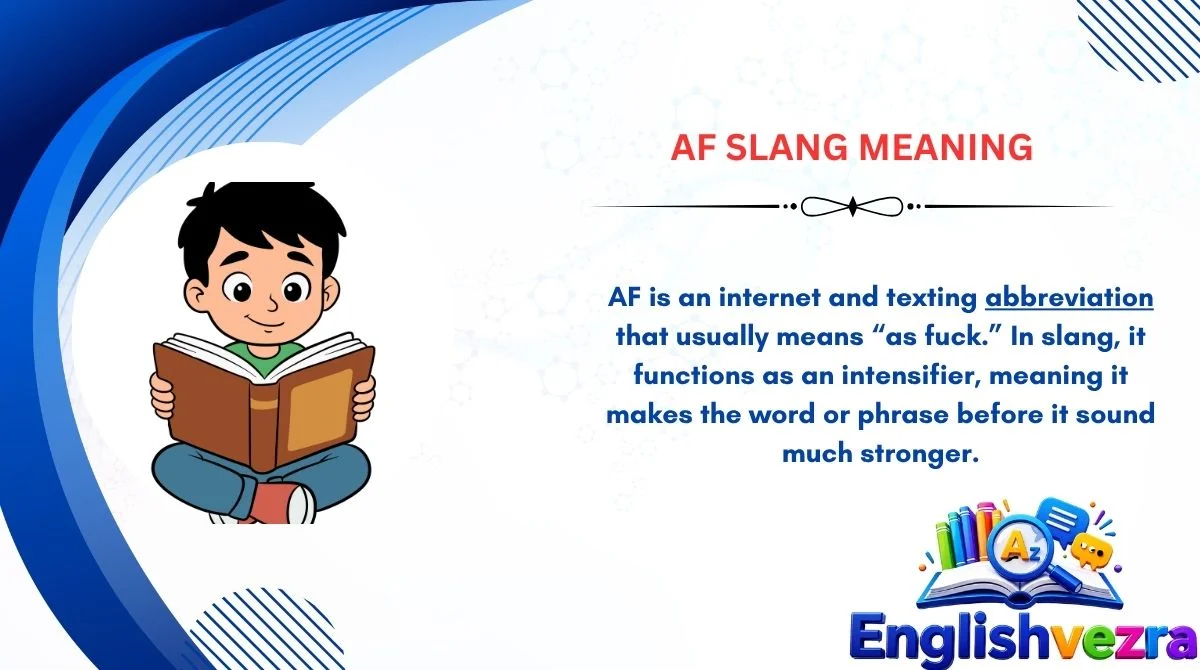
In most informal conversations, AF is an abbreviation for “as fuck.” The word “fuck” makes the expression vulgar, so AF is generally considered casual and sometimes profane language. People often use it for emphasis rather than its literal meaning.
Understanding AF is useful because its tone can change depending on who says it, where it appears, and what words surround it. A friend may use it jokingly, while the same expression would be inappropriate in a formal email, workplace document, or professional conversation.
Quick Answer
AF slang meaning is “as fuck,” an informal and vulgar expression used to strongly emphasize an adjective or feeling. It is most commonly found in texts, social media, memes, gaming chats, and casual conversations. For example, “I’m tired AF” means “I’m extremely tired.” Its exact tone depends on the context and relationship between the people communicating.
Meaning & Definition
AF is an internet and texting abbreviation that usually means “as fuck.” In slang, it functions as an intensifier, meaning it makes the word or phrase before it sound much stronger.
For example:
- “I’m tired AF” = I’m extremely tired.
- “That test was hard AF” = That test was extremely hard.
- “This food is good AF” = This food is extremely good.
- “It’s cold AF outside” = It’s extremely cold outside.
- “He’s funny AF” = He’s extremely funny.
The important point is that AF usually does not add a completely different idea to the sentence. Instead, it increases the intensity of the statement.
AF is normally written after an adjective or descriptive phrase:
adjective + AF
Examples include:
- happy AF
- busy AF
- cute AF
- tired AF
- expensive AF
- loud AF
- scary AF
It can also appear in captions, comments, memes, gaming messages, and short posts where people want to sound relaxed or humorous.
Because the full expression contains profanity, AF is not considered formal English. Some people use it casually without intending to offend anyone, but others may consider it inappropriate or unnecessarily vulgar.
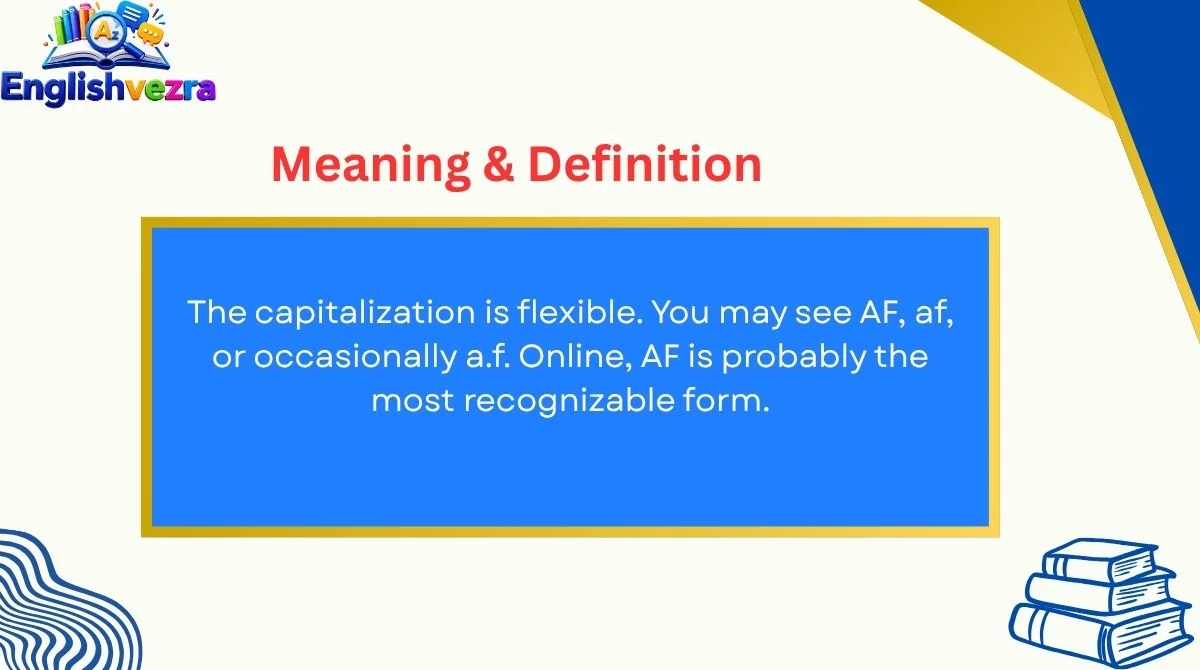
The capitalization is flexible. You may see AF, af, or occasionally a.f. Online, AF is probably the most recognizable form.
The expression can also be used humorously or sarcastically. For instance, someone might post “Productive AF today” after completing several tasks. The abbreviation adds an exaggerated sense of emphasis to the statement.
In simple terms, when you see AF after a descriptive word online, you can usually read it as “very,” “extremely,” or “really”, while remembering that the original expression is considerably more vulgar.
Background
The slang expression behind AF comes from the phrase “as fuck,” where “fuck” is used as an intensifier rather than in its literal sexual sense. The abbreviation AF developed as a shorter way to write the expression, fitting the general tendency of internet communication to shorten words and phrases.
There is not one universally documented moment when AF suddenly became slang. Its popularity developed alongside informal digital communication, texting, social media, forums, memes, and online communities. As people became increasingly comfortable communicating through short written messages, abbreviations became an efficient way to express familiar phrases.
AF became especially recognizable because it is extremely easy to attach to descriptive words. Instead of writing “I am extremely tired,” a person can write “I’m tired AF.” The shorter version can also sound more humorous, dramatic, or emotionally expressive.
Online language has many examples of this type of abbreviation. People frequently shorten common expressions because fast communication favors compact language. AF fits naturally into that pattern.
The abbreviation is also useful because the full phrase contains profanity. Writing “AF” allows someone to communicate the same general emphasis without spelling out the entire expression. However, the abbreviation still carries the vulgar tone of the original phrase.
It is important not to claim that AF has only one historical origin beyond this. Slang often develops gradually through multiple communities rather than being invented by one identifiable person or organization. Its modern meaning is clear, but the precise point at which it entered widespread internet usage is not something that should be presented as a single confirmed event without reliable historical evidence.
Today, AF is widely recognizable in informal online English. Younger internet users, social-media communities, gamers, meme creators, and casual texters may use it frequently, although individual preferences vary.
Usage in Different Contexts
The meaning of AF generally remains the same across informal settings, but its tone can change significantly depending on the situation.
AF in Chat
In private messaging, AF is usually used for emphasis. Friends may write:
“I’m hungry AF.”
This simply means the person is extremely hungry.
Because texting is generally informal, AF can fit naturally into conversations between friends or people who already communicate casually.
AF on Social Media
On platforms such as Instagram, TikTok, X, Facebook, and similar services, AF often appears in captions, comments, memes, and reactions.
Examples include:
- “This outfit is cute AF.”
- “That sunset is beautiful AF.”
- “Monday got me tired AF.”
Social media encourages short, expressive language, making abbreviations like AF particularly convenient.
AF in Professional Fields
AF should generally be avoided in formal professional communication unless you know the environment is extremely casual and the audience is comfortable with profanity.
For example, instead of writing:
“The presentation was confusing AF.”
A professional alternative would be:
“The presentation was extremely confusing.”
In a workplace email, academic paper, official report, or business proposal, words such as extremely, very, highly, or particularly are usually more appropriate.
AF in Casual Conversations
Among friends, AF can be completely ordinary. Someone might say:
“You’re lucky AF.”
The expression may sound playful rather than aggressive.
However, the fact that AF is common online does not mean everyone likes profanity. When speaking with someone you do not know well, it is safer to use a non-profane alternative.
The key lesson is that AF is mainly an informal intensifier, and context determines whether it sounds funny, natural, rude, or inappropriate.
Meaning in Chat, WhatsApp, Instagram, and TikTok
AF is commonly encountered across messaging and social-media platforms because these environments encourage short, expressive communication.
AF in WhatsApp
In WhatsApp chats, AF can appear in conversations between friends, family members, partners, classmates, or gaming groups.
For example:
Person 1: “How was your day?”
Person 2: “Busy AF. I barely had time to eat.”
Here, AF means “extremely.” The speaker is emphasizing how busy the day was.
AF on Instagram
Instagram users may put AF in captions or comments:
“This view is beautiful AF.”
The abbreviation makes the sentence more casual and emotionally expressive.
AF on TikTok
TikTok comments and captions often use highly informal internet language. AF may appear alongside humor, exaggeration, reactions, or trends.
Someone might comment:
“That transition was smooth AF.”
The person is saying the transition was extremely smooth.
AF in Memes
AF is particularly common in memes because memes often depend on exaggeration.
A meme might use a phrase such as:
“Me trying to wake up early: tired AF.”
The abbreviation contributes to the humorous and informal style.
AF in Online Gaming
Gamers may also use AF in quick messages:
“That boss is hard AF.”
This means the boss is extremely difficult.
The important thing is that AF does not normally change its basic meaning from one platform to another. Whether you see it on WhatsApp, Instagram, TikTok, Discord, a gaming chat, or another social platform, it usually functions as an informal intensifier.
However, always consider the surrounding sentence. Abbreviations can occasionally have different meanings in specialized communities.
Meaning in Physics, Medical, and Aircraft Terminology
The slang meaning of AF should not automatically be applied to technical contexts. Abbreviations can have completely different meanings in professional fields.
AF in Physics
AF does not have one universal standard meaning in physics that corresponds to the internet slang “as fuck.”
A technical document may use the letters AF as part of a field-specific abbreviation, notation, label, or measurement-related term. The surrounding material would be necessary to determine the intended meaning.
Therefore, if you see AF in a physics textbook or research paper, do not automatically interpret it as internet slang.
AF in Medical Terminology
In medicine, AF can have established meanings depending on the specialty and context. One well-known medical use is atrial fibrillation, a type of irregular heart rhythm.
That meaning is completely different from the slang expression.
For example, a medical document discussing heart rhythm may use AF to refer to atrial fibrillation. In that setting, interpreting AF as “as fuck” would obviously be incorrect.
Medical abbreviations should always be interpreted within their clinical context rather than according to internet slang.
AF in Aircraft or Aviation Terminology
In aviation, AF may appear as an abbreviation, code, identifier, or part of technical terminology depending on the document or system being used.
There is no universal aviation rule that AF means “as fuck.” If you encounter AF in a flight-related document, cockpit material, aircraft manual, airport information, or aviation database, the surrounding terminology should be checked.
The same two letters can therefore have completely different meanings in slang, medicine, science, and technical communication.
Common Misconceptions
One common misconception is that AF always means the slang phrase “as fuck.” That is true in many informal online conversations, but not every appearance of the letters AF is slang.
Context is essential.
For example:
- “I’m tired AF” → slang intensifier.
- “The patient has AF” → may refer to atrial fibrillation.
- “AF” in a technical document → may represent a field-specific abbreviation.
Another misunderstanding is that AF necessarily means someone is angry or insulting another person. It does not. The abbreviation usually intensifies a description rather than expressing anger.
For example:
“This cake is good AF.”
This is normally praise, not an insult.
People may also assume that AF means exactly “very” in every situation. While “very” or “extremely” can explain its function, AF carries a stronger, more vulgar, and more informal tone.
Another misconception is that AF is appropriate everywhere because it is common on social media. Frequency does not make a slang term professional. A phrase that works perfectly in a group chat may be unsuitable for a job application, business email, academic assignment, or formal presentation.
Finally, AF should not be confused with every other abbreviation containing the letters A and F. Many technical and conversational abbreviations happen to use these letters.
Similar Terms & Alternatives
Several words and abbreviations can perform a similar function to AF, although they may differ in strength and tone.
Very
“Very” is a standard English intensifier.
- “I’m very tired.”
It is neutral and suitable for most situations.
Extremely
“Extremely” communicates strong emphasis while remaining formal.
- “I’m extremely tired.”
This is much safer than AF in professional writing.
Really
“Really” is common in casual and everyday English.
- “That movie was really good.”
It is less vulgar than AF and works in many contexts.
Super
“Super” is informal but generally non-profane.
- “That was super fun.”
It can sound friendly and enthusiastic.
As hell
“As hell” can function similarly to AF:
- “That was loud as hell.”
However, it is still informal and can be considered somewhat vulgar.
As heck
“As heck” is a softer alternative.
- “That was funny as heck.”
It preserves the basic emphasis without using the profanity found in the original expression.
Freaking / Freakin’
Some people use “freaking” or “freakin’” as a softer intensifier:
- “That was freaking amazing.”
It is generally less explicit than AF.
Choosing between these expressions depends on the audience, relationship, platform, and desired tone.
How to Respond to It
If someone uses AF in a message, you usually do not need to respond to the abbreviation itself. Simply understand the sentence and reply naturally.
For example:
Them: “I’m tired AF.”
You could respond:
- “Same, I barely slept.”
- “You should get some rest.”
- “Sounds like you had a long day.”
If someone says:
Them: “That movie was funny AF.”
Possible replies include:
- “Right? I couldn’t stop laughing.”
- “I know! It was hilarious.”
- “I need to watch it again.”
If you are uncomfortable with profanity, you can still respond without using the same language:
Them: “That exam was hard AF.”
You: “Yeah, it was definitely difficult.”
There is generally no special response required for AF. Its meaning is usually understood from the sentence around it.
If someone sends only “AF” without additional context, however, the meaning may be unclear. In that situation, a simple response such as “What do you mean by AF here?” can prevent misunderstanding.
When responding, match the level of formality to the conversation. You do not have to copy someone’s slang just because they use it.
Differences from Similar Words
AF differs from ordinary intensifiers mainly in tone and strength.
| Expression | Basic Function | Tone | Formal? |
|---|---|---|---|
| AF | Strong emphasis | Vulgar, casual | No |
| Very | Emphasis | Neutral | Yes |
| Really | Emphasis | Casual/neutral | Usually |
| Extremely | Strong emphasis | Formal/neutral | Yes |
| Super | Strong emphasis | Casual, friendly | Usually informal |
| As hell | Strong emphasis | Vulgar/casual | No |
| As heck | Strong emphasis | Mild/casual | Generally informal |
For example:
- “I’m very tired.” — neutral.
- “I’m really tired.” — natural and conversational.
- “I’m extremely tired.” — stronger and more formal.
- “I’m tired AF.” — very casual and vulgar.
- “I’m tired as hell.” — casual and vulgar.
- “I’m tired as heck.” — casual but softened.
The central difference is not simply intensity. AF also communicates a particular internet-casual style.
Someone using AF may be trying to sound humorous, relaxed, dramatic, enthusiastic, or expressive. Therefore, replacing AF with “very” can preserve the basic meaning while changing the personality and tone of the sentence.
Relevance in Online Conversations & Dating Apps
AF is especially relevant in modern online communication because dating apps, social platforms, messaging services, and online communities often rely on informal language.
On a dating app, someone might write:
“You’re cute AF.”
Depending on the conversation, this could be intended as a strong compliment. However, the expression is still informal and contains profanity.
Someone might also write:
“I’m awkward AF on first dates.”
Here, the person is using self-deprecating humor to describe themselves as extremely awkward.
Context matters greatly on dating apps because people who have never met may have different comfort levels with slang and profanity. One person may see AF as funny and relaxed, while another may consider it immature or overly familiar.
In social-media conversations, AF can also help communicate enthusiasm:
“That photo is amazing AF.”
In gaming communities, it can emphasize difficulty:
“This level is hard AF.”
In casual friendships, it may be completely unremarkable.
The relationship between speakers therefore matters. Friends who regularly use profanity may see AF as normal. A stranger, employer, teacher, customer, or professional contact may interpret the same expression differently.
The safest approach is to consider the overall communication style. If the conversation is full of memes, abbreviations, jokes, and casual language, AF is probably being used informally. If the conversation is formal or professional, a different interpretation may be necessary.
Above all, do not assume that every occurrence of AF online has the slang meaning. Technical, medical, academic, and organizational contexts can use the same abbreviation for unrelated purposes.
FAQs
What does AF mean in text?
AF usually means “as fuck” in informal text messages. It is used as an intensifier to mean “very” or “extremely.” For example, “I’m tired AF” means “I’m extremely tired.” Because the original phrase contains profanity, AF is considered informal and should generally be avoided in professional or formal communication.
What does AF mean in chat?
In chat, AF usually means “as fuck” and adds strong emphasis to a description. A person might write “That game was fun AF,” meaning the game was extremely fun. The expression is common in casual conversations, gaming chats, group messages, and online communities.
Is AF a slang term?
Yes, AF is commonly used as an internet and texting slang abbreviation for “as fuck.” It is informal and somewhat vulgar because it represents a profanity-based expression. Although it is widespread online, it is not normally appropriate for formal writing, professional emails, academic work, or official documents.
What does AF mean on social media?
On social media, AF usually works as an intensifier meaning “extremely” or “very.” For example, “This outfit is cute AF” means the person thinks the outfit is extremely cute. It often appears in captions, comments, memes, reactions, and short posts where users want to express strong emotion casually.
How do you respond to AF in a message?
You can respond naturally based on the sentence rather than responding to AF itself. If someone says, “I’m tired AF,” you might say, “Same, I need sleep too.” If you are unsure what AF means in a particular message, simply ask the sender what they intended.
Can AF have different meanings?
Yes, AF can have different meanings outside internet slang. In casual texts, it commonly means “as fuck,” while in medical contexts AF can refer to atrial fibrillation. Other specialized fields may use AF as their own abbreviation. Always consider the surrounding words and subject before deciding what the letters mean.
Does AF mean very?
AF can function similarly to “very” or “extremely,” but it has a much more informal and vulgar tone. For example, “I’m hungry AF” means “I’m extremely hungry.” The words are not identical in style, so “very” is a better choice when writing formally.
Is it okay to use AF professionally?
AF is generally not recommended in professional communication because it represents a profanity-based slang expression. In workplace emails, reports, applications, and formal documents, alternatives such as “very,” “extremely,” “highly,” or “particularly” are more appropriate.
Conclusion
AF is a widely recognized piece of internet and texting slang that usually stands for “as fuck.” In informal communication, it acts as a strong intensifier, allowing people to emphasize an adjective or description.
Phrases such as “tired AF,” “funny AF,” and “cold AF” generally mean “extremely tired,” “extremely funny,” and “extremely cold.”
The expression is especially common in texts, social media, memes, gaming chats, and casual conversations. However, its profanity-based origin makes it unsuitable for most formal or professional situations.
Context is particularly important because AF does not always have the slang meaning. In medical communication, for example, it can refer to atrial fibrillation, while specialized fields may use the same letters differently.
When you encounter AF online, look at the surrounding sentence and the type of conversation.
If it appears after an adjective in a casual message, “as fuck” is usually the intended meaning. If it appears in a technical or professional context, consider other possible interpretations before making a conclusion.

Samuel Hartwell is an English language educator and word enthusiast who enjoys explaining meanings in simple, clear ways. He creates helpful content to make English vocabulary easier to understand and learn.