Have you ever received a message that ends with three dots (…) and wondered what the sender was trying to say? These tiny punctuation marks can sometimes communicate more than a full sentence. Depending on the conversation, they may suggest hesitation, uncertainty, disappointment, suspense, or an unfinished thought.
People often use three dots in text messages, WhatsApp chats, Instagram comments, TikTok conversations, and other online spaces. While some use them simply to create a pause, others use them to express feelings without directly explaining themselves.
Understanding … meaning in text can help you avoid misunderstandings and recognize the tone behind a message. For example, receiving “Okay…” might feel different from receiving “Okay!” even though both contain the same word.
The meaning depends on the sender, the relationship, and the situation. This guide explains how three dots work in digital communication, what they may suggest emotionally, and how to respond naturally.
Quick Answer
Three dots (…) in text usually indicate a pause, hesitation, or an unfinished thought. This punctuation mark is called an ellipsis. In texting and online conversations, it can also suggest uncertainty, suspense, disappointment, or an awkward silence. The exact interpretation of … meaning in text depends on the message, the sender’s tone, and the surrounding conversation.
Meaning & Definition of Three Dots (…)
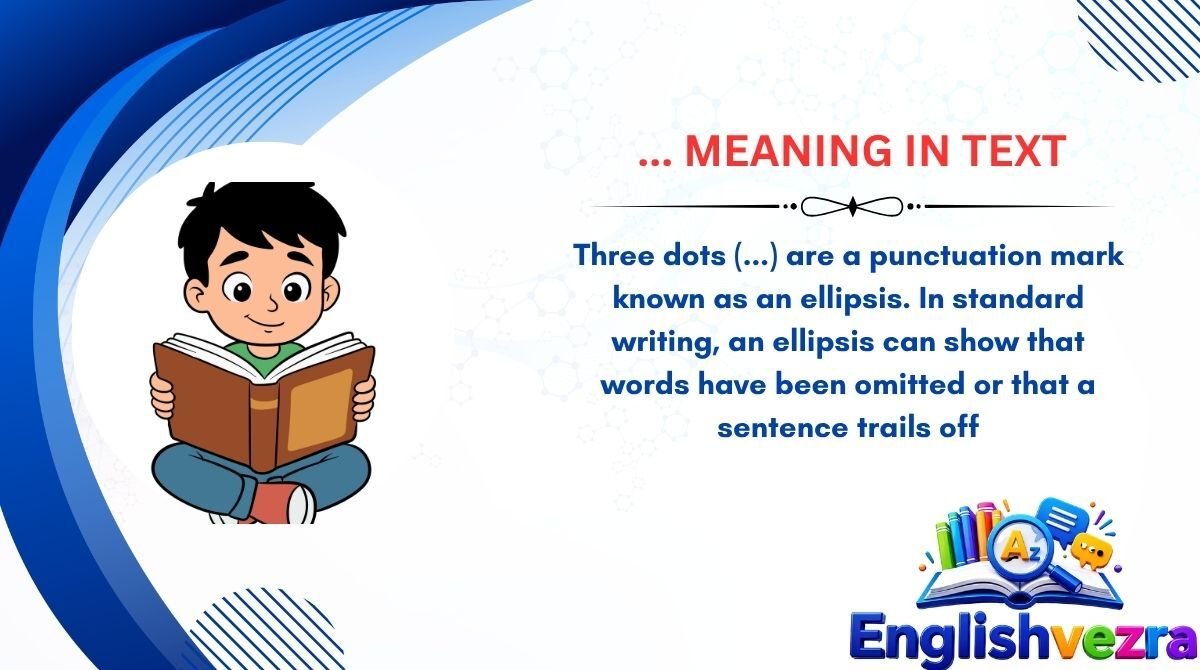
Three dots (…) are a punctuation mark known as an ellipsis. In standard writing, an ellipsis can show that words have been omitted or that a sentence trails off. In informal text messages, it often carries an additional emotional meaning.
Unlike ordinary punctuation, three dots can make a message feel incomplete, thoughtful, uncomfortable, or mysterious.
For example:
- “I don’t know…” — The sender may feel uncertain.
- “Well…” — Someone may be thinking before responding.
- “Okay…” — The reply may suggest hesitation or disappointment.
- “Wait…” — The sender may be surprised or preparing to explain something.
- “I was going to tell you…” — The message creates suspense.
These interpretations are possibilities, not fixed rules.
What Do Three Dots Symbolize?
In everyday digital communication, three dots commonly represent:
- Hesitation: Someone is unsure what to say.
- Suspense: The sender wants to create anticipation.
- Unfinished thoughts: A sentence is intentionally left incomplete.
- Disappointment: The message may carry a subdued or uncomfortable tone.
- Awkward silence: The sender may be reacting to something unexpected.
- A thoughtful pause: Someone is considering their next words.
Is (…) a Word or an Abbreviation?
Three dots are neither a word nor a standard abbreviation. They are punctuation marks.
An abbreviation shortens a word or phrase, such as “BRB” for “be right back.” An ellipsis, however, changes how a sentence is read or interpreted.
It can communicate feelings indirectly without adding extra words.
For example, “That’s interesting…” might sound skeptical, while “That’s interesting!” sounds more enthusiastic.
Still, not everyone uses punctuation in the same way. Some people regularly end messages with three dots without intending any hidden emotional meaning.
Background: Where Did Three Dots Come From?
The ellipsis existed in written language long before smartphones, social media, and instant messaging became popular.
Traditionally, writers used it to indicate missing material, an incomplete statement, or a pause in speech.
For example:
“She opened the letter and discovered…”
The unfinished sentence encourages readers to imagine what happens next.
In edited quotations, an ellipsis can also show that part of the original text has been removed.
How Three Dots Became Common in Texting
As digital communication developed, people began using punctuation to express tone.
Text messages lack many features of face-to-face conversations, such as facial expressions, voice changes, and body language.
As a result, punctuation can help communicate emotions.
For example:
- “Sure.” sounds straightforward.
- “Sure!” sounds enthusiastic.
- “Sure…” may sound hesitant.
The words remain the same, but the punctuation changes how readers might interpret them.
Why People Still Use Ellipses
Three dots remain useful because they are short, familiar, and flexible.
People use them to create dramatic pauses, show uncertainty, or soften a message.
However, texting habits differ between individuals and generations.
Some people consider ellipses normal punctuation. Others interpret them as signs of annoyance, doubt, or passive-aggressive behavior.
There is no single emotional meaning that applies to every message.
Usage in Different Contexts
The meaning of three dots can change depending on where they appear and who sends them.
1. Three Dots in Casual Chat
In everyday texting, an ellipsis often represents a pause or an unfinished thought.
Example:
Person A: “I accidentally deleted your photos.”
Person B: “You did what…?”
Here, the dots may express disbelief or shock.
In another conversation:
Person A: “Are you coming tonight?”
Person B: “Maybe…”
The sender may be unsure about attending.
2. Three Dots on Social Media
On social media, people frequently use three dots to create suspense or express a reaction.
Example:
“Nobody expected what happened next…”
This encourages readers to keep watching or reading.
A comment containing only “…” may express confusion, disbelief, or a reaction that the commenter does not want to put into words.
3. Three Dots in Professional Communication
In professional writing, an ellipsis is primarily a punctuation mark rather than slang.
It can indicate omitted words in a quotation or a sentence that trails off.
For example:
“The report states that sales increased … during the final quarter.”
In formal quotations, omissions should be handled carefully so the original meaning is not distorted.
In workplace messages, however, an ellipsis may accidentally sound uncertain or critical.
Compare:
“Please review the document.”
“Please review the document…”
The second version may feel less direct or suggest an unspoken concern.
4. Three Dots in Everyday Conversations
People also use three dots to represent natural pauses in speech.
For example:
“I wanted to ask you something…”
This might indicate nervousness or uncertainty.
The meaning depends on the topic, relationship, and previous messages.
Meaning in Chat, WhatsApp, Instagram, and TikTok
Three dots appear across nearly every major messaging and social media platform. Although their basic function stays similar, their interpretation can change with the setting.
Three Dots in Chat
In private conversations, three dots often suggest that someone is pausing or holding back a thought.
For example:
“I thought you were different…”
Depending on the situation, this could communicate disappointment or emotional hurt.
However, “I have something exciting to tell you…” creates anticipation instead.
Three Dots on WhatsApp
On WhatsApp, an ellipsis inside a message can show hesitation, suspense, or an unfinished sentence.
Examples:
- “Hmm…” — Thinking or uncertainty.
- “Fine…” — Possible reluctance or disappointment.
- “So…” — Preparing to introduce a topic.
- “Really…” — Possible doubt or surprise.
The sender’s usual texting habits matter.
Three dots written in a message are also different from an app’s typing indicator. A typing indicator is a feature showing that someone is composing a message, not a punctuation choice.
Three Dots on Instagram
On Instagram, people use ellipses in captions, comments, and direct messages.
For example:
“Some memories never fade…”
This creates a reflective or emotional tone.
In comments, three dots alone may communicate surprise, skepticism, or an awkward reaction.
Instagram also uses three-dot menu icons for app controls. Those icons are interface elements, not emotional messages.
Three Dots on TikTok
TikTok creators often use three dots to build curiosity.
Example:
“I tried this challenge and…”
The unfinished statement encourages viewers to watch what happens.
Commenters may also use “…” when reacting to surprising, embarrassing, or confusing content.
Quick Comparison
| Platform | Common interpretation |
|---|---|
| Hesitation, pause, uncertainty | |
| Emotion, suspense, reflection | |
| TikTok | Dramatic pause, reaction, anticipation |
| Private chat | Unfinished thought, doubt, awkwardness |
| Professional messaging | Pause or potentially ambiguous tone |
These are common possibilities rather than universal meanings.
Meaning in Physics, Medical, and Aircraft Terminology
Three dots have different roles in technical communication. It is important not to confuse informal texting meanings with scientific notation or professional terminology.
Three Dots in Physics
In physics, an ellipsis can indicate that a mathematical sequence or expression continues.
For example:
\[ 1+2+3+\cdots+n \]
The dots show that intermediate terms have been omitted.
In mathematical physics, three vertically arranged dots can also represent a third derivative with respect to time in certain notation systems.
However, three horizontal dots do not have one universal physical meaning.
Their interpretation depends on the mathematical expression.
Three Dots in Medical Terminology
An ellipsis is not a standard medical diagnosis, disease name, or universal medical abbreviation.
In medical writing, three dots may appear when quoting incomplete statements or indicating omitted text.
For example:
“The patient reported feeling dizzy … before the examination.”
In actual medical records, omissions must be handled carefully because missing information can affect interpretation.
The punctuation itself does not identify a medical condition.
Three Dots in Aircraft and Aviation Terminology
In aviation, three dots are not a universal aircraft abbreviation or standard technical term.
An ellipsis may appear in ordinary written communication or documentation, but its meaning depends on the surrounding text.
A related distinction is Morse code: three short signals, represented as ..., correspond to the letter S.
The international distress signal SOS is represented in Morse code as ... --- ....
This does not mean that every three-dot text message refers to aviation or an emergency.
Common Misconceptions About Three Dots
Because ellipses can communicate different emotions, they are easy to misunderstand.
Misconception 1: Three Dots Always Mean Someone Is Angry
This is incorrect.
While “Okay…” may sometimes suggest annoyance, it can also indicate hesitation or simply reflect someone’s writing style.
A person who regularly uses ellipses may not intend any negative meaning.
Misconception 2: Three Dots Always Mean Sadness
An ellipsis does not automatically indicate sadness.
For example:
“Guess what happened today…”
This message creates excitement or suspense rather than sadness.
Misconception 3: Three Dots Are Always Passive-Aggressive
Some readers interpret ellipses as passive-aggressive because they can make statements sound incomplete or critical.
For example:
“Interesting choice…”
This might suggest disapproval, but it could also express genuine curiosity.
You need context before deciding.
Misconception 4: Three Dots Mean Someone Is Typing
A typing indicator and a typed ellipsis are different things.
A typing indicator is generated by the messaging platform.
An ellipsis inside a sent message is punctuation entered by the sender.
Misconception 5: Three Dots Have the Same Meaning Everywhere
Three dots can function differently in literature, mathematics, social media, and everyday conversation.
In writing, they may indicate omitted material.
In texting, they may express hesitation.
In mathematics, they may show that a sequence continues.
The setting determines how they should be interpreted.
Similar Terms & Alternatives
Several punctuation marks, abbreviations, and expressions can communicate feelings similar to an ellipsis.
1. Hmm
“Hmm” often indicates that someone is thinking, considering an idea, or expressing doubt.
Example: “Hmm, I’m not sure.”
It communicates hesitation more explicitly than three dots.
2. IDK
IDK means “I don’t know.”
It directly communicates uncertainty.
An ellipsis can imply uncertainty without stating it.
3. Well
“Well” can introduce hesitation, disagreement, or a careful response.
Example: “Well, that’s complicated.”
It is often combined with an ellipsis: “Well…”
4. Question Mark (?)
A question mark indicates a question.
A message containing only “?” may express confusion or request clarification.
Three dots are less direct and more open to interpretation.
5. Exclamation Mark (!)
An exclamation mark commonly expresses emphasis, excitement, or strong emotion.
Compare:
“Wow!”
“Wow…”
The first often sounds excited. The second may sound surprised, doubtful, or speechless.
6. Em Dash (—)
An em dash can indicate an interruption, sudden change, or break in thought.
For example:
“I wanted to explain—but you left.”
An ellipsis usually suggests a trailing or gradual pause instead.
7. SMH
SMH means “shaking my head.”
It usually expresses disappointment, disbelief, or disapproval.
Three dots may sometimes suggest similar feelings, but their meaning is less specific.
How to Respond to Three Dots in a Text
The best response depends on the conversation and what the sender might be feeling.
Rather than assuming something is wrong, consider the complete message.
When Someone Seems Hesitant
Message: “I wanted to tell you something…”
Possible response: “Sure, what’s on your mind?”
This encourages the sender to continue without pressure.
When Someone Seems Upset
Message: “Okay…”
Possible response: “Is everything okay?”
This gives the person an opportunity to explain their feelings.
When Someone Creates Suspense
Message: “You won’t believe what happened…”
Possible response: “What happened? Tell me!”
This matches the playful or exciting tone.
When Someone Appears Confused
Message: “Wait…”
Possible response: “What’s confusing? I can explain.”
This helps keep the conversation clear.
When Someone Sends Only Three Dots
Message: “…”
Possible response: “Did I miss something?”
An ellipsis alone may express disbelief, awkwardness, or uncertainty.
Instead of guessing, ask a friendly question.
Should You Ignore Three Dots?
You do not need to respond to every ellipsis.
If someone regularly uses three dots as normal punctuation, there may be nothing to address.
However, if their message seems emotionally different from usual, a gentle question can prevent misunderstandings.
The goal is to understand the person’s intention rather than interpret every punctuation mark as a hidden signal.
Differences Between Three Dots and Similar Expressions
Although several punctuation marks can change a message’s tone, they are not interchangeable.
| Expression | Main function | Possible tone |
|---|---|---|
... | Pause or unfinished thought | Hesitant, thoughtful, suspenseful |
. | Ends a sentence | Neutral, direct |
! | Adds emphasis | Excited, urgent |
? | Marks a question | Curious, confused |
?! | Combines questioning and emphasis | Shocked, surprised |
— | Marks a break or interruption | Abrupt, dramatic |
Hmm | Expresses thought | Uncertain, reflective |
IDK | States lack of knowledge | Unsure, casual |
Three Dots vs. One Dot
A single period normally ends a sentence.
An ellipsis can make the sentence feel unfinished.
Example:
“I understand.”
“I understand…”
The first sounds more complete. The second may suggest hesitation or an unspoken thought.
Three Dots vs. Two Dots
Two dots (..) are not the standard form of an ellipsis in English punctuation.
However, people sometimes use two dots casually in messages.
Their intended emotional effect may resemble three dots, but the standard ellipsis consists of three dots or the single ellipsis character (…).
Three Dots vs. Multiple Dots
Some people write four, five, or more dots to create a longer dramatic pause.
For example:
“Seriously……”
In casual texting, this may exaggerate hesitation or disbelief.
However, additional dots do not create a universally recognized new slang meaning.
Three Dots vs. Silence
An ellipsis is still a form of communication.
It can indicate that the sender has something to express but is leaving part of the thought unstated.
Silence, by contrast, provides no written punctuation to interpret.
Relevance in Online Conversations & Dating Apps
Three dots can become especially noticeable in personal conversations because people often pay close attention to tone.
On dating apps and messaging platforms, a short message ending in an ellipsis may seem mysterious, playful, uncertain, or uncomfortable.
Three Dots While Flirting
In a playful conversation, three dots can create anticipation.
Example:
“I have a surprise for you…”
This may be a flirtatious way to build curiosity.
Similarly:
“Maybe we should meet sometime…”
The sender may be making a tentative suggestion.
However, an ellipsis alone does not prove romantic interest.
Three Dots From a Girl
If a girl sends three dots, their meaning depends on what she says and how she normally communicates.
For example:
“Really…” may suggest doubt.
“I miss you…” may communicate an emotional or thoughtful mood.
“Okay…” may indicate hesitation or simply be her usual writing style.
There is no special meaning that applies to all girls.
Three Dots From a Guy
The same principle applies when a guy uses three dots.
For example:
“We need to talk…”
This may introduce a serious conversation.
“You looked amazing today…” may create a warm or flirtatious tone.
Neither message can be interpreted confidently from punctuation alone.
Can Three Dots Be a Red Flag?
Three dots are not inherently a relationship warning sign.
However, if someone repeatedly uses vague messages to create anxiety, avoid direct communication, or imply criticism without explaining themselves, the overall communication pattern may be worth discussing.
The important factor is the person’s behavior, not the punctuation itself.
Why Context Matters in Dating Conversations
Online messages often lack facial expressions and vocal cues.
A person may interpret “Fine…” as disappointment, while the sender intended a normal response.
Before making assumptions, consider the previous conversation, the person’s usual style, and whether the message genuinely needs clarification.
FAQs
1. What does it mean when someone sends only “…” in a text?
Sending only three dots may express awkward silence, disbelief, hesitation, or an unfinished reaction. Sometimes it means the sender does not know what to say. The exact meaning depends on the conversation. If the intention is unclear, a simple reply such as “What do you mean?” can help.
2. Does “…” mean someone is mad at you?
No, three dots do not automatically mean someone is angry. They can suggest disappointment or irritation in certain conversations, but they may also represent a pause or uncertainty. Some people use ellipses routinely. Consider the person’s usual communication style before assuming they are upset.
3. What does “Okay…” mean in texting?
“Okay…” can suggest hesitation, reluctance, disappointment, or an unfinished thought. It may sound less enthusiastic than “Okay!” or more uncertain than “Okay.” However, the punctuation does not prove that the sender is unhappy. The surrounding conversation helps explain the intended tone.
4. Is using three dots considered rude?
Using three dots is not inherently rude. An ellipsis is a normal punctuation mark, but some readers may interpret it as dismissive or passive-aggressive in short messages. In professional or sensitive conversations, clearer wording can reduce confusion. Whether it feels rude depends on the context and relationship.
5. What does “…” mean from your crush?
Three dots from your crush may suggest hesitation, playful suspense, nervousness, or an unfinished thought. For example, “I wanted to ask you something…” may introduce a personal question. However, punctuation alone cannot confirm romantic feelings. Pay attention to the actual words and the overall conversation.
6. What is the difference between “…” and the typing dots?
A typed ellipsis is punctuation included in a message, while a typing indicator is an app feature showing that someone is composing a response. Although both may appear as dots, they serve different purposes. A typing indicator does not reveal the sender’s feelings or guarantee that a message will be sent.
7. Why do people put three dots at the end of sentences?
People put three dots at the end of sentences to create a pause, leave a thought unfinished, suggest suspense, or communicate hesitation. Others use them as a personal punctuation habit. In formal writing, an ellipsis has more specific functions, including marking omitted material.
8. Do three dots mean the same thing on WhatsApp and Instagram?
Three dots have similar conversational uses on WhatsApp and Instagram, including pauses, uncertainty, and suspense. However, their interpretation depends on whether they appear in a message, caption, comment, or interface menu. A three-dot menu icon is an app control, while typed dots may affect the tone of a message.
Conclusion
Understanding … meaning in text becomes easier when you recognize that three dots are more than a simple punctuation mark in casual communication. Known as an ellipsis, they traditionally indicate omitted words, pauses, or unfinished thoughts. In modern texting, they can also suggest hesitation, suspense, disappointment, uncertainty, or an awkward reaction.
People use three dots across WhatsApp, Instagram, TikTok, dating apps, and everyday conversations. Their meaning can change depending on the message, relationship, and sender’s communication habits.
An ellipsis does not automatically mean someone is angry, sad, or romantically interested. Those interpretations require more context.
When you receive a message containing three dots, read the surrounding words and consider the situation before reacting. If the message feels unclear, asking a friendly question is often the simplest solution.
Ultimately, three dots are a flexible communication tool, and context is the key to understanding them correctly.

Samuel Hartwell is an English language educator and word enthusiast who enjoys explaining meanings in simple, clear ways. He creates helpful content to make English vocabulary easier to understand and learn.