Have you ever opened Snapchat, read a message from a friend, and noticed the letters KMS? If you are unfamiliar with internet slang, this short abbreviation might leave you confused or even concerned.
Snapchat users often communicate through quick messages, funny captions, private stories, and short expressions. However, not every abbreviation has a lighthearted meaning.
KMS is one of those terms that can sound casual in some conversations but carry a serious message in others. People sometimes use it to express frustration, embarrassment, or emotional distress. Its meaning depends on the situation, the sender’s tone, and the relationship between the people chatting.
Understanding what does KMS mean on Snapchat helps you recognize when someone is exaggerating and when they might genuinely need support. This guide explains its definition, background, everyday uses, related slang, and appropriate responses so you can understand the expression without making unsafe assumptions.
Quick Answer
KMS means “kill myself” on Snapchat. It is an internet slang abbreviation sometimes used to express extreme frustration, embarrassment, or sadness. While some people use it as an exaggeration in casual messages, others may use it to communicate genuine emotional distress or suicidal thoughts. Always consider the context and take concerning messages seriously.
Meaning & Definition of KMS
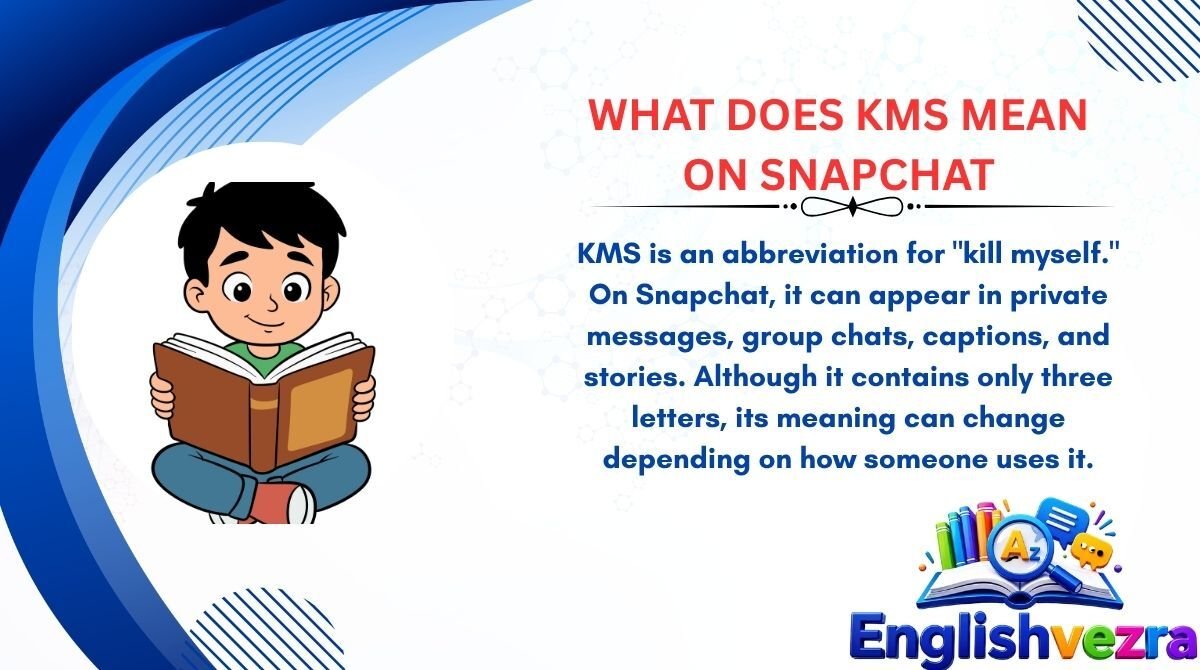
KMS is an abbreviation for “kill myself.” On Snapchat, it can appear in private messages, group chats, captions, and stories. Although it contains only three letters, its meaning can change depending on how someone uses it.
What Does KMS Mean in Slang?
In internet slang, KMS sometimes describes an overwhelming feeling. Someone might use it after an embarrassing moment, a disappointing result, or an unpleasant experience.
For example:
- “I forgot about my presentation, kms.” — Expressing embarrassment or stress.
- “Another exam tomorrow, kms.” — Showing frustration about schoolwork.
- “I’ve been feeling hopeless lately, kms.” — Potentially expressing serious emotional distress.
The first two examples might be exaggerations, but the third raises concern. Even when someone appears to be joking, you should not automatically assume they are safe.
Is KMS Always Serious?
No, KMS is not always intended literally. Some people use it as dramatic internet humor. However, its literal meaning refers to suicide, making it different from harmless expressions such as LOL or OMG.
A message can be serious even when it includes emojis, laughter, or casual wording.
If someone repeatedly uses KMS, mentions feeling worthless, or talks about not wanting to live, those messages deserve particular attention.
Why Context Matters
Snapchat conversations often lack the facial expressions and voice tone that help people understand meaning.
Consider these two messages:
Message A: “My phone died right before the concert, kms 😭.”
Message B: “Nobody cares about me anymore. Kms.”
The first might describe an annoying situation. The second could indicate genuine emotional pain.
The safest approach is to recognize the possible meanings without dismissing the sender’s feelings.
Background: Where Did KMS Come From?
KMS developed as part of the wider culture of internet abbreviations. Online communication encourages short expressions because they are quick to type and easy to recognize.
There is no reliably established single inventor or exact creation date for this abbreviation.
Early Internet Slang
Long before Snapchat became popular, internet users shortened common phrases in text messages, online forums, and instant messaging platforms.
Examples include:
- LOL — Laughing out loud
- BRB — Be right back
- IDK — I don’t know
- OMG — Oh my God
KMS follows the same initial-letter pattern, although its meaning is much more sensitive.
As online humor developed, some users began using serious phrases as exaggerated reactions to ordinary problems. KMS became one expression used in that style of communication.
How KMS Became Common on Snapchat
Snapchat encourages fast conversations through disappearing messages, photos, videos, and private stories.
These features make short abbreviations convenient, particularly among users familiar with internet slang.
Someone might type KMS rather than writing a longer sentence about their feelings.
However, Snapchat did not create the abbreviation, and it is not exclusive to the platform.
The Influence of Meme Culture
Internet memes often use exaggeration to make ordinary situations seem dramatic.
For example, a person might describe a small mistake as a complete disaster.
KMS sometimes appears in this type of humor, but its connection to suicide makes it potentially upsetting or alarming.
How Its Usage Has Changed
As awareness of mental health has grown, more people have recognized that expressions involving self-harm can affect others.
Some users avoid KMS because they do not want to make light of suicide. Others continue using it without intending harm.
The important distinction is between the sender’s intended tone and the actual meaning of the words.
Usage in Different Contexts
KMS does not always communicate the same intention. Understanding where it appears can help you interpret it more accurately.
1. KMS in Casual Chat
Friends sometimes use KMS as an exaggerated response to frustration.
Example:
Friend: “We have three assignments due tomorrow.”
Reply: “Kms, I haven’t even started.”
Here, the sender may be expressing stress rather than describing an intention to hurt themselves.
Still, the message alone cannot prove that interpretation.
2. KMS on Social Media
On Snapchat, Instagram, TikTok, and other platforms, KMS can appear in captions, comments, or replies.
A person might post:
“Accidentally sent that Snap to the wrong person. Kms.”
The message could be an exaggerated expression of embarrassment.
However, a post describing loneliness, hopelessness, or personal suffering requires more careful attention.
3. KMS in Professional Communication
KMS is generally inappropriate in professional emails, workplace messages, and formal discussions.
Its slang meaning can cause confusion or concern, especially when coworkers do not share the same communication style.
For example, instead of writing:
“This deadline is impossible, kms.”
A clearer workplace message would be:
“I’m feeling overwhelmed by this deadline and need help prioritizing the work.”
This communicates frustration without suggesting self-harm.
4. KMS in Casual Conversations
Outside texting, someone might say the full phrase aloud, sometimes as an exaggeration.
However, spoken words also require context.
Tone, behavior, and previous conversations can provide clues, but they cannot reliably establish whether a person is at risk.
5. KMS in Emotional Conversations
When someone uses KMS while discussing depression, rejection, isolation, or personal struggles, it may indicate suicidal thoughts.
In those situations, avoid treating the message as a joke.
A caring response could be:
“I’m worried about you. Are you thinking about hurting yourself?”
Asking directly can help clarify what the person means and whether immediate support is needed.
KMS Meaning in Chat, WhatsApp, Instagram, and TikTok
Although Snapchat is a common place to encounter KMS, the abbreviation also appears across other messaging and social media platforms.
Its basic slang meaning remains the same, but the surrounding conversation influences its interpretation.
KMS Meaning in Snapchat Chat
Snapchat users may include KMS in text messages, private stories, or photo captions.
For example:
“I just realized I studied the wrong chapter, kms.”
The sender may be exaggerating their frustration.
Because Snapchat messages can disappear, important context may also be missing.
If a message worries you, respond directly rather than relying on assumptions.
KMS Meaning on WhatsApp
On WhatsApp, KMS can appear in personal conversations and group chats.
For example:
Person A: “How are you feeling today?”
Person B: “Not good. Everything feels pointless. Kms.”
This message could be a warning sign, particularly if the person has been struggling emotionally.
A supportive reply is more appropriate than a laughing emoji or another joke.
KMS Meaning on Instagram
Instagram users may include KMS in comments, direct messages, or story replies.
Example:
“Posted the wrong photo by accident, kms.”
In this context, it might express embarrassment.
However, comments mentioning self-harm should not be automatically dismissed as internet humor.
KMS Meaning on TikTok
On TikTok, KMS may appear in reaction comments, video captions, or discussions about difficult experiences.
Some users employ it as exaggerated humor, while others may be communicating distress.
A public comment provides limited information about the person’s situation.
Comparison Across Platforms
| Platform | Where KMS appears | Possible context |
|---|---|---|
| Snapchat | Snaps, stories, chats | Frustration or distress |
| Personal and group messages | Emotional conversations | |
| Comments, stories, DMs | Embarrassment or distress | |
| TikTok | Comments and captions | Dramatic reactions or serious feelings |
| Discord | Community and private chats | Gaming frustration or emotional distress |
The platform does not determine whether the expression is serious. The person’s words, circumstances, and wellbeing matter more.
KMS Meaning in Physics, Medical, and Aircraft Terminology
KMS can also appear outside internet slang. However, technical meanings should not be confused with its Snapchat definition.
KMS in Physics
In physics, km/s means kilometers per second.
It measures speed or velocity and is commonly used in astronomy and other scientific discussions.
For example:
“A spacecraft is moving at 8 km/s.”
This means the spacecraft travels eight kilometers every second.
The correct scientific notation uses a slash and appropriate capitalization.
Therefore, km/s is not the same abbreviation as KMS in Snapchat slang.
KMS in Medical Terminology
KMS is not a universally recognized medical abbreviation for one specific condition.
Certain healthcare organizations or technical systems may use these letters for specialized terms, but their meanings depend on the setting.
The slang phrase behind KMS is not a formal medical diagnosis.
If someone uses KMS while discussing mental health, the important issue is their wellbeing, not whether the abbreviation is an official medical term.
KMS in Aircraft and Aviation Terminology
KMS is not a standard, universally recognized aviation abbreviation with one fixed meaning.
Aviation uses many abbreviations, identifiers, and technical codes, so unfamiliar letters must be interpreted through their specific documentation.
Speed in aviation is often measured in knots, while scientific discussions may use kilometers per second.
It would be inaccurate to assign KMS a universal aircraft meaning without a reliable context.
Key Differences
| Context | Meaning | Important detail |
|---|---|---|
| Snapchat slang | Kill myself | May express exaggeration or serious distress |
| Physics | km/s = kilometers per second | Scientific speed unit |
| Medical | No single universal meaning | Depends on specific documentation |
| Aviation | No single universal meaning | Depends on the technical context |
Common Misconceptions About KMS
Because KMS appears in different settings, people sometimes misunderstand its meaning or seriousness.
Misconception 1: KMS Always Means Someone Is Joking
This is incorrect.
Although some users employ KMS as exaggeration, others may use it to communicate genuine suicidal thoughts.
A person can also hide serious feelings behind humor.
Never assume a concerning message is harmless simply because it includes an emoji.
Misconception 2: KMS Is a Snapchat-Specific Feature
KMS is not a special Snapchat function, setting, or notification.
It is a slang abbreviation used across multiple online platforms.
Snapchat users may encounter it frequently, but the app did not invent it.
Misconception 3: KMS Means Kiss Me Slowly
Some people suggest alternative interpretations such as “kiss me slowly.”
However, this is not the established common meaning of KMS in Snapchat slang.
An unusual private meaning is possible if two people have explicitly agreed on it, but it should not be assumed.
Misconception 4: Emojis Prove KMS Is Harmless
A laughing emoji or crying emoji does not establish someone’s emotional state.
People sometimes use humor to manage uncomfortable feelings.
For example:
“I’m so tired of everything, kms 😂.”
This could be exaggeration, but the emoji alone does not confirm that.
Misconception 5: KMS Is the Same as KM
KMS and KM are different abbreviations.
KM commonly represents a kilometer in measurement, while KMS has a distinct meaning in online slang.
Capitalization and context are important.
Misconception 6: You Should Ignore KMS Messages
Ignoring a concerning message can leave someone feeling unsupported.
If you are uncertain about the person’s intentions, a simple check-in is appropriate.
You do not need to diagnose the situation to show concern.
Similar Terms & Alternatives to KMS
Several internet abbreviations and expressions relate to strong emotions, frustration, or mental health.
However, they do not all carry the same meaning.
1. KYS — Kill Yourself
KYS is an abbreviation for “kill yourself.”
Unlike KMS, which refers to the speaker, KYS is directed toward another person.
It is often abusive or threatening and should not be treated as harmless teasing.
2. FML — F*** My Life
FML expresses frustration, disappointment, or annoyance.
Example:
“Missed the bus again. FML.”
It is commonly used as exaggeration and does not directly express a desire for self-harm.
3. SMH — Shaking My Head
SMH communicates disbelief, disappointment, or disapproval.
Example:
“He forgot his own birthday. SMH.”
It is generally less alarming than KMS.
4. ISTG — I Swear to God
ISTG adds emphasis to frustration, surprise, or a strong statement.
Example:
“ISTG, this app keeps crashing.”
It does not inherently refer to self-harm.
5. IDK — I Don’t Know
IDK communicates uncertainty.
Example:
“IDK what to do about this assignment.”
It can appear in emotional conversations but does not carry the same meaning as KMS.
6. IJBOL — I Just Burst Out Laughing
IJBOL is used to describe a strong laughing reaction.
It belongs to humorous internet slang rather than expressions involving self-harm.
Safer Alternatives for Expressing Frustration
Instead of using KMS casually, someone might write:
- “I’m so frustrated right now.”
- “That was incredibly embarrassing.”
- “I can’t believe that happened.”
- “I’m having a rough day.”
- “This is stressing me out.”
These expressions communicate feelings more clearly without introducing a reference to suicide.
How to Respond When Someone Says KMS on Snapchat
Your response should depend on the message, your relationship with the sender, and whether you have reason to worry about their safety.
When in doubt, check in rather than assume.
1. Respond to an Apparently Casual Message
If a friend uses KMS after a minor inconvenience, you can acknowledge the frustration while checking how they feel.
Example:
Friend: “I spilled coffee on my notes, kms.”
You: “That’s so frustrating. Are you okay?”
This keeps the conversation natural without making assumptions.
2. Respond When Someone Seems Upset
If the message sounds emotionally serious, respond with care.
Example:
Friend: “Everything keeps going wrong. Kms.”
You: “I’m sorry things are so hard right now. Do you want to talk about what’s happening?”
This gives the person an opportunity to share more.
3. Ask Directly About Safety
If someone describes hopelessness, wanting to disappear, or not wanting to live, ask a clear question.
For example:
“Are you thinking about suicide or hurting yourself?”
Asking directly does not put the idea into someone’s head. It can help you understand whether they need urgent support.
4. What to Do if the Person Is in Immediate Danger
If someone says they intend to act soon, has already harmed themselves, or appears to be in immediate danger, treat it as urgent.
Try to stay connected with them while arranging help.
Contact local emergency services or a trusted person who can reach them safely. If you know their location, share it with emergency responders when necessary.
If you are both teenagers, involve a trusted adult rather than handling the situation alone.
5. What Not to Say
Avoid responses that dismiss or shame the sender, such as:
- “You’re just being dramatic.”
- “Stop looking for attention.”
- “Everyone has problems.”
- “You’re obviously joking.”
Instead, communicate concern and listen.
6. If a Stranger Posts KMS
You can still respond kindly, even if you do not know the person.
For example:
“Your message sounds worrying. Are you safe right now?”
You may also use the platform’s safety reporting tools when a post suggests a risk of self-harm.
Differences Between KMS and Similar Slang Words
KMS is sometimes grouped with other dramatic online expressions, but important differences exist in meaning and tone.
KMS vs. FML
KMS literally refers to killing oneself.
FML expresses frustration with life or a particular situation.
Both may appear after an unpleasant event, but FML does not directly reference suicide.
KMS vs. KYS
KMS refers to the person writing the message.
KYS is directed at another person and can be used as harassment.
This difference matters because KYS can be threatening or deeply hurtful.
KMS vs. SMH
SMH means shaking my head.
It typically expresses disappointment or disbelief.
KMS has a much more serious literal meaning, even when used casually.
KMS vs. LOL
LOL means laughing out loud.
It usually indicates amusement.
KMS can appear in humorous conversations, but its literal meaning makes it unsuitable as a direct replacement for LOL.
Comparison Table
| Term | Full form | Typical use | Tone |
|---|---|---|---|
| KMS | Kill myself | Frustration or possible suicidal thoughts | Potentially serious |
| KYS | Kill yourself | Hostile or abusive message | Harmful |
| FML | F*** my life | Annoyance or disappointment | Casual frustration |
| SMH | Shaking my head | Disapproval or disbelief | Mild |
| LOL | Laughing out loud | Amusement | Playful |
| ISTG | I swear to God | Strong emphasis | Depends on context |
These distinctions help prevent misunderstandings, especially when interpreting short messages without much background.
KMS in Online Conversations and Dating Apps
KMS can appear in online friendships, romantic conversations, group chats, and dating apps.
The relationship between the sender and receiver often affects how a message is understood.
KMS Between Friends
Close friends may share a communication style that includes exaggerated expressions.
For example:
“I just waved at someone who wasn’t waving at me, kms.”
The sender may be describing embarrassment.
However, familiarity does not eliminate the possibility of genuine distress.
KMS in Romantic Conversations
In a romantic conversation, KMS might appear after an awkward moment, an argument, or a difficult personal discussion.
For example:
“I feel like I’m ruining everything. Kms.”
This message deserves attention because it may communicate more than ordinary embarrassment.
A supportive response could be:
“I’m concerned about what you just said. Are you safe?”
KMS on Dating Apps
Dating apps such as Tinder, Bumble, and Hinge involve conversations between people who may not know each other well.
If someone uses KMS, it can be difficult to understand their intention.
Without an established relationship, avoid assuming that a dramatic statement is flirtation or humor.
Can KMS Be Flirty?
KMS is not a standard flirting abbreviation.
Someone might use it during an awkward romantic exchange, but that does not make the expression inherently romantic.
For example:
“I accidentally liked your photo from three years ago, kms.”
The sender may be embarrassed about showing interest.
The romantic context does not change the abbreviation’s literal meaning.
Why Online Context Matters
Digital communication can hide emotional cues.
A short message may be missing the tone, facial expression, or background information needed to interpret it confidently.
This is especially important when the message involves suicide-related language.
If you are concerned, a direct and compassionate conversation is more useful than trying to decode every emoji or punctuation mark.
FAQs
1. What Does KMS Mean in Text Messages From a Friend?
KMS usually means “kill myself” in text messages. A friend may use it as an exaggerated expression of frustration or embarrassment, but it can also indicate genuine suicidal thoughts. The surrounding conversation helps explain the intended tone. If the message sounds concerning, ask your friend whether they are safe rather than assuming they are joking.
2. What Does KMS Mean on Snapchat From a Girl?
KMS has the same common meaning regardless of the sender’s gender. A girl might use it to express embarrassment, frustration, sadness, or serious emotional distress. There is no separate standard meaning for girls on Snapchat. Pay attention to the message and situation rather than interpreting the abbreviation differently because of who sent it.
3. What Does KMS Mean on Snapchat From a Guy?
KMS generally means “kill myself” when sent by a guy on Snapchat. It may be used as dramatic slang or as a genuine expression of distress. Gender does not determine whether the message is serious. If he mentions hopelessness, self-harm, or feeling unable to cope, respond supportively and ask directly about his safety.
4. Is KMS Considered Offensive or Inappropriate Slang?
KMS can be considered inappropriate because its literal meaning refers to suicide. Some people find casual use upsetting, particularly those affected by suicide or mental health struggles. It is best avoided in professional communication and conversations where its meaning could cause harm or confusion. Clear alternatives can express frustration without referencing self-harm.
5. Does KMS Mean the Same Thing on Snapchat and TikTok?
Yes, KMS generally has the same slang meaning on Snapchat and TikTok. Users on both platforms may employ it in jokes, dramatic reactions, or serious discussions about emotional pain. The platform does not change the definition. What matters is the context, the sender’s circumstances, and whether the message suggests a genuine safety concern.
6. What Should I Do if Someone Keeps Saying KMS?
If someone repeatedly says KMS, check on their emotional wellbeing rather than dismissing the messages. Ask how they are feeling and whether they are thinking about suicide. Encourage them to speak with someone they trust or a mental health professional. If they appear to be in immediate danger, contact emergency services or someone who can provide immediate help.
7. Does KMS Mean Kilometers on Snapchat?
KMS usually does not mean kilometers in ordinary Snapchat slang. Its common meaning is “kill myself.” However, “kms” can also be used informally as a plural abbreviation for kilometers when discussing distance, such as “10 kms away.” The surrounding words normally make the distinction clear. In scientific writing, the standard symbol for kilometer is km.
8. Can Someone Use KMS as a Joke Without Being Suicidal?
Yes, some people use KMS as exaggerated humor without intending to describe suicidal thoughts. However, you cannot determine someone’s safety from the abbreviation alone. Even messages accompanied by laughing emojis may deserve a check-in. If the person seems distressed or the meaning is unclear, asking how they are feeling is a thoughtful response.
Conclusion
Understanding what does KMS mean on Snapchat is important because the abbreviation can carry different intentions. Its common slang meaning is “kill myself,” and users sometimes include it in messages to express embarrassment, frustration, or emotional distress.
Although it may appear in casual jokes, its literal meaning should never be ignored. A message that seems playful to one person might be upsetting to another, and someone experiencing genuine difficulties may use casual language to describe serious feelings.
KMS is also found on WhatsApp, Instagram, TikTok, and other online platforms. Its meaning depends on the conversation rather than the app itself.
When someone sends KMS, consider their words, recent behavior, and emotional state. If you are unsure whether they are safe, ask directly and respond with kindness.
The most important lesson is simple: understand the slang, respect its seriousness, and never dismiss a possible request for help.

Samuel Hartwell is an English language educator and word enthusiast who enjoys explaining meanings in simple, clear ways. He creates helpful content to make English vocabulary easier to understand and learn.