If a girl sends you the 🙂 emoji in a text, you may immediately wonder what she is trying to say. A simple smiling face can feel surprisingly complicated because its meaning often depends on the conversation, the relationship between two people, and the words surrounding it. Unlike a long message, an emoji can communicate emotion without directly explaining it.
The 🙂 emoji is commonly seen in text messages, WhatsApp chats, Instagram DMs, TikTok comments, Snapchat conversations, and dating apps. People often use it to make a message appear friendly, polite, calm, or less serious. However, it can sometimes feel awkward, distant, or even slightly passive-aggressive depending on the situation.
When the emoji comes from a girl, its meaning is not automatically different from when anyone else uses it.
The most useful way to understand it is to look at the entire conversation rather than focusing on the emoji alone. Her wording, response time, relationship with you, and the topic being discussed can all provide important clues.
Quick Answer
The meaning of this emoji 🙂 from a girl usually suggests a gentle smile, friendliness, politeness, or a calm response. In texting, she may use it to make a message feel warmer or less blunt. However, depending on the conversation, 🙂 can also express awkwardness, mild discomfort, emotional distance, or restrained irritation.
Meaning & Definition
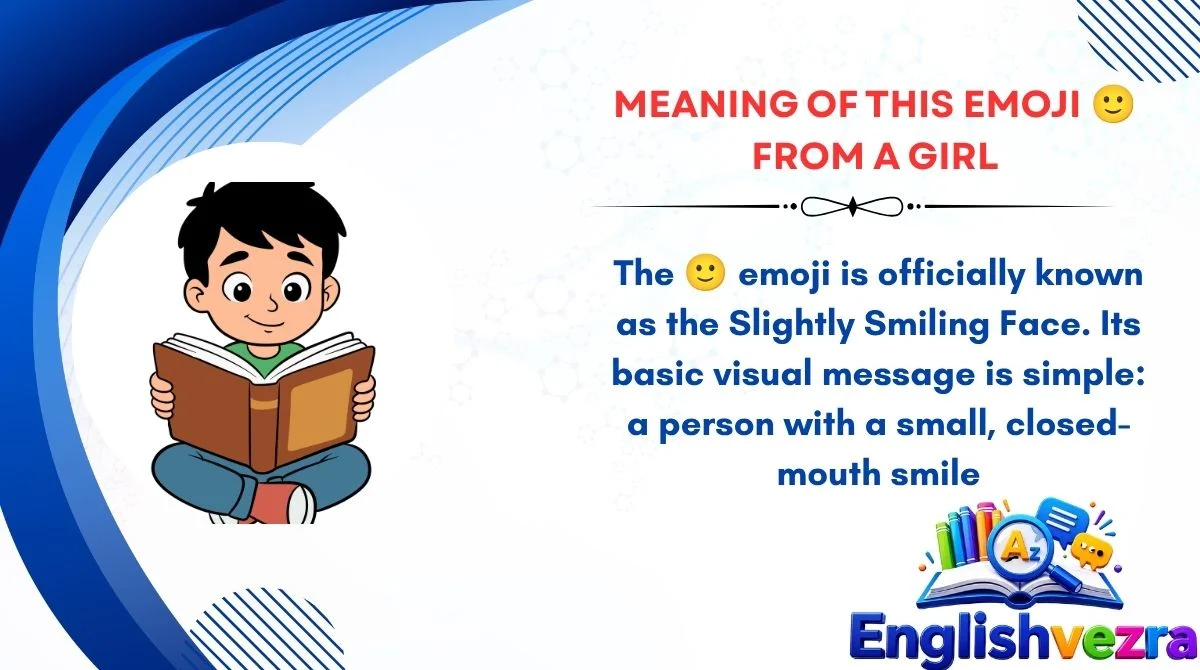
The 🙂 emoji is officially known as the Slightly Smiling Face. Its basic visual message is simple: a person with a small, closed-mouth smile. At its most straightforward level, it communicates a mild positive emotion rather than intense happiness.
When a girl sends 🙂, she may simply be trying to sound friendly. For example:
“That sounds good 🙂”
In this situation, the emoji can make the message feel warmer and more pleasant.
It can also soften a short response. Compare:
- “Okay.”
- “Okay 🙂”
The second version may feel friendlier because the emoji adds a small amount of positive emotion.
However, 🙂 does not always mean that the sender is genuinely excited or extremely happy. The smile is intentionally subtle. That makes it different from emojis such as 😍, 😂, 🤣, or 🥰, which usually communicate stronger emotions.
The context becomes especially important when the message itself sounds unusual. For example:
“Sure, do whatever you want 🙂”
Here, the emoji could be completely harmless, but it could also suggest frustration, disappointment, or sarcasm depending on what happened earlier.
This is why there is no universal translation such as “she likes you” or “she is angry.” The emoji itself does not reveal her exact feelings.
Another important point is that being sent by a girl does not give 🙂 a completely separate dictionary meaning. Gender does not determine the official definition. What changes is the personal context between the sender and receiver.
Background
The 🙂 symbol belongs to the wider development of modern emoji communication. Emojis were developed as small visual characters that could add emotional or contextual information to digital messages.
The Slightly Smiling Face eventually became part of the standardized emoji set used across modern digital platforms. Its appearance may vary slightly between Apple, Google, Microsoft, Samsung, and other systems, but the general idea remains a subtle smile.
Before modern emojis became common, people frequently used text-based expressions such as :) to communicate a smile. Emojis provided a more visual way to express similar feelings.
It is important to distinguish the standardized meaning of the emoji from the way people use it socially. The official concept of 🙂 is a slight smile, but everyday communication is much more flexible.
For example, a person can use a smile while feeling:
- genuinely happy
- politely friendly
- slightly awkward
- emotionally neutral
- uncomfortable
- sarcastic
- disappointed
- mildly annoyed
That does not mean the emoji has multiple official definitions. Rather, human communication allows the same symbol to take on different meanings according to context.
This is particularly noticeable in texting because written communication does not include facial expressions, voice tone, or body language. An emoji can therefore become a small substitute for those missing signals.
As digital communication evolved, people also developed personal habits with emojis. One person may use 🙂 constantly, while another may use it only when they want to sound particularly careful or restrained.
Therefore, understanding a girl’s personal texting style can be more useful than trying to memorize one fixed interpretation.
NTM Meaning in Text: What Does NTM Mean in Chat and Social Media?
LWK Meaning in Text: What Does LWK Mean in Chat and Social Media?
Usage in Different Contexts
The meaning of 🙂 can change significantly depending on where and how it is used.
In Chat
In ordinary conversation, 🙂 often makes a message sound friendly and relaxed.
Example:
“Yeah, I can help you with that 🙂”
This usually has a positive or cooperative tone.
A short message such as:
“Okay 🙂”
can simply mean “Okay, no problem.”
But if the conversation involves an argument, the same emoji can feel emotionally different.
“Fine 🙂”
could sound like genuine acceptance, or it could suggest that the person is not completely happy.
On Social Media
On Instagram, TikTok, Facebook, or other platforms, 🙂 can be used in comments and direct messages to communicate friendliness or a mild reaction.
Someone might comment:
“That’s actually funny 🙂”
The emoji can make the comment feel softer.
In Professional Communication
In professional environments, 🙂 may be used to make a message appear less cold.
For example:
“Thanks for sending that over 🙂”
Here, it can add friendliness without being overly emotional.
However, professional communication should still consider the relationship and workplace culture. An emoji that feels normal between coworkers may not be appropriate in every formal situation.
In Casual Conversations
Among friends, 🙂 can simply be part of someone’s normal texting style. If she uses it frequently with everyone, you should not automatically interpret it as a hidden romantic signal.
The key lesson is simple: the surrounding words matter more than the emoji by itself.
Meaning in Chat, WhatsApp, Instagram, and TikTok
On messaging and social media platforms, 🙂 is often used as an emotional modifier. It can change how a sentence feels without changing the literal words.
For example:
“Thank you.”
This can sound neutral.
“Thank you 🙂”
This may sound warmer or more appreciative.
Another example:
“I guess that’s fine.”
This may sound uncertain.
“I guess that’s fine 🙂”
Depending on the conversation, the emoji could make it sound relaxed—or strangely restrained.
On WhatsApp, the emoji frequently appears at the end of ordinary messages. A girl might send it simply because she wants to keep the conversation friendly.
In Instagram DMs, 🙂 can accompany casual conversation, reactions, compliments, or short replies. The surrounding conversation is particularly important because DMs can range from friendly conversations to romantic discussions.
TikTok
On TikTok, people may use 🙂 in comments or private messages as a mild reaction. It can sometimes communicate amusement, awkwardness, or a deliberately understated response.
When She Sends It After a Compliment
If you compliment her and she replies:
“Aww thank you 🙂”
the emoji generally makes the response feel pleasant and friendly. However, it does not automatically prove romantic interest.
When She Sends It After a Question
If she answers:
“Yeah, maybe 🙂”
the emoji may simply soften an uncertain answer.
The safest approach is to read the complete message and conversation pattern, not just one emoji.
Meaning in Physics, Medical, and Aircraft Terminology
The 🙂 emoji does not have a recognized technical meaning in standard physics, medical terminology, or aircraft/aviation terminology.
Physics
In physics, 🙂 is not a standard scientific symbol representing a physical quantity, law, unit, or commonly recognized concept.
Medical Terminology
In medicine, 🙂 is not a standard medical abbreviation or diagnostic symbol. If you see it in a medical conversation, it is generally being used as an ordinary emoji rather than as professional terminology.
Aircraft and Aviation
In aviation, 🙂 is not a standard aircraft designation, flight symbol, or recognized technical abbreviation.
This distinction matters because people sometimes search for unusual meanings of familiar symbols in specialized fields. Unless a specific organization or document has assigned a private meaning to the character, the ordinary emoji interpretation should be used.
Therefore, if someone sends 🙂 in a normal message, you should interpret it as an emoji rather than a physics, medical, or aviation term.
Common Misconceptions
One of the biggest misunderstandings about 🙂 is assuming that it always means happiness.
A slight smile can communicate friendliness, but communication is more complicated than a dictionary definition.
Misconception 1: “She definitely likes me.”
Not necessarily. A girl may use 🙂 because she is friendly, polite, or simply accustomed to using the emoji.
Misconception 2: “She is definitely angry.”
Again, not necessarily. Some people interpret 🙂 as passive-aggressive because they have encountered it in tense conversations. But the emoji itself does not automatically mean anger.
Misconception 3: “The emoji has a secret meaning when a girl sends it.”
There is no universal secret meaning that applies specifically when a girl uses 🙂. Her individual communication style matters.
Misconception 4: “A smile always means excitement.”
The smile is slight, so it usually communicates a softer emotion than strong excitement.
Misconception 5: “One emoji tells me exactly how she feels.”
An emoji is only one small piece of communication. The words, conversation history, relationship, and situation provide much more information.
Similar Terms & Alternatives
Several emojis and expressions can appear similar to 🙂 but carry different emotional shades.
| Emoji / Expression | Common Impression |
|---|---|
| 🙂 | Slight smile, friendliness, mild positivity |
| 😊 | Warm happiness, friendliness, genuine pleasure |
| 😌 | Relief, peacefulness, contentment |
| 😄 | Stronger happiness or cheerful excitement |
| 😁 | Broad grin, enthusiasm |
| 😅 | Nervousness, awkwardness, relief |
| 🙃 | Irony, awkwardness, playful frustration |
| 😐 | Neutral or emotionally flat |
| “Okay” | Neutral acceptance |
| “Sure” | Agreement, though tone depends on context |
| “Haha” | Light amusement or conversational friendliness |
The difference between 🙂 and 😊 is particularly important.
🙂 often feels more restrained.
😊 usually feels warmer and more openly cheerful.
Likewise, 🙂 and 🙃 should not be treated as identical. The upside-down smile often carries an ironic or intentionally awkward feeling that is not normally part of the basic meaning of 🙂.
How to Respond to It
How you respond should depend on what she actually said.
If her message is friendly, you can respond naturally without overthinking the emoji.
For example:
“Haha, sounds good 🙂”
Or:
“Glad we’re on the same page!”
If you think she is being playful, you can match the energy:
“That smile makes me suspicious 😂”
If the conversation is romantic and she sends 🙂 after a flirtatious message, you can keep your response light rather than immediately assuming she is interested.
For example:
“I’m taking that smile as a good sign 😄”
If her message seems cold or uncertain, avoid making a dramatic interpretation. Instead, continue the conversation normally.
For example:
“Everything okay?”
If you believe she may be uncomfortable, giving her space is often better than repeatedly asking what the emoji means.
The best response is usually one that addresses the actual message, rather than treating 🙂 as a coded statement that must be decoded.
Differences from Similar Words
The meaning of 🙂 becomes clearer when compared with ordinary texting expressions.
“Okay” vs. “Okay 🙂”
“Okay” is relatively neutral. Adding 🙂 can make it sound softer or friendlier.
“Thanks” vs. “Thanks 🙂”
“Thanks” communicates gratitude. “Thanks 🙂” can add warmth and friendliness.
“Sure” vs. “Sure 🙂”
“Sure” can be completely neutral. The emoji may make it sound more relaxed, but depending on the conversation, it can also make the response feel restrained.
🙂 vs. ❤️
A smile should not automatically be interpreted as romantic affection. A heart usually carries a stronger emotional or affectionate association.
🙂 vs. 😊
Both can communicate positivity, but 😊 generally looks warmer and more openly happy, while 🙂 can feel subtle or restrained.
🙂 vs. 😏
The smirking face often has a teasing, suggestive, or knowing quality. 🙂 does not inherently carry that meaning.
This is why replacing one emoji with another can significantly change the emotional tone of a message.
Relevance in Online Conversations & Dating Apps
In online dating, emoji interpretation can become especially confusing because people often communicate with fewer words.
If a girl sends:
“That was fun 🙂”
after meeting you, the emoji may reinforce a positive and friendly tone. But it does not independently confirm romantic interest.
Similarly:
“Maybe we can do that sometime 🙂”
could be genuine openness, casual friendliness, or polite uncertainty. The rest of her communication pattern matters.
Look for broader signals instead of focusing on one emoji:
- Does she continue the conversation?
- Does she ask you questions?
- Does she initiate messages?
- Does she suggest meeting again?
- Does she respond enthusiastically to your messages?
- Does her communication feel consistent?
A single 🙂 cannot answer these questions.
On social media, the meaning can also depend on the relationship. A close friend may use it casually, while someone you barely know might use it mainly as a polite way to soften a response.
In dating conversations, it is particularly important not to overinterpret small digital signals. People have different emoji habits, and some users place emojis in almost every message.
The healthiest interpretation is to consider 🙂 as a tone signal rather than a definitive emotional confession.
FAQs
What does this emoji 🙂 mean in text from a girl?
The 🙂 emoji usually means a slight smile, friendliness, politeness, or mild positivity. A girl may add it to make a message feel warmer or less blunt. However, its exact tone depends on the conversation. In a tense exchange, the same emoji can sometimes feel awkward, restrained, or passive-aggressive.
What does 🙂 mean in chat?
In chat, 🙂 commonly communicates a gentle smile or friendly tone. It can soften short responses such as “Okay 🙂” or “Sure 🙂.” It does not automatically indicate romantic interest. The words around the emoji and the sender’s usual texting style are important for understanding what she intended.
Is 🙂 a slang term?
No, 🙂 is not a slang term. It is an emoji representing a Slightly Smiling Face. People can use it in slang-like or informal ways, including sarcasm or awkward humor, but those interpretations come from context rather than from the emoji having an official slang definition.
What does 🙂 mean on social media?
On social media, 🙂 usually communicates a mild smile, friendliness, or a calm reaction. It can appear in comments, replies, captions, and direct messages. Depending on the conversation, someone may also use it to make an uncomfortable or restrained response appear less harsh.
Does 🙂 mean a girl likes you?
Not necessarily. A girl using 🙂 does not by itself prove romantic interest. She may simply be friendly, polite, or using the emoji as part of her normal texting style. To understand possible romantic interest, consider her overall behavior, conversation effort, and whether she actively tries to maintain contact.
How should I respond when a girl sends 🙂?
Respond to the message rather than overanalyzing the emoji. If she says something friendly, continue naturally. For example, you might say, “Sounds good!” or “Haha, glad you agree.” If the conversation seems uncomfortable, ask about the situation directly instead of assuming that 🙂 means anger or attraction.
Can 🙂 mean sarcasm?
Yes, 🙂 can sometimes be used sarcastically, especially during an argument or uncomfortable exchange. However, sarcasm is not the emoji’s universal meaning. The wording, previous messages, and relationship between the people determine whether the smile is genuine or sarcastic.
What is the difference between 🙂 and 😊?
🙂 generally communicates a subtle or mild smile, while 😊 often feels warmer, happier, and more openly affectionate. Neither emoji has a guaranteed romantic meaning. The sender’s personal habits and the context of the conversation should be considered before interpreting either one.
Conclusion
The 🙂 emoji is simple in appearance but flexible in real-world communication. Its basic meaning is a slight smile, and it commonly adds friendliness, politeness, calmness, or mild positivity to a message. When a girl sends it, however, the emoji should not automatically be interpreted as proof that she likes you, dislikes you, or is secretly angry.
Context is the most important factor. A message such as “Thanks 🙂” will usually feel different from “Fine 🙂” during an argument. Her normal texting habits also matter because some people use the emoji frequently while others use it only in specific situations.
The same principle applies to WhatsApp, Instagram, TikTok, dating apps, and ordinary text messages. Instead of decoding one symbol in isolation, consider the words around it and the overall relationship.
In short, 🙂 is usually friendly and mild, but its emotional tone can shift with context. If you are unsure, focus on the complete conversation rather than treating the emoji as a secret code.

Samuel Hartwell is an English language educator and word enthusiast who enjoys explaining meanings in simple, clear ways. He creates helpful content to make English vocabulary easier to understand and learn.