If someone sends you “TIA” in a message, comment, email, or online conversation, you may wonder what those three letters mean.
Texting abbreviations are everywhere today, especially on messaging apps and social media, where people often shorten phrases to communicate quickly. TIA is one of those abbreviations that can be confusing because its meaning depends heavily on context.
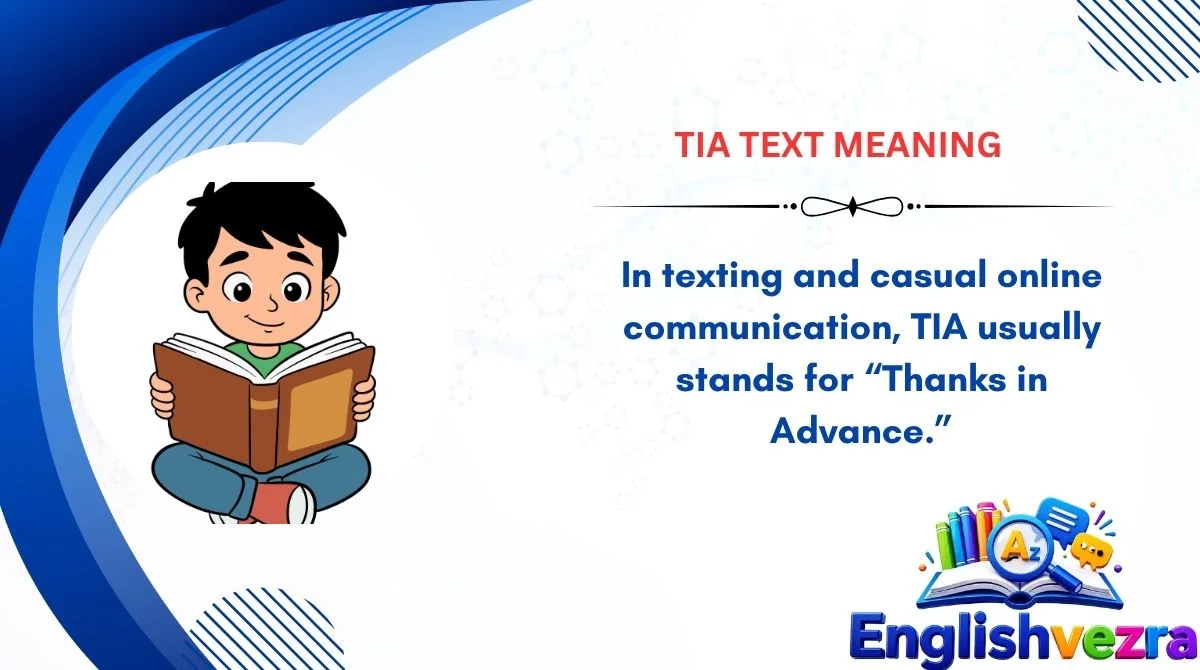
In everyday texting and online communication, TIA most commonly means “Thanks in Advance.” People use it when they are asking someone for help, information, advice, or a favor and want to thank that person beforehand. For example, someone might write, “Can anyone tell me how to fix this? TIA!”
However, TIA can also have completely different meanings in professional or specialized contexts. In medicine, for example, TIA commonly refers to transient ischemic attack, which is a serious medical term.
Understanding the surrounding conversation is therefore important before deciding what TIA means.
Quick Answer
TIA text meaning is usually “Thanks in Advance.” It is commonly added to a message when someone asks for help, information, or a favor and wants to express thanks beforehand. For example, “Does anyone know a good restaurant nearby? TIA!” means “Thanks in advance!” The abbreviation can have different meanings in medical or specialized contexts.
Meaning & Definition
In texting and casual online communication, TIA usually stands for “Thanks in Advance.” It is a short and convenient way to thank someone before they have actually provided the requested help, information, or favor.
The phrase is generally used after a question or request. Instead of writing a complete sentence such as “Thank you in advance for your help,” a person may simply add “TIA” at the end.
For example:
- “Does anyone know where I can find this book? TIA!”
- “Please send me the address when you get a chance. TIA.”
- “Can someone explain how this works? TIA!”
- “Looking for recommendations for a good laptop. TIA!”
The abbreviation does not normally change the basic meaning of the message. It simply makes the expression shorter.
Is TIA slang?
TIA can be considered an internet abbreviation rather than traditional slang. It became useful in environments where people wanted to communicate quickly, particularly in online discussions, forums, emails, chats, and social media.
Its tone is usually friendly and informal. However, “thanks in advance” itself is not inherently slang, so TIA can sometimes appear in semi-professional online communication too.
One important point is that TIA does not always mean “Thanks in Advance.” If the conversation involves medicine, for example, the same abbreviation can refer to something completely different. Context should always be considered.
Background
The abbreviation TIA developed from the phrase “Thanks in Advance.” Like many online abbreviations, it is essentially a shortened form created to save time and space when communicating electronically.
There is no single confirmed moment when TIA was first created or introduced into internet communication. It is better understood as part of the broader development of abbreviated online language. People have long shortened common phrases in emails, forums, instant messages, and text conversations.
The logic behind the abbreviation is simple:
Thanks in Advance → TIA
The first letters of the three words form the abbreviation.
This type of shortening became particularly useful in online communities where users regularly asked questions or requested assistance. A person could post a question and add “TIA” instead of writing a longer thank-you sentence.
For example:
“Does anyone know where I can download the form? TIA.”
The writer is essentially saying:
“Thanks in advance for helping me.”
Over time, abbreviations such as TIA became familiar to many internet users. However, abbreviations are not always universal. A person unfamiliar with online shorthand may not immediately recognize the expression.
Another reason TIA can cause confusion is that it has established meanings outside casual communication. In medical terminology, TIA has a very different meaning: transient ischemic attack. Therefore, you should never automatically assume that TIA means “Thanks in Advance” when reading a medical document or healthcare-related conversation.
Usage in Different Contexts
The meaning of TIA can change depending on where and how it appears.
In Chat
In ordinary chat, TIA most commonly means “Thanks in Advance.” Someone may use it after asking a friend or group for information.
Example:
“Do you know what time the movie starts? TIA!”
The writer expects someone to answer and is thanking them beforehand.
On Social Media
People may use TIA when asking followers for recommendations, opinions, or assistance.
For example:
“What are the best places to visit this weekend? TIA!”
It can also appear in comments or community posts where someone needs advice.
In Professional Communication
TIA can sometimes appear in informal workplace emails or online discussions, particularly when someone is asking colleagues for assistance.
For example:
“Could someone send me the updated file? TIA.”
However, it is generally safer to write “Thank you in advance” in formal business communication if you are unsure whether the recipient understands internet abbreviations.
In Casual Conversations
Among friends and online communities, TIA can sound relaxed and efficient.
“Anyone know how to reset this? TIA.”
The tone is usually neutral or friendly rather than emotional.
The important point is that the surrounding topic determines the intended meaning. If the conversation is about everyday help, “Thanks in Advance” is usually the natural interpretation.
Meaning in Chat, WhatsApp, Instagram, and TikTok
On messaging and social platforms, TIA is most commonly understood as “Thanks in Advance” when it appears after a question or request.
A WhatsApp user might write:
“Can someone send me yesterday’s notes? TIA.”
This means the person is thanking others beforehand for sending the notes.
TIA can appear in captions, comments, or direct messages:
“Any recommendations for good photography pages? TIA!”
Here, the writer is asking followers for recommendations.
TikTok
A TikTok user could use TIA when asking viewers for information:
“Does anyone know the name of this song? TIA!”
Again, the intended meaning is “Thanks in Advance.”
Group Chats
TIA can be especially useful in group conversations because a person can quickly ask everyone for assistance without writing a long thank-you.
For example:
“Does anyone have the homework questions? TIA.”
In each of these situations, the request provides the clue. When TIA follows a question or favor, “Thanks in Advance” is usually the most appropriate interpretation.
Meaning in Physics, Medical, and Aircraft Terminology
TIA does not have one universal technical meaning across every field.
Physics
TIA is not a standard, universally recognized physics abbreviation with the same meaning used in texting. If you encounter TIA in a physics document, its interpretation would depend on the specific subject, publication, notation, or organization involved.
Therefore, it would be incorrect to automatically define TIA as “Thanks in Advance” in a technical physics context.
Medical Terminology
In medicine, TIA commonly means “transient ischemic attack.” This is a medical condition involving temporary disruption of blood flow to part of the brain.
This meaning is completely different from the texting abbreviation. If TIA appears in a medical report, discussion with a healthcare professional, or health-related article, the medical meaning should be considered rather than “Thanks in Advance.”
A suspected TIA can be associated with stroke-like symptoms and requires medical attention. Medical terminology should therefore be interpreted within its healthcare context.
Aircraft and Aviation
TIA does not have one universal meaning in everyday aircraft terminology that should automatically be assumed whenever it appears in aviation material.
In aviation-related contexts, abbreviations and codes can have highly specific meanings depending on the organization, document, airport, or communication system. TIA is also used as the IATA airport code for Tirana International Airport in Albania, but that is an airport code rather than a general texting or aircraft abbreviation.
The key lesson is simple: specialized contexts can give TIA meanings that are entirely unrelated to online messaging.
Common Misconceptions
One common misconception is that TIA always means “Thanks in Advance.” That is true in many casual messages, but not everywhere.
For example, a medical professional using TIA is likely referring to transient ischemic attack, not a thank-you expression.
Another misunderstanding occurs when people assume every three-letter abbreviation has one fixed definition. Internet language does not work that way. The same abbreviation can be used differently by different communities.
People may also confuse TIA with other short expressions such as:
- TY — Thank You
- TYSM — Thank You So Much
- TMI — Too Much Information
- BTW — By the Way
- FYI — For Your Information
- IMO — In My Opinion
The safest way to understand an unfamiliar abbreviation is to look at the words surrounding it.
If someone writes:
“Can you send me the details? TIA.”
“Thanks in Advance” makes sense.
If a medical document says:
“The patient experienced a TIA.”
The medical meaning is clearly more appropriate.
Similar Terms & Alternatives
Several abbreviations and expressions can appear similar to TIA because they are also used when communicating online.
TY — Thank You
TY is a short way of saying “Thank You.” Unlike TIA, it generally expresses thanks after receiving something or when simply showing appreciation.
TYSM — Thank You So Much
TYSM expresses stronger gratitude and is common in casual messages and social media.
THX — Thanks
THX is another informal abbreviation for “Thanks.”
Thanks in Advance
This is the complete phrase represented by TIA. It is clearer than the abbreviation and works well when you want to avoid confusion.
FYI — For Your Information
FYI is not a thank-you phrase. It is used when giving someone information that may be useful to them.
BTW — By the Way
BTW introduces an additional point or subject in a conversation. It has no connection to thanking someone in advance.
These distinctions matter because short abbreviations can look confusing when removed from their original context.
How to Respond to It
If someone uses TIA to mean “Thanks in Advance,” you usually do not need to respond specifically to the abbreviation. Simply answer their question or provide the requested information.
For example:
Person: “Does anyone know the meeting time? TIA!”
Response: “Yes, it starts at 10 AM.”
You could also respond casually:
- “Sure, I’ll check.”
- “No problem!”
- “I’ll send it over.”
- “You’re welcome!”
- “I’ll let you know when I find out.”
- “Sure thing!”
If the person has already helped you and uses TIA in another context, look at the surrounding conversation before deciding what it means.
When TIA is used in a medical conversation, do not reply as though it means “Thanks in Advance.” The context should determine your response.
Differences from Similar Words
The main difference between TIA and other gratitude abbreviations is when the thanks are being expressed.
| Term | Meaning | Typical Use |
|---|---|---|
| TIA | Thanks in Advance | Before receiving help |
| TY | Thank You | General thanks |
| TYSM | Thank You So Much | Stronger casual thanks |
| THX | Thanks | Informal appreciation |
| YW | You’re Welcome | Reply to someone’s thanks |
| FYI | For Your Information | Sharing information |
| BTW | By the Way | Introducing another point |
For example, if you ask someone for help, you might write:
“Can you send me the file? TIA.”
After they send it, you could respond:
“TY!”
So, TIA is particularly connected with a request made before the favor or information has been provided.
Relevance in Online Conversations & Dating Apps
TIA can appear in online communities, direct messages, social media posts, and occasionally dating-app conversations when someone asks for advice or information.
For example, a person might write:
“Any good coffee shops around here? TIA.”
The meaning is still generally “Thanks in Advance.”
On dating apps, however, the surrounding conversation matters. Someone might use TIA while asking a match for a recommendation:
“I’m visiting your city this weekend. Any places you recommend? TIA!”
This is simply a polite way of saying thanks beforehand.
TIA is not normally a romantic abbreviation by itself. It does not automatically indicate flirting, affection, attraction, or a particular relationship. If it appears in a romantic conversation, its meaning still depends on the sentence around it.
Context is especially important online because people frequently mix slang, abbreviations, emojis, and informal expressions. A person may also use abbreviations differently depending on their age, online community, or communication style.
When in doubt, reading the entire message rather than focusing on the three letters alone usually makes the intended meaning clear.
FAQs
What does TIA mean in text?
TIA usually means “Thanks in Advance” in text messages. People use it after asking someone for information, assistance, advice, or a favor. For example, “Can you send me the details? TIA!” means “Can you send me the details? Thanks in advance!” The exact meaning can change in specialized contexts, especially medicine.
What does TIA mean in chat?
In casual chat, TIA generally means “Thanks in Advance.” It is often placed at the end of a question or request. For example, “Does anyone know the answer? TIA.” The abbreviation lets the sender express appreciation before another person provides the requested answer or assistance.
Is TIA a slang term?
TIA is better described as an internet or texting abbreviation than traditional slang. It is a shortened form of “Thanks in Advance” and is commonly used in digital communication. Because it is an abbreviation, it may be more appropriate in casual or informal conversations than in highly formal writing.
How do you respond to TIA in a message?
If TIA means “Thanks in Advance,” you can simply respond to the person’s request. Natural replies include “Sure,” “No problem,” “Of course,” or “I’ll send it over.” You do not normally need to respond to the abbreviation itself because it is simply an expression of appreciation included with the person’s request.
What does TIA mean on social media?
On social media, TIA commonly means “Thanks in Advance.” Users may add it to posts or comments when asking followers for recommendations, information, opinions, or help. For example, “What are some good restaurants in the area? TIA!” means the person is thanking people before they provide recommendations.
Can TIA have different meanings?
Yes, TIA can have different meanings depending on context. In casual texting, it usually means “Thanks in Advance.” In medicine, TIA commonly means “transient ischemic attack.” It can also appear as a specific code or abbreviation in other technical contexts, so the surrounding subject should always be considered.
Does TIA mean “thank you”?
TIA means “Thanks in Advance,” which is a way of thanking someone before they provide help or information. It is therefore related to “thank you,” but it specifically suggests that the expected assistance has not happened yet. A simple “TY” usually means “Thank You” without that advance aspect.
What does TIA mean in a medical context?
In a medical context, TIA commonly means “transient ischemic attack.” This is different from the texting abbreviation “Thanks in Advance.” If you see TIA in a medical report or healthcare discussion, you should interpret it according to the medical context rather than assuming it refers to internet slang.
Conclusion
TIA is a useful example of how the same abbreviation can mean different things depending on context.
In everyday texting, chatting, social media, and online discussions, TIA most commonly means “Thanks in Advance.” People typically add it after a question or request to thank others before they provide help, information, advice, or a favor.
However, TIA should not automatically be interpreted this way everywhere. In medical communication, it commonly means transient ischemic attack, while other specialized environments may use the letters differently. This is why looking at the surrounding words and subject is important.
If you receive TIA in a casual message, “Thanks in Advance” is usually the safest interpretation.
If it appears in a technical or medical setting, consider the context before responding. Understanding the situation around an abbreviation is often the easiest way to determine what the sender actually means.

Samuel Hartwell is an English language educator and word enthusiast who enjoys explaining meanings in simple, clear ways. He creates helpful content to make English vocabulary easier to understand and learn.