If you have received a message containing “TYVM”, you may have wondered what those four letters mean.
Online conversations are filled with abbreviations that make texting faster, and TYVM is one of the simple expressions people use to show appreciation.
It is commonly seen in text messages, chats, comments, social media posts, and casual online conversations.
The abbreviation is especially useful when someone wants to thank another person without typing a complete sentence.
You may see it after someone receives help, gets a useful answer, receives a compliment, or wants to acknowledge another person’s effort.
Because texting language changes quickly, people often search for abbreviations they do not immediately recognize.
Understanding TYVM is straightforward once you know what each letter represents. However, the tone can depend on the situation and the relationship between the people communicating.
A message between close friends may sound casual, while the same abbreviation in a workplace conversation may feel less formal.
Quick Answer
TYVM means “thank you very much” in text messages and online conversations. It is an informal abbreviation used to express gratitude or strong appreciation. People commonly use TYVM in chats, social media comments, messaging apps, and casual conversations when they want to thank someone quickly without writing the full phrase.
Meaning & Definition
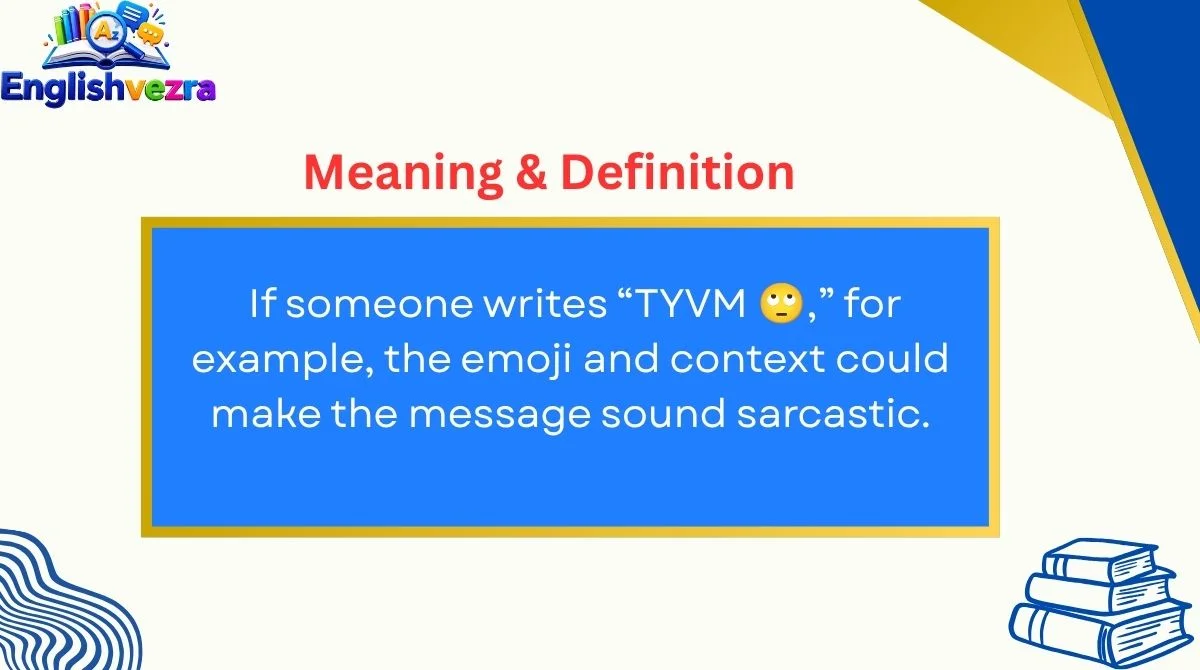
TYVM stands for “thank you very much.” It is a shortened form of a common expression of gratitude. Each letter represents part of the phrase:
- T = Thank
- Y = You
- V = Very
- M = Much
Instead of typing “thank you very much,” someone can simply write “TYVM.” The meaning stays essentially the same, but the abbreviated version is more casual and convenient.
For example, if a friend helps you solve a problem, you might reply:
“TYVM for helping me!”
This means:
“Thank you very much for helping me!”
TYVM generally communicates appreciation, politeness, or gratitude. It can be used for small favors as well as more meaningful acts of kindness. The strength of the appreciation usually comes from the phrase “very much,” rather than from the abbreviation itself.
The expression is most appropriate in informal digital communication. People may use it when replying to friends, family members, classmates, online followers, gaming teammates, or other people they communicate with casually.
It can also appear as part of a longer sentence. For example:
- “TYVM for the quick reply.”
- “TYVM! That really helped.”
- “Got the information, TYVM.”
- “TYVM for sharing this.”
- “TYVM, I appreciate it.”
The abbreviation does not normally represent anger, criticism, or a hidden negative meaning. However, like many short expressions, its tone can change depending on the surrounding message. If someone writes “TYVM 🙄,” for example, the emoji and context could make the message sound sarcastic.
In most ordinary situations, though, TYVM simply means thank you very much.
Background
TYVM developed from the same general texting culture that produced many other shortened expressions. Online communication often encourages people to communicate quickly, particularly when using mobile phones or participating in fast-moving chats.
The phrase “thank you very much” naturally lends itself to abbreviation because its individual words can be represented by their first letters. TYVM therefore follows a straightforward initialism pattern rather than having a complicated or specialized origin.
There is no need to assume that TYVM has a secret meaning or a specific technical history. Its meaning comes directly from the words it abbreviates.
Texting abbreviations became particularly useful as people began communicating through short messages, instant messaging services, online forums, gaming chats, and social media. Users developed convenient ways to express common phrases with fewer characters and less typing.
TYVM belongs to this broader group of informal internet and messaging expressions. Other examples include:
- TY — Thank you
- THX — Thanks
- TYSM — Thank you so much
- YW — You’re welcome
- NP — No problem
- PLS — Please
Unlike some internet slang, TYVM is relatively easy to understand because its letters closely correspond to the original phrase.
Its use is mainly informal rather than professional or academic. A person might send TYVM to a coworker in a casual internal chat, but they would generally write “Thank you very much” in a formal email, official letter, application, or business document.
It is also worth remembering that online abbreviations are not always universal. A person who rarely uses texting slang might not immediately recognize TYVM. In that situation, spelling out the phrase can make the message clearer.
Overall, TYVM is best understood as a practical shorthand for expressing appreciation in digital communication.
Usage in Different Contexts
The meaning of TYVM remains consistent across most contexts, but its tone and appropriateness can change depending on where it is used.
In Chat
TYVM is common in casual chat because people often want to respond quickly. If someone gives you information, answers a question, or helps you with something, you can reply with “TYVM.”
Example:
Person A: “The meeting starts at 3 PM.”
Person B: “TYVM!”
Here, TYVM simply acknowledges the information and expresses thanks.
On Social Media
People may use TYVM in comments, replies, captions, or direct messages. For example, someone might receive a compliment and respond:
“TYVM! That means a lot.”
It can also be used when someone shares useful information or supports a post.
In Casual Conversations
Among friends and family, TYVM can make a thank-you message short and relaxed.
“TYVM for picking me up!”
The abbreviation gives the message a distinctly digital and informal feel.
In Professional Communication
TYVM can occasionally appear in workplace chats, particularly where employees communicate casually through instant messaging. However, it is usually not the best choice for formal professional communication.
For example, an informal team chat might contain:
“TYVM for sending that file.”
But a formal email would normally be better as:
“Thank you very much for sending the file.”
The important point is that TYVM does not become a different word in professional settings. The difference is mainly tone and appropriateness.
Meaning in Chat, WhatsApp, Instagram, and TikTok
TYVM can be used across many popular communication platforms, including WhatsApp, Instagram, TikTok, Facebook, Discord, and other messaging services. Its basic meaning does not change from one platform to another.
TYVM on WhatsApp
On WhatsApp, TYVM can be used in private chats, group conversations, and replies.
Example:
“TYVM for sending me the notes!”
The sender is expressing appreciation for receiving the notes.
TYVM on Instagram
Instagram users may use TYVM in comments or direct messages. For example, someone who receives a compliment might reply:
“TYVM 😊”
The emoji adds warmth to the simple thank-you.
TYVM on TikTok
On TikTok, the abbreviation may appear in comments or direct messages when someone wants to thank another user.
For example:
“TYVM for explaining this!”
It could also be used when someone shares a helpful recommendation or responds to a question.
TYVM in Group Chats
Group chats often contain short abbreviations because conversations can move quickly. TYVM allows someone to acknowledge another person’s help without interrupting the flow of conversation.
For example:
“Who has the homework details?”
“It’s due Friday.”
“TYVM!”
In this case, the abbreviation is simply a quick expression of gratitude.
The important thing to remember is that the platform does not change the basic definition. Whether you see TYVM on WhatsApp, Instagram, TikTok, or another platform, it normally means thank you very much.
Meaning in Physics, Medical, and Aircraft Terminology
TYVM is primarily an informal communication abbreviation, not a standard technical term. Therefore, it should not automatically be interpreted as having a specialized meaning in science, medicine, or aviation.
TYVM in Physics
There is no standard general physics meaning for TYVM. In a physics discussion, the letters could potentially appear as part of a specific notation, identifier, document code, or unrelated abbreviation, but TYVM itself is not commonly recognized as a standard physics term.
TYVM in Medical Terminology
TYVM is not a standard medical abbreviation for “thank you very much.” Medical professionals use many specialized abbreviations, but TYVM is normally just the informal texting expression when it appears in ordinary communication.
Medical contexts require particular caution with abbreviations because some shortened forms can have multiple interpretations. Therefore, an unfamiliar abbreviation in a medical document should not automatically be interpreted based on texting slang.
TYVM in Aircraft or Aviation Terminology
TYVM does not have a standard general aviation meaning that replaces its common texting interpretation. If you see the letters in an aircraft-related document, flight system, technical manual, or code, the surrounding information would be necessary to determine what they represent.
In ordinary online conversation, however, there is no reason to treat TYVM as an aviation term.
So, unless a specific technical source establishes another definition, TYVM should be understood as “thank you very much” in casual digital communication.
Common Misconceptions
One common misconception is that TYVM is a completely different slang word with a hidden meaning. In reality, its meaning is quite direct: it is an abbreviation of thank you very much.
Another misunderstanding is assuming that every use of TYVM is formal. It is actually much more natural in casual digital communication than in formal writing.
Some people may also confuse TYVM with similar abbreviations such as TYSM, TY, or THX. These expressions all relate to gratitude, but they are not identical abbreviations.
Another potential misunderstanding involves tone. TYVM is normally positive, but the surrounding message can change how it sounds. For example:
“TYVM!!!”
may feel enthusiastic, while:
“Oh, TYVM.”
could sound less warm depending on the conversation.
Emojis can also affect interpretation. “TYVM ❤️” is likely to sound warm or affectionate, while “TYVM 🙄” could potentially be sarcastic.
It is therefore important not to interpret an abbreviation completely separately from the rest of the message.
Finally, people sometimes assume that a short abbreviation is always appropriate because it saves time. That is not necessarily true. If you are writing to a client, professor, manager, official organization, or someone you do not know well, the complete phrase “Thank you very much” is generally clearer and more professional.
Similar Terms & Alternatives
Several expressions are closely related to TYVM.
TY
TY means “thank you.” It is shorter and simpler than TYVM.
Example:
“TY for helping me!”
TYSM
TYSM means “thank you so much.” It often sounds warm and appreciative.
Example:
“TYSM for the advice!”
THX
THX is a shortened form of “thanks.” It is casual and commonly associated with quick online communication.
Example:
“THX for sending that!”
Thanks
“Thanks” is not an abbreviation, but it is one of the most natural alternatives to TYVM.
Thank You Very Much
This is the complete phrase represented by TYVM. It is clearer and more appropriate for formal situations.
Much Appreciated
“Much appreciated” is another way to express gratitude. It can sound slightly more polished or professional than TYVM.
The main difference is that these alternatives can vary in formality, warmth, and length, while TYVM specifically provides a quick texting-style version of “thank you very much.”
How to Respond to TYVM
If someone sends you TYVM, you normally do not need a complicated response. They are simply thanking you.
Common replies include:
- “You’re welcome!”
- “No problem!”
- “Anytime!”
- “Of course!”
- “Glad I could help!”
- “No worries!”
- “My pleasure!”
- “You got it!”
For a casual chat, you could simply reply:
“Np!”
Here, NP means “no problem.”
If the conversation is friendly, an emoji can also work:
“You’re welcome 😊”
If someone says:
“TYVM for helping me!”
you might answer:
“You’re very welcome!”
The best response depends on the relationship and situation. A friend may appreciate a short response, while a professional conversation may call for something slightly more polished.
If you are unsure whether the person is using TYVM sincerely or sarcastically, look at the surrounding conversation. Tone is often easier to understand from the full message rather than from the abbreviation alone.
Differences from Similar Words
TYVM and similar expressions all communicate gratitude, but their tone and level of emphasis can differ.
| Expression | Meaning | Typical Tone |
|---|---|---|
| TYVM | Thank you very much | Casual, appreciative |
| TY | Thank you | Very casual, brief |
| TYSM | Thank you so much | Casual, warm |
| THX | Thanks | Casual, quick |
| Thanks | Thanks | Casual to neutral |
| Thank you very much | Full form of TYVM | Neutral to formal |
| Much appreciated | Strong appreciation | Polite, professional-friendly |
The biggest difference is often not the meaning but the style of communication.
For example, TY is extremely short and works well when the conversation is moving quickly. TYSM can feel warmer or more enthusiastic. TYVM expresses strong appreciation while still sounding like an internet or texting abbreviation.
The complete phrase “thank you very much” is generally safer when speaking with someone formally because it avoids the abbreviated, casual style.
In other words, the choice depends on what you want your message to sound like. The underlying idea is still gratitude.
Relevance in Online Conversations & Dating Apps
TYVM can naturally appear in modern online conversations because dating apps, social networks, and messaging platforms encourage short, fast communication.
On a dating app, someone might write:
“TYVM for the recommendation!”
This is simply a friendly way of thanking another person.
The abbreviation itself does not automatically indicate romantic interest. If someone sends TYVM after receiving a compliment, invitation, recommendation, or helpful answer, the phrase should generally be understood according to that immediate context.
For example:
“You look great in that picture.”
“TYVM 😊”
The response clearly expresses appreciation, but the emoji and the broader conversation may provide additional clues about the person’s tone.
Similarly, if someone says:
“TYVM for being so understanding.”
the phrase may carry more emotional weight because of the surrounding words.
On dating apps, context is especially important because people often use emojis, shortened words, punctuation, and informal expressions to communicate tone. TYVM by itself does not tell you whether someone is flirting, being friendly, or simply being polite.
The safest interpretation is the straightforward one: the person is thanking you very much. Any additional emotional meaning should come from the rest of the conversation rather than from TYVM alone.
FAQs
What does TYVM mean in text?
TYVM means “thank you very much” in text messages. It is an informal abbreviation used to express gratitude, appreciation, or thanks. People commonly use it when chatting with friends, replying to helpful information, commenting online, or communicating through messaging apps. It is usually casual rather than formal.
What does TYVM mean in chat?
In chat, TYVM means “thank you very much.” Someone may send it after you answer a question, provide information, help with a task, or do something kind. It is simply a quicker way of typing the complete phrase and usually carries a friendly, appreciative tone.
Is TYVM a slang term?
TYVM is best described as a texting abbreviation or internet shorthand rather than a slang word with a separate definition. It abbreviates “thank you very much” and is mainly used in casual digital communication. Its meaning is straightforward and normally does not depend on specialized slang knowledge.
What does TYVM mean on social media?
On social media, TYVM usually means “thank you very much.” People may use it in comments, replies, direct messages, or conversations after receiving compliments, advice, information, or support. The platform does not normally change its meaning, although emojis and surrounding messages can affect the tone.
How do you respond to TYVM?
You can respond to TYVM with phrases such as “You’re welcome,” “No problem,” “Anytime,” “Of course,” or “Glad I could help.” The best response depends on the situation. In a casual chat, a short reply is fine, while a professional conversation may be better suited to a complete and polite response.
Can TYVM have different meanings?
TYVM normally means “thank you very much.” It does not generally have another widely recognized meaning in ordinary texting. However, abbreviations can occasionally have specialized meanings inside particular organizations, technical systems, or private communities. If TYVM appears in an unusual technical context, the surrounding information should be checked before assuming the texting definition.
What is the difference between TYVM and TYSM?
TYVM means “thank you very much,” while TYSM means “thank you so much.” Both express gratitude and are commonly used in casual online conversations. Their meanings are very similar, although a particular person may use one more often than the other based on personal texting habits.
Does TYVM mean someone is being polite?
Yes, TYVM generally communicates politeness and appreciation. When someone writes TYVM after receiving help, information, or a favor, they are usually showing that they are grateful. However, tone can depend on context, punctuation, emojis, and the rest of the conversation, so the abbreviation alone cannot always reveal the speaker’s exact attitude.
Conclusion
TYVM is a simple and widely understandable texting abbreviation that stands for “thank you very much.”
People use it to express gratitude in casual digital communication, including text messages, chats, social media comments, direct messages, and group conversations.
Its meaning normally stays the same across platforms. Whether you see it on WhatsApp, Instagram, TikTok, or another messaging service, it generally indicates that someone is thanking you.
Similar expressions such as TY, TYSM, and THX also communicate appreciation, but each has a slightly different style or level of emphasis.
TYVM is most suitable for informal communication. In formal emails, official documents, or professional situations where polished language matters, writing “thank you very much” is usually a better choice.
Most importantly, context can affect tone. TYVM is normally friendly and appreciative, but emojis, punctuation, and surrounding messages can make it sound warmer, more enthusiastic, or occasionally sarcastic.
When you understand the conversation around it, the intended meaning is usually easy to recognize.

Samuel Hartwell is an English language educator and word enthusiast who enjoys explaining meanings in simple, clear ways. He creates helpful content to make English vocabulary easier to understand and learn.