If someone sends you a message containing “HBU,” you might wonder what the abbreviation means or what they expect you to say next. Short forms like HBU are especially common in texting, social media comments, direct messages, and casual online conversations.
People often use abbreviations because they make conversations quicker and more natural, especially when chatting with friends or replying on mobile devices.
The meaning of an abbreviation can sometimes seem confusing when you encounter it for the first time. Fortunately, HBU is one of the simpler texting expressions to understand.
It is generally used when someone wants to turn a question back to you after sharing their own answer.
In this guide, we will explain what HBU means, where it is commonly used, how its tone can change depending on the conversation, and how you can respond naturally.
Quick Answer
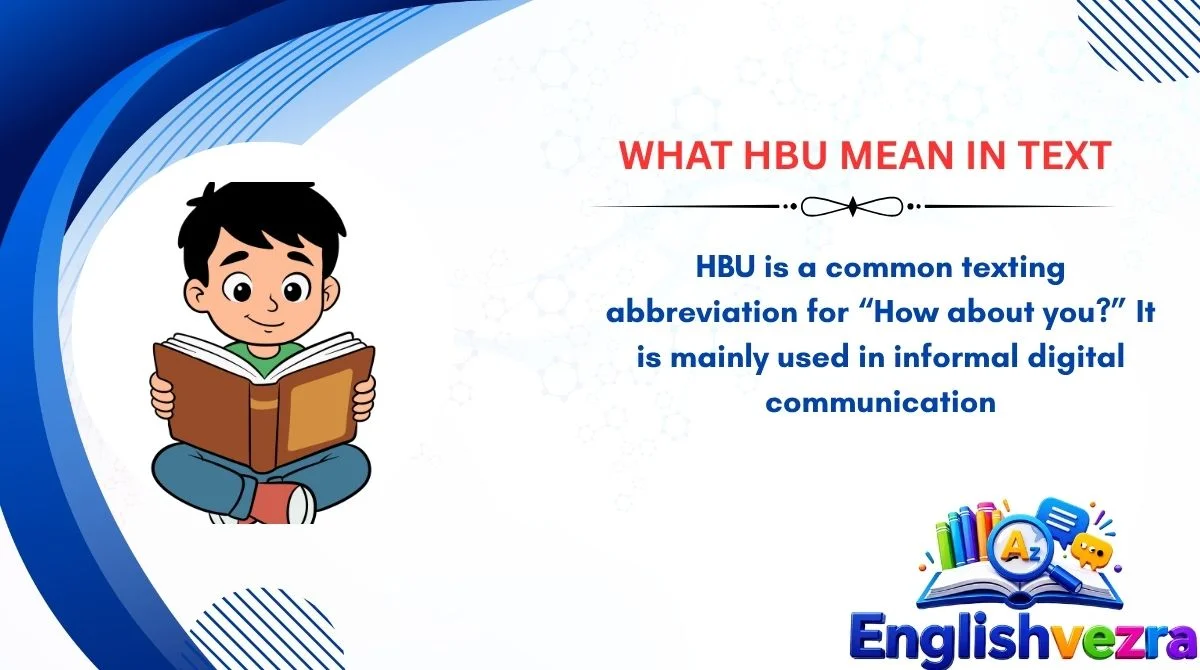
HBU means “How about you?” in text. It is commonly used in casual chats when someone has answered a question or shared something about themselves and wants to know the same thing about you. For example, “I’m good, HBU?” simply means “I’m good, how about you?”
Meaning & Definition
HBU is a common texting abbreviation for “How about you?” It is mainly used in informal digital communication. Instead of typing the complete phrase, people use the three letters H-B-U to keep the conversation short and quick.
For example:
“I’m watching a movie, HBU?”
This means:
“I’m watching a movie, how about you?”
The abbreviation usually does not change the meaning or emotion of the original phrase. It is simply a shortened way to ask about the other person’s situation, opinion, activity, or feelings.
HBU can follow many types of statements or questions. Someone might say, “I love pizza, HBU?” when asking about your food preference. They might write, “I’m staying home tonight, HBU?” to ask about your plans. Similarly, “My day was pretty good, HBU?” asks about your day.
The expression is generally friendly and conversational. It does not normally carry a hidden meaning by itself. The surrounding conversation is what determines whether it sounds friendly, curious, romantic, or simply polite.
HBU is particularly useful when both people are sharing information. One person answers first and then uses HBU to invite the other person to share their answer.
Because it is an informal abbreviation, HBU is more appropriate for texting, social media, gaming chats, and casual messages than for formal business writing or professional documents.
Background
HBU developed as part of the broader culture of internet and mobile texting abbreviations. Online communication encouraged people to shorten frequently used expressions, particularly when conversations were happening through keyboards or mobile phones.
There is no single well-established individual or event that can be identified as the inventor of HBU. Like many texting abbreviations, it became useful because the phrase “How about you?” occurs frequently in everyday conversations and can easily be shortened to its initial letters.
The abbreviation follows a straightforward pattern:
- H = How
- B = About
- U = You
Similar initial-based abbreviations became widespread as online messaging, instant messaging, SMS, and social networking grew. People began using shortened expressions to communicate quickly while still being understood by others familiar with internet slang.
HBU belongs to the same general family of conversational abbreviations as expressions such as “WBU,” which can also mean “What about you?” The exact abbreviation someone chooses can depend on personal preference and the surrounding sentence.
Unlike some slang expressions, HBU is relatively easy to understand because its letters correspond directly to the words in the full phrase.
It is also important not to assume that every three-letter abbreviation has one universal meaning. Abbreviations can have different meanings in specialized fields, organizations, or particular communities. However, in ordinary texting and social media conversation, HBU overwhelmingly refers to “How about you?”
Usage in Different Contexts
The meaning of HBU remains essentially the same across casual contexts, but the reason someone uses it can vary.
In Chat
In private chats, HBU is often used to keep a conversation moving.
Example:
“I’m just relaxing at home. HBU?”
The person is saying that they are relaxing and asking what you are doing.
On Social Media
HBU may appear in comments, direct messages, or replies. Someone might use it after discussing a preference or experience.
Example:
“I prefer summer. HBU?”
Here, the person is asking which season you prefer.
In Casual Conversations
Friends may use HBU when talking about plans, interests, food, entertainment, school, work, or everyday activities.
Example:
“I’m free this weekend. HBU?”
This asks whether you are free as well.
In Professional Fields
HBU is generally not considered formal professional language. In a workplace email, report, application, or official communication, writing “How about you?” is usually clearer and more appropriate.
However, coworkers who already communicate casually through instant messaging may occasionally use HBU.
In Friendly Conversations
Among friends, HBU can sound completely natural and relaxed. It often encourages both people to participate rather than allowing the conversation to become one-sided.
The key point is that HBU normally asks the other person to provide a similar answer to the one just given.
Meaning in Chat, WhatsApp, Instagram, and TikTok
HBU is commonly understood as “How about you?” when it appears in casual digital conversations.
On WhatsApp, someone might write:
“I’m going to the gym, HBU?”
They want to know what you are doing.
On Instagram, it could appear in a direct message:
“I like this song a lot. HBU?”
The person is asking whether you like it too.
On TikTok, HBU may appear in comments or private messages when users discuss preferences, experiences, or plans.
For example:
“I’ve watched this movie three times 😂 HBU?”
This means the person wants to know how many times you have watched it or whether you have watched it.
The abbreviation can also be written in lowercase as hbu. Capitalization usually does not change its meaning.
For example:
- “HBU?”
- “hbu?”
- “Hbu?”
All three can mean “How about you?”
The tone depends largely on the surrounding message. “HBU?” by itself can be very brief, while “I’m doing great today! HBU? 😊” sounds warmer and more enthusiastic.
On dating apps, HBU may also appear because conversations often involve exchanging personal preferences and everyday information. However, the abbreviation itself does not automatically indicate romantic interest.
Meaning in Physics, Medical, and Aircraft Terminology
In ordinary texting, HBU means “How about you?” There is no reason to reinterpret it as a technical term unless the surrounding context clearly indicates a specialized field.
Physics
HBU is not a standard, universally recognized physics abbreviation that should automatically be assumed when encountered without context. If it appears in a physics document, its meaning would need to be determined from that specific document or field.
Medical Terminology
HBU does not have one standard medical meaning that should replace its ordinary texting interpretation. Medical abbreviations can be highly context-dependent, so an unfamiliar abbreviation in a clinical document should not be interpreted based solely on internet slang.
Aircraft or Aviation Terminology
HBU is not generally recognized as the standard aviation meaning of the texting phrase “How about you?” Aviation has many specialized abbreviations, but a technical occurrence of HBU would need context to establish what it represents.
Therefore, if someone sends you “HBU?” in a normal message, the safest and most natural interpretation is “How about you?”
Common Misconceptions
One common misunderstanding is thinking that HBU represents a complicated slang phrase. In ordinary texting, it is simply a shortened version of “How about you?”
Another misconception is that HBU automatically indicates flirting. It does not. A friend, classmate, coworker, stranger, or romantic interest can all use HBU. The surrounding conversation determines the tone.
For example:
“I like football. HBU?”
This is simply asking about your preference.
Another example:
“I’m having a great day 😊 HBU?”
This may sound friendly, but the emoji and broader conversation—not HBU itself—create the warmer tone.
People may also confuse HBU with similar abbreviations such as WBU. Both can be used to return a question to another person, although their wording is slightly different.
It is also unnecessary to capitalize HBU. Lowercase “hbu” is equally common in casual messaging.
Finally, not every occurrence of the letters HBU must mean “How about you?” in every specialized environment. Context should always be considered, particularly in technical or organizational documents.
Similar Terms & Alternatives
Several expressions can serve a similar conversational purpose.
WBU
WBU commonly means “What about you?” It is very similar to HBU and is often interchangeable in casual conversations.
What About You?
This is the complete phrase represented by WBU. It is natural and informal without being an abbreviation.
How About You?
This is the full version of HBU. It is appropriate in both casual conversation and many ordinary written situations.
And You?
“And you?” is an even shorter natural alternative. It works particularly well after answering a question.
Example:
“I’m from Lahore. And you?”
What Do You Think?
This is not always interchangeable with HBU. It specifically asks for someone’s opinion rather than simply asking about their corresponding situation or preference.
How About Yourself?
This can have a similar function to “How about you?” but may sound slightly more deliberate or polite depending on the situation.
The important difference is that HBU is an abbreviation, while these alternatives are complete expressions.
How to Respond to It
When someone sends you HBU, the easiest response is usually to answer the question they have just asked about you.
For example:
Message:
“I’m doing good, HBU?”
Possible response:
“I’m doing great too!”
If someone says:
“I love action movies, HBU?”
You could respond:
“Same! I’m a big fan of action movies.”
If you do not share the same preference:
“Not really. I prefer comedies.”
You can also continue the conversation by adding another question:
“I’m good too. What are you doing today?”
If HBU appears after someone shares their plans, simply share your own plans:
“I’m staying home tonight. What about you?”
You do not need a special or clever response. HBU is normally an invitation to share your own answer.
Differences from Similar Words
| Expression | Meaning | Typical Tone |
|---|---|---|
| HBU | How about you? | Casual |
| WBU | What about you? | Casual |
| How about you? | Full form of HBU | Casual/Natural |
| What about you? | Full form of WBU | Casual/Natural |
| And you? | Asking for the other person’s answer | Very natural |
| What do you think? | Asking specifically for an opinion | Neutral |
The main difference between HBU and WBU is the wording rather than the basic conversational purpose.
For example:
“I’m tired today, HBU?”
and
“I’m tired today, WBU?”
both generally invite the other person to share how they are doing.
HBU is usually best understood as a quick texting abbreviation. If you are writing a formal email, academic assignment, professional report, or official document, spelling out the phrase is usually preferable.
Relevance in Online Conversations & Dating Apps
HBU is particularly useful in online conversations because digital communication often depends on short, quick messages.
On dating apps, someone might ask:
“I love traveling. HBU?”
They may simply want to learn whether you enjoy traveling too.
Another person might write:
“I’m more of a coffee person. HBU?”
This creates an easy opportunity to continue the conversation.
The abbreviation itself does not prove that someone is interested romantically. Context matters. If HBU appears after several personal questions, playful messages, or flirtatious comments, it may form part of a more personal conversation. But the letters themselves simply mean “How about you?”
The same principle applies to social media. A person commenting “HBU?” may be genuinely asking for your opinion, preference, experience, or plans.
Understanding this distinction can prevent overthinking a simple abbreviation. Instead of trying to find a hidden meaning in HBU, look at the complete message and the relationship between the people communicating.
FAQs
What does HBU mean in text?
HBU means “How about you?” in text messages. People use it after sharing their own answer, opinion, feelings, or activity and want the other person to respond with their own. For example, “I’m good, HBU?” means “I’m good, how about you?”
What does HBU mean in chat?
HBU means “How about you?” in casual chat. It is commonly used to return a question to another person. For example, if someone says, “I’m watching Netflix, HBU?” they are asking what you are doing.
Is HBU a slang term?
HBU is best described as a texting abbreviation or internet shorthand rather than traditional slang. It is a shortened form of “How about you?” and is especially common in informal messages, social media, and online conversations.
How do you respond to HBU?
Respond to HBU by giving your own answer. If someone says, “I’m having a good day, HBU?” you can say, “I’m doing well too.” You can also continue the conversation by adding another question, such as “I’m good too. What are you doing later?”
What does HBU mean on social media?
On social media, HBU normally means “How about you?” It can appear in comments, replies, or direct messages. Someone might use it when discussing favorite foods, movies, music, hobbies, opinions, plans, or personal experiences.
Can HBU have different meanings?
HBU can potentially have different meanings in specialized contexts, because abbreviations are not universally fixed. However, in ordinary texting, chat, and social media conversations, HBU normally means “How about you?” Technical or professional uses should always be interpreted from their specific context.
Is HBU rude or polite?
HBU is generally casual and neutral, not rude. It is commonly used between friends and other people communicating informally. In a formal setting, however, writing “How about you?” may be more appropriate because HBU is informal shorthand.
What is the difference between HBU and WBU?
HBU means “How about you?”, while WBU usually means “What about you?” They perform a very similar conversational function and can often be used in the same situations. The main difference is the wording of the full phrase.
Conclusion
HBU is a simple and widely understandable texting abbreviation that normally means “How about you?” People use it to return a question or invite someone else to share their own answer, opinion, feelings, activity, or preference.
You may encounter HBU in text messages, WhatsApp chats, Instagram conversations, TikTok comments, gaming chats, dating apps, and other informal online spaces. Its meaning generally remains the same across these platforms, although the overall tone can depend on the conversation.
HBU should not automatically be interpreted as flirting, sarcasm, or a hidden message. In most situations, it is simply a quick and convenient way to keep a conversation going. Similar expressions such as WBU, “What about you?” and “And you?” can serve much the same purpose.
When you receive HBU, simply answer the question that came before it and, if you want, ask another question to continue the conversation.

Samuel Hartwell is an English language educator and word enthusiast who enjoys explaining meanings in simple, clear ways. He creates helpful content to make English vocabulary easier to understand and learn.